


Vague anxiety doesn’t have to go away. Noticing it and getting a little distance from it is enough. You’re in the bath washing your hair, and it arrives: “Am I really okay like this?” That one is hard, isn’t it.
Here is how to live with it, one step at a time.
Notice
Narrate it — “I’m anxious right now” — and get some distance.
Write it out
Sort it into what you can act on and what has no answer yet.
Come back to now
Use a longer exhale and your five senses to return to the body.
Steady the base
Set a time for worrying, and review your sleep and how much information you take in.
Do I have to get rid of vague anxiety?
Is it okay to leave vague anxiety where it is?
Yes, it’s okay. Anxiety is a natural response that prepares us for danger, and it happens to everyone, as Japan’s National Center of Neurology and Psychiatry notes on its Kokoro no Joho mental health information site.
You probably know this already: the harder you try to chase anxiety away, the more it holds your attention. Getting rid of it is not the goal.
What should I do the moment anxiety shows up?
Narrate it. If your chest tightens while you’re doing the dishes, say to yourself, “Ah, it’s here.” That alone is enough.
How do I sort out anxiety that keeps circling in my head?
How do I get looping worries out of my head?
Write them down on paper so you can see them. The back of a flyer will do. Write whatever comes, in whatever order.
You thought you had ten worries, and once they were written down there were three. That happens a lot.
What do I do with worries once they’re on paper?
Sort the written worries into two groups: “things I can do now” and “things that have no answer yet.” From the first group, pick just one small thing. On the second group, write “on hold” and close the paper.
The “on hold” part is the one that matters most.
We’ve gathered ways of putting your inner life into words in our article on introspection.
Is there anything I can do on the spot when anxiety gets stronger?
What kind of breathing helps when anxiety gets stronger?
Breathe so the exhale is a little longer than the inhale. Only a little longer is enough.
If it starts to feel uncomfortable, you can stop right away.
Why does paying attention to the body help with anxiety?
Anxiety is said to grow more easily when we think about what lies ahead. One research review looks at how anticipating an uncertain future relates to anxiety (Grupe & Nitschke, 2013).
The body, though, is here and now, so we come back to the body.
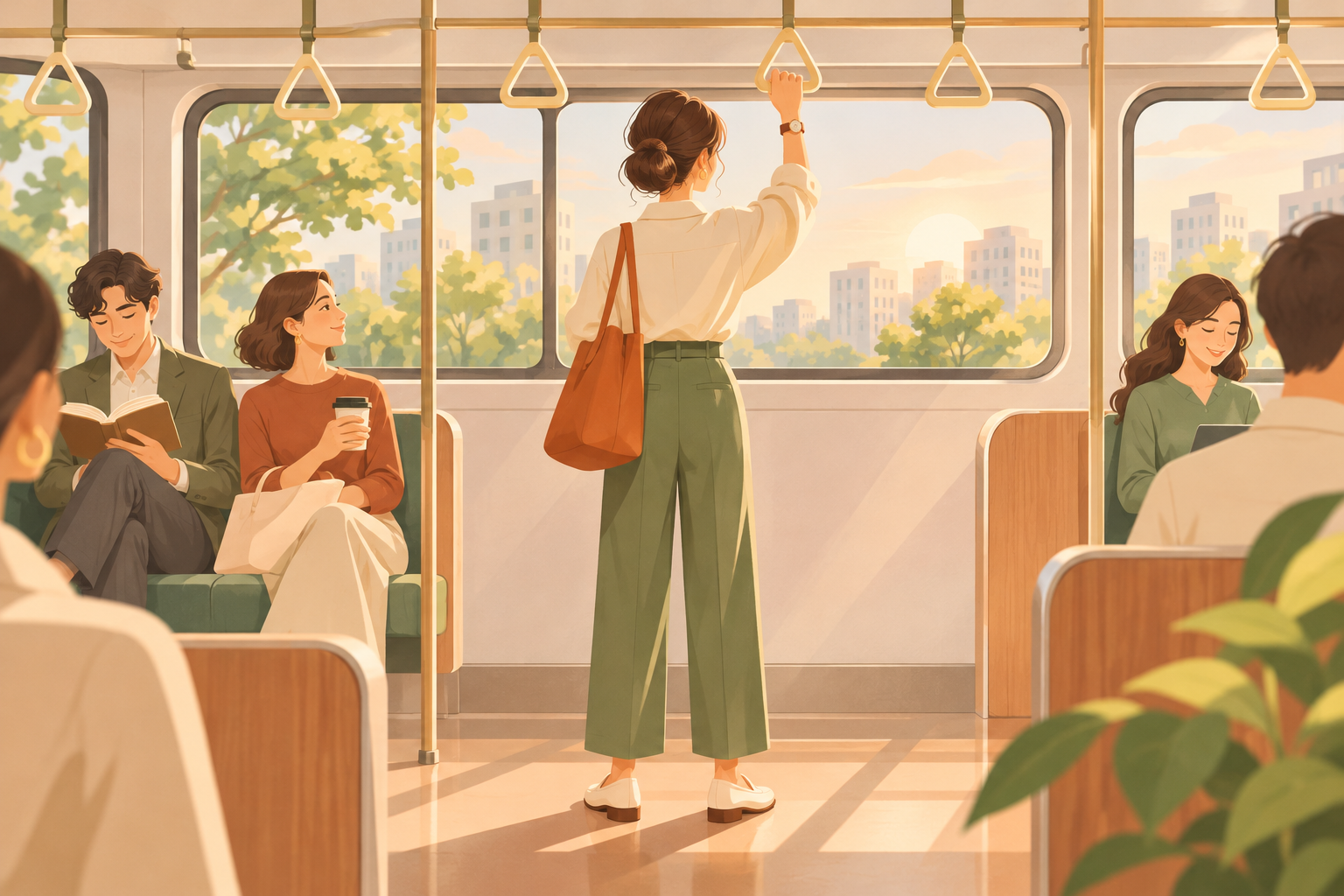
On a packed train, that might be the soles of your feet pressing into the floor. At your desk, it’s the warmth of the mug in your hands.
FREE PROGRAM
A doorway to seeing your life anew — through the body
Add us on LINE to receive the free online lessons — the parts we couldn’t fit into this article.
Free to join, unsubscribe anytime. This is not medical treatment; results vary by individual.
How do I stop worrying all day long?
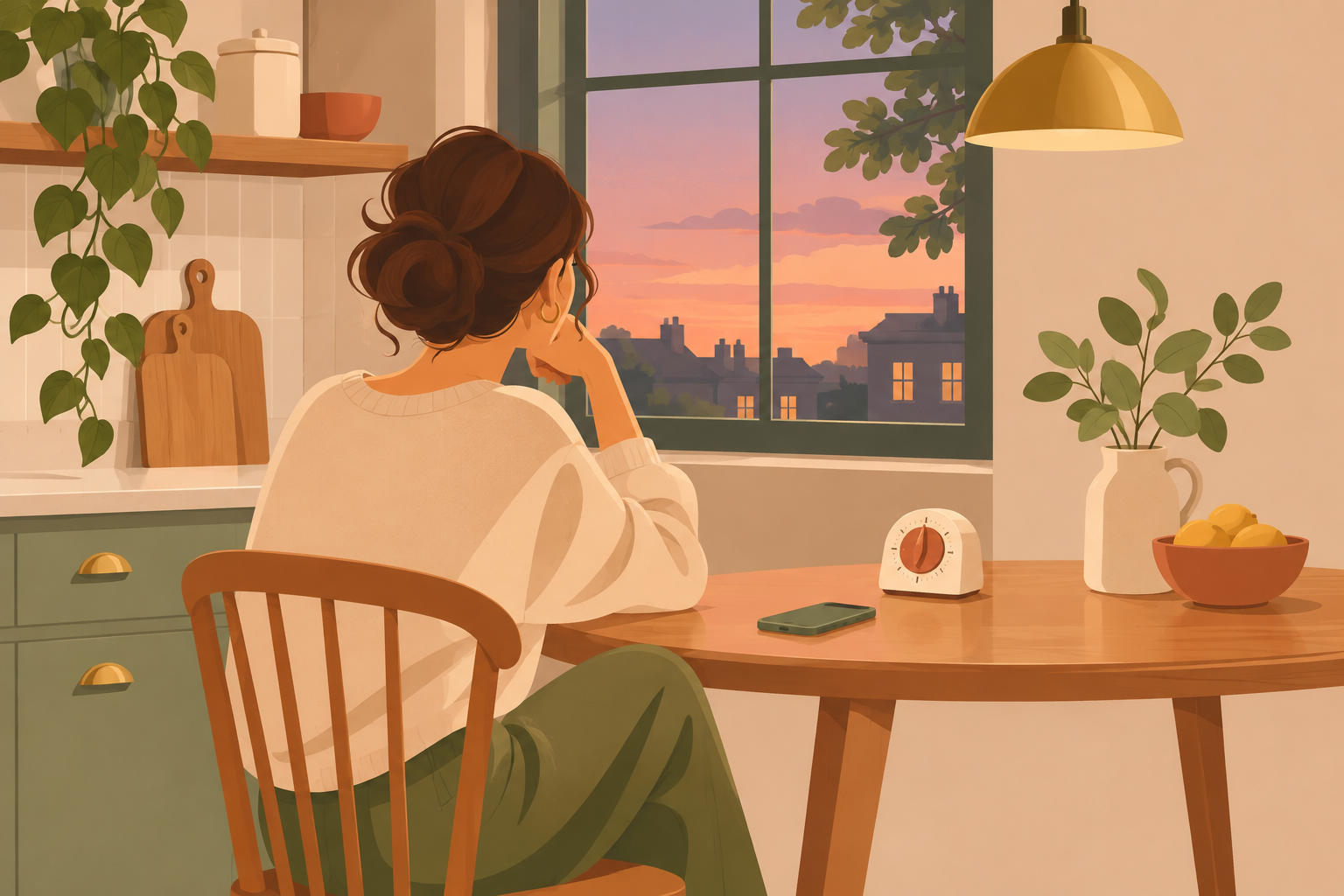
Can I set a time for worrying instead of stopping it?
You don’t stop the worrying. You decide when in the day it happens. For example, fifteen minutes from 6 p.m., on a kitchen chair.
When a worry comes up at any other time, write one line in your phone’s notes and leave it for later. Avoid scheduling this right before bed.
Which everyday basics make anxiety easier to live with?
Two basics matter: sleep, and the amount of information coming in. On a morning after too little sleep, the same news looks twice as frightening.
If you follow unsettling topics on social media from bed at night, start by turning off notifications. Self-care such as sleep is also covered on Kokoro no Mimi, a site run by Japan’s Ministry of Health, Labour and Welfare.
How is continuing on my own different from turning to a professional or a group setting?
When is working on anxiety by myself enough?
Working on your own suits a time when daily life is still running. You can start today, and how long you keep going is up to you.
The thing to watch for is that it’s easy to end up carrying everything alone.
When is a professional or a group setting a better fit for anxiety?
When anxiety is strong or has lasted a long time, a professional comes first. You need an appointment and it can take effort to find someone who suits you, but you have someone alongside you.
Joining a group setting suits a time when your condition is settled. You have to fit it into your schedule, and how well it lasts depends on the follow-up afterward. It is not a substitute for medical care.
When should I talk to a doctor or a support line?
What signs mean it’s time to seek help for anxiety?
You can’t sleep. You can’t eat. Work or housework is being affected. When this continues, seek help early.
The Kokoro no Joho site also recommends consulting a medical institution in these cases.
Where can I turn, and is my anxiety “bad enough” to go?
There are three routes: your regular doctor, a psychosomatic medicine or psychiatry clinic, and public support lines you can reach by phone or social media.
In Japan, the Ministry of Health, Labour and Welfare lists these lines at Mamorou yo Kokoro.
If you’re wondering, “Is it all right to go for something like this?” — yes, it is. Nobody is asking you to compete over how long you can put up with it.
If I slip back into my old routine on my own, is stepping away from daily life an option?
Is a retreat an option when I keep slipping back into my old routine?
Yes, it is, although when symptoms are strong, consulting a medical institution comes first. After that, a retreat is a place to step away for a few days and face yourself.
By the first morning back at work you’re already your old self again. That is not because your will is weak. Here are five yardsticks for choosing a retreat:
- Can you see the organizer’s background?
- Can you say “I want to stop” partway through?
- Are the price and cancellation rules stated clearly?
- Is there follow-up after it ends?
- How intense is the breathwork, and will someone be with you?
What does a retreat look like in practice?
One example is the 3-day, 2-night journey at nehan Retreat Center. It includes breathwork sessions and time in silence. You can join with no meditation experience, and you can come alone.
Afterward there are 14 days of online follow-up, with two Zoom sessions.
If you’re thinking, “Is it okay to jump straight into three days?”, coming to a consultation session first and asking your questions is enough. Costs are explained there too.
You can read what participants have said in their stories.
FAQ
Q: Do I have to get rid of vague anxiety completely? A: No, you don’t. Rather than aiming for zero, make the goal noticing it and getting some distance.
Q: Is there something I can do right away when anxiety is strong? A: Make your exhale a little longer, and bring your attention to the soles of your feet or the feeling in your hands. If it’s uncomfortable, you can stop.
Q: How do I start setting a time for worrying? A: Once a day, decide on a short time and a place. Worries that come up at other times just get a note, and they wait.
Q: What kind of ongoing state means I should talk to a doctor or a support line? A: When you can’t sleep, have no appetite, or work and housework are affected, and it continues.
This article is general information, not medical advice. Results vary from person to person. If you have concerns about your health, please consult a professional.
FREE PROGRAM
A doorway to seeing your life anew — through the body
Add us on LINE to receive the free online lessons — the parts we couldn’t fit into this article.
Free to join, unsubscribe anytime. This is not medical treatment; results vary by individual.
Sources / References
- National Center of Neurology and Psychiatry (Japan), Kokoro no Joho Site (mental health information site) https://kokoro.ncnp.go.jp/ (anxiety as a natural response; when to seek care)
- Ministry of Health, Labour and Welfare (Japan), Kokoro no Mimi https://kokoro.mhlw.go.jp/ (self-care)
- Ministry of Health, Labour and Welfare (Japan), Mamorou yo Kokoro https://www.mhlw.go.jp/mamorouyokokoro/ (phone and social media support lines)
- Grupe, D. W., & Nitschke, J. B. (2013). Uncertainty and Anticipation in Anxiety. Nature Reviews Neuroscience, 14(7), 488–501. (anticipation of the future and anxiety)




