


Key takeaways
- Facing a worry doesn’t mean making it disappear. It means separating “time spent worrying” from “time spent thinking.”
- Write it down, then draw a line between what you can move and what you can’t. The steps are the same for relationships, work, money and family.
- If you keep slipping back anyway, it’s fine to borrow the strength of people or a place. Just bring a yardstick for safety when you choose.
What does “facing a worry” actually mean in practice?
Isn’t facing a worry the same as getting rid of it?
No. Facing a worry means separating “I’m worrying” from “I’m thinking,” and noticing which of the two you’re in right now. Inside your head, these two wear exactly the same face.
Worrying is emotion going round in circles. Thinking is looking for the one move you can make today. The goal isn’t to stop the worry. It’s to know which mode you’re in.
How do I tell worrying from thinking?
You’re lying in bed at night, replaying one comment from your boss for the third time. It looks like thinking. It’s worrying.
No new answer arrives. Only the tiredness grows. What you need first isn’t a solution — it’s the half-step back where you catch yourself: “Ah, I’m going round again.”
Why do I keep circling the same thoughts?
- Handled only in your headThe worry looks bigger than it is
- Repeating a question with no answerAsking, over and over, something only the other person can answer
- No new information comes inThe same loop keeps running
- Get it outsideWrite, talk, walk and feel it in your body
- It starts to look smallerThe way you circle changes, the repetition drops
Why does a worry feel bigger inside my head?
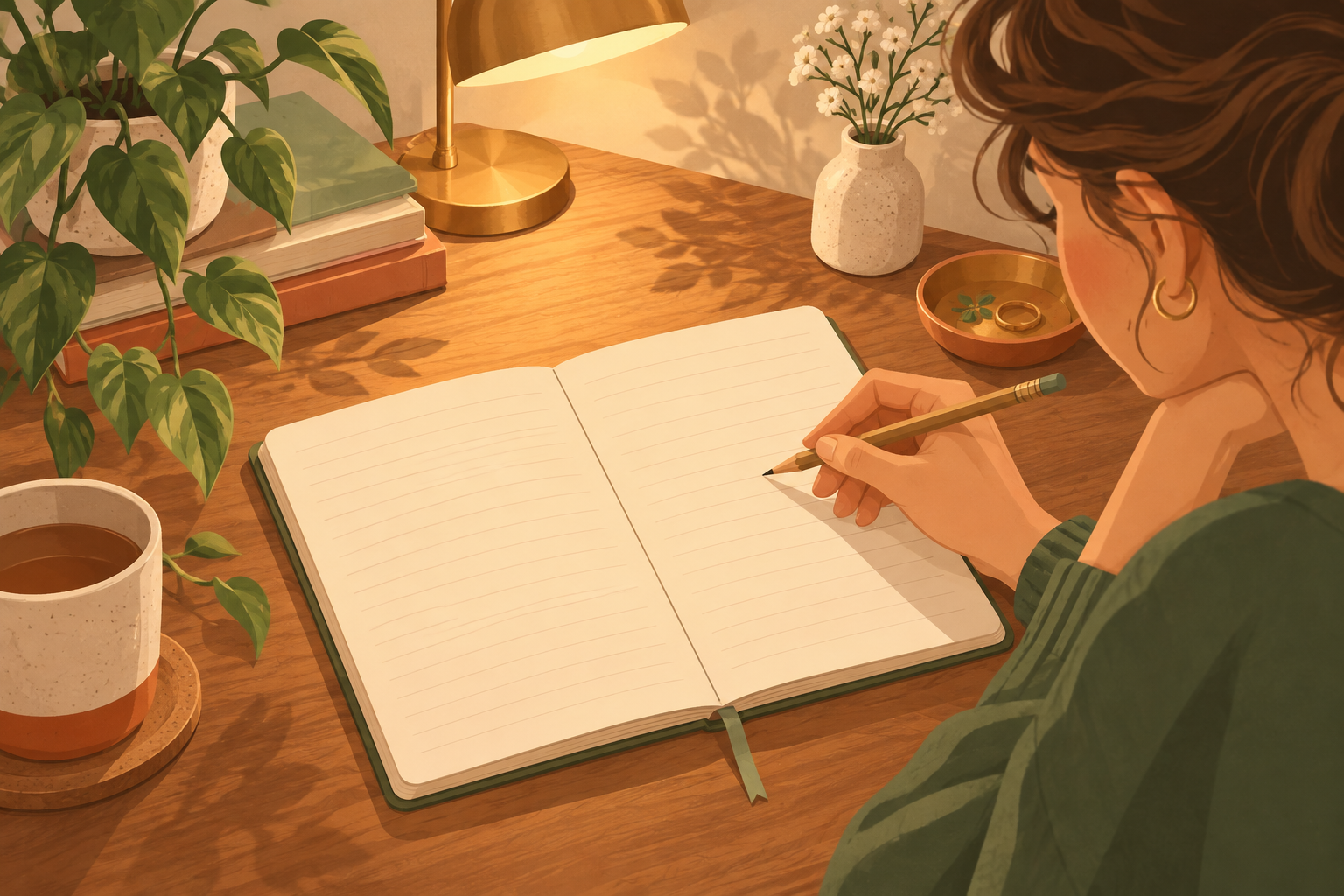
When you handle a worry only in your head, it looks bigger than it actually is. “Why did they say that to me?” is a question only the other person can answer.
You can go round it twenty times and no new information will appear.
That’s the trap. The loop feels productive, but nothing changes except how tired you are.
What does research say about going in circles?
There is a research summary reporting that repeating the same thoughts (rumination) is linked to activity in the brain’s resting-state network, the default mode network.
The more you’re circling, the harder it is to step out. That’s why changing *how* you circle tends to shift things more than changing the content.
Have you ever walked to the convenience store and thought, “Huh, that’s smaller than I thought”? Many people find a worry returns to life size once they come back into the body, into right now.
What can I do on my own first?
What are the three steps I can start with today?
There are three: write it down and divide it, rest instead of rushing, and check with your body before trying one small thing.
Write it out as is, then divide
Complaints, anxieties, all of it onto paper, untidied. Then draw a line: “what I can move / what I can’t move.”
Don’t rush the answer — rest
A sleepy head overestimates every worry. Leave it overnight and re-read it; most people find they can read it calmly.
Check with your body, try one thing
Ask “what do I actually want?” and notice the answer in your stomach or chest. Try one small thing in the direction that feels a little lighter.
Does writing things down actually help?
In psychologist Pennebaker’s research on written disclosure, writing out emotions and events was reported to help people sort through their feelings, with possible benefits for mental and physical state as well.
Your phone works. But I recommend paper. You can’t delete it, so you can’t fool yourself.
Does the approach change for relationships, work, money, or family?

What stays the same across the four areas?
The steps are identical. The only thing that differs is what sits in the “can’t move” column.
Relationships
What you can’t move: the other person. What you can: your distance, and how you respond.
Work
What you can’t move: the organisation’s circumstances. See also how to sort out your reasons before quitting.
Money
What you can’t move: this month’s numbers. What you can: next month’s one move, and how you estimate the fear.
Family
What you can’t move: the past. What you can: how you open the next conversation.
What question is left once I’ve sorted it?
After you’ve divided things up, one question remains in every area: “So — what do you actually want?”
If that’s where you get stuck, starting from how to find what you really feel and value tends to be faster than circling the worry itself.
FREE PROGRAM
A doorway to seeing your life anew — through the body
Add us on LINE to receive the free online lessons — the parts we couldn’t fit into this article.
Free to join, unsubscribe anytime. This is not medical treatment; results vary by individual.
I can’t talk to anyone. Is it bad to carry this alone?
Is it okay to sort things out by myself?
Yes. Time to sort things out alone is necessary. But people who don’t talk to anyone tend to get stuck at three points: “I don’t want to be a burden,” “I don’t want to look weak,” and “I can’t put it into words.”
The trick is to divide it on paper first. Then you can say, “Just hear this one part.” You’re not handing someone the whole tangle.
When should I stop handling it on my own?

If you can’t sleep or can’t eat and it’s been two weeks, go to a professional service rather than a friend. This isn’t about weakness. It’s about order — which door to knock on, and when.
Should I handle it myself, see a professional, or join a program?
Which option suits which situation?
Doing it yourself — writing, walking, resting — suits you if you want to start today and can still put the worry into words. The catch is that everyday life pulls you back easily.
A professional, such as counselling, suits you if you want to sort it out through words and can keep going. It won’t be finished in one session.
Joining a place — nature, naikan, a program-type retreat — suits you if you understand everything in your head but still can’t move. It requires stepping away for several days in a row.
How do I choose between them?
Cost, time, and whether you can put it into words right now. Choosing by these three is the realistic way. If you write every week and the paper looks the same every week, it’s time to borrow someone’s hands.
If you’re considering a place, see why face yourself in nature, how to choose a naikan retreat, and a retreat for re-deciding how to live.
Why do I slip back into the same worry even when I understand it?
Why doesn’t understanding stop the worry from returning?

You understand it in your head, and in daily life it comes back. That’s normal. On the train home, the moment you sit at your desk, the worry you’d sorted out yesterday returns wearing yesterday’s face.
This isn’t weak will. A large part of it is the environment doing what environments do.
What does a program-type retreat offer, and what should I check?
“Understanding” in your head and your life actually “changing” are two different things. Touching the body and the emotions can sometimes shift the flow.
One option is a program-type retreat — a few days away, facing yourself with a guide.
But check the organiser’s background, whether you can stop partway, the fees and cancellation terms, and the follow-up afterwards. If breathwork is involved, confirm that the intensity can be adjusted and that someone stays beside you.
A vague setup — honestly, I don’t recommend it.
The full picture is in methods for facing yourself, and examples of people who kept slipping back the same way are in participant stories.
Is jumping straight into a 3-day, 2-night retreat okay?
How do I know whether a retreat is the right size for me?
It depends on “what you’re struggling with right now.” nehan’s “Journey to See Your Life Flash Before You” is three days and two nights in Kobuchizawa, Yamanashi, followed by 14 days of bringing one change back into daily life.
What should I try before deciding?
Try the three steps above on your own first. If you still feel yourself slipping back, read what happens over the three days and how the days unfold in Yatsugatake.
Whether it fits you is something you can talk through at a consultation session.
FAQ
Q: What’s the difference between worrying and thinking? A: Worrying is emotion going round in circles; thinking is searching for the one move you can make now. Noticing which you’re in is the first step.
Q: What do people who don’t talk about their worries have in common? A: Three things come up most: not wanting to be a burden, not wanting to look weak, and not being able to put it into words.
Q: Will a retreat solve my worries? A: It doesn’t promise a solution. It’s a place to step away from daily life and bring one change back. Whether it fits you can be checked at a consultation session.
The steps for facing a worry are the same whatever the area. Write, divide, rest, check with your body. If you still feel you can’t hold it alone, there’s the option of borrowing the strength of a place — with a yardstick for safety in hand.
This article is general information, not medical advice. Results vary from person to person. If you have concerns about your health, please consult a professional.
FREE PROGRAM
A doorway to seeing your life anew — through the body
Add us on LINE to receive the free online lessons — the parts we couldn’t fit into this article.
Free to join, unsubscribe anytime. This is not medical treatment; results vary by individual.
Sources / References
- Zhou, H.-X., et al. (2020). Rumination and the default mode network: Meta-analysis of brain imaging studies and implications for depression. *NeuroImage*, 206, 116287.
- Pennebaker, J. W., & Beall, S. K. (1986). Confronting a traumatic event: Toward an understanding of inhibition and disease. *Journal of Abnormal Psychology*, 95(3), 274–281.
- nehan official site, “Journey to See Your Life Flash Before You” (/soumatou/)




