


Key Takeaways
Why can self-help feel meaningless even when the advice makes sense?
- Self-help can feel meaningless because gaining knowledge does not easily change automatic reactions under stress.
- The “understanding” you get from books and videos and the learning that supports what you say and do in daily life rely on quite different processes in the brain.
What should you look at before blaming yourself for not changing?
- Before judging your behavior, it is more realistic to look at the situations that trigger a reaction, the state of your body, and an environment you can actually sustain.
“I ended up back where I started” is the emptiest feeling

Why does self-help feel pointless after a sincere fresh start?
On Sunday evening, you finish a self-help book in a café. “Starting tomorrow, I won’t compare myself to other people.” You even underline it in the margin. You mean it. You really do.
Then, at 9:12 on Monday morning, you open a short chat from your manager: “Could you review the materials?” Your stomach tightens. By lunch, you are already blaming yourself. Where did yesterday’s resolve go?
When that gap keeps happening, it makes sense to think, “Self-help is pointless.” If anything, feeling that way usually means you have tried seriously, again and again: books, habit apps, early mornings, courses.
The books on the shelf multiply, the room gets smarter, and you get more tired. Familiar, right? The books are not at fault. Still, watching only the bookshelf grow is a little sad.
Self-help feels meaningless when knowledge has not reached the reflexive moments of ordinary life. Your personality is not the problem. Often, the way you are learning is simply too far removed from the situations where your reactions appear.
You probably know the experience: the message made perfect sense, but by the next morning you were back to your usual self. That is not proof that you lack willpower.
The brain and body are not smartphones that update when you hit “finished reading.”
Why can’t I act even when I genuinely want to change?
I can hear the objection: “Is this going to be another lecture about mindset?” Did you think that? Honestly, that caution is reasonable. If determination and positive words alone could undo years of habitual reactions, nobody would keep scrolling through social media at midnight beside a bowl of cold miso soup.
I think “you just don’t want it badly enough” is half a lie. No, it is a very crude explanation. On a tired day, your partner says, “You forgot to take out the trash,” and you snap back.
That is not only a question of love or character. Lack of sleep, tension from work, and memories of past mistakes may overlap, leading the brain to detect danger early.
The more you know you should speak kindly, the worse you may feel after snapping. But scolding yourself even more only adds pressure to a brain already on alert.
It is like pressing the accelerator while shouting, “Stop already.”
What do you want to change: the ideal person in your notebook, or that fast reaction when someone bumps your shoulder on a crowded morning train? Unless you work with the latter, self-help can easily remain time spent feeling as if you understand. I want to be clear about that.
Why reading books does not easily change your reactions

Why does my body react before I can use what I understand?
Even when you know, intellectually, that you should not overthink, your body may react first. Neuroscience suggests that neural circuits involved in threat detection, including the amygdala, can operate faster than the deliberation of the prefrontal cortex.
This system exists to keep you safe, so it does not obediently follow logic.
At 10 p.m., you are standing in front of a sink full of dishes, looking at a notification with no read receipt. You understand that they are probably busy, yet your upper stomach feels heavy.
“Maybe they dislike me,” you think, refreshing the screen again and again. No new read receipt appears. Still, you open it. Have you done that?
This is less a defeat of knowledge than a prediction that reads ambiguity as potential danger before anything else. For the brain, uncertainty in a relationship can be a reason to think, “Just check to be safe.” It is inconvenient, but it may be more accurate to see this not as something broken, but as a protective circuit working a little too hard.
The automatic thoughts addressed in cognitive behavioral therapy also draw attention to these rapid interpretations. The point is not to paint your thoughts positive.
It is to ask, “What am I treating as fact right now?” No reply is a fact. “They dislike me” is an interpretation. Separating the two may be plain, but collecting quotes without this step makes it harder to build a circuit you can use when it matters.
Before blaming yourself for overthinking again, notice that the fast reaction appeared. That alone can change your next move.
Why do familiar places and times pull me back into old habits?
One thing that lands when you read habit research is that behavior does not begin with willpower alone. People readily respond to cues connected with a place, time, or preceding action.
So even if you decide not to look at your phone at night, once you sink into the sofa at 10 p.m. and pick up the charging cable, your thumb can move almost by itself.
The sofa is not bad. The charging cable is innocent too. But the brain may have formed a set: this posture, this time, this texture means videos or social media.
Much like holding a toothbrush leads to brushing your teeth, daily life runs on cues.
When self-help spins its wheels, the issue may not be a lack of willpower but overlooking the strength of the cue. If Monday mornings make you anxious, the email that arrives only on Monday, the smell of the meeting room, or even the numbers you see on your commute may be part of the material your reaction uses.
Have you ever felt your work tension rise just by arriving at one particular station?
POINT
Change rarely comes from “having the right thoughts” alone. Knowledge begins to enter your life when you make small adjustments to the cue just before a reaction, the tension in your body, and the action available to you.
“Get more motivated” is not always the first answer. First, look at what happens immediately before motivation disappears. Continuing to force yourself onward without looking there is like pouring water into a bucket with a hole in it.
Why adding more motivation can make change harder to sustain
Why can big goals make me harsher with myself?
People often say that setting ambitious goals helps us grow. But for someone already exhausted by self-help, I think it can easily have the opposite effect.
I want to say this plainly. “Wake at 5 every morning.” “Study for an hour every day.” “Always speak in a good mood.” The more impressive the goal, the harsher the inner grader becomes on the nights you do not meet it.
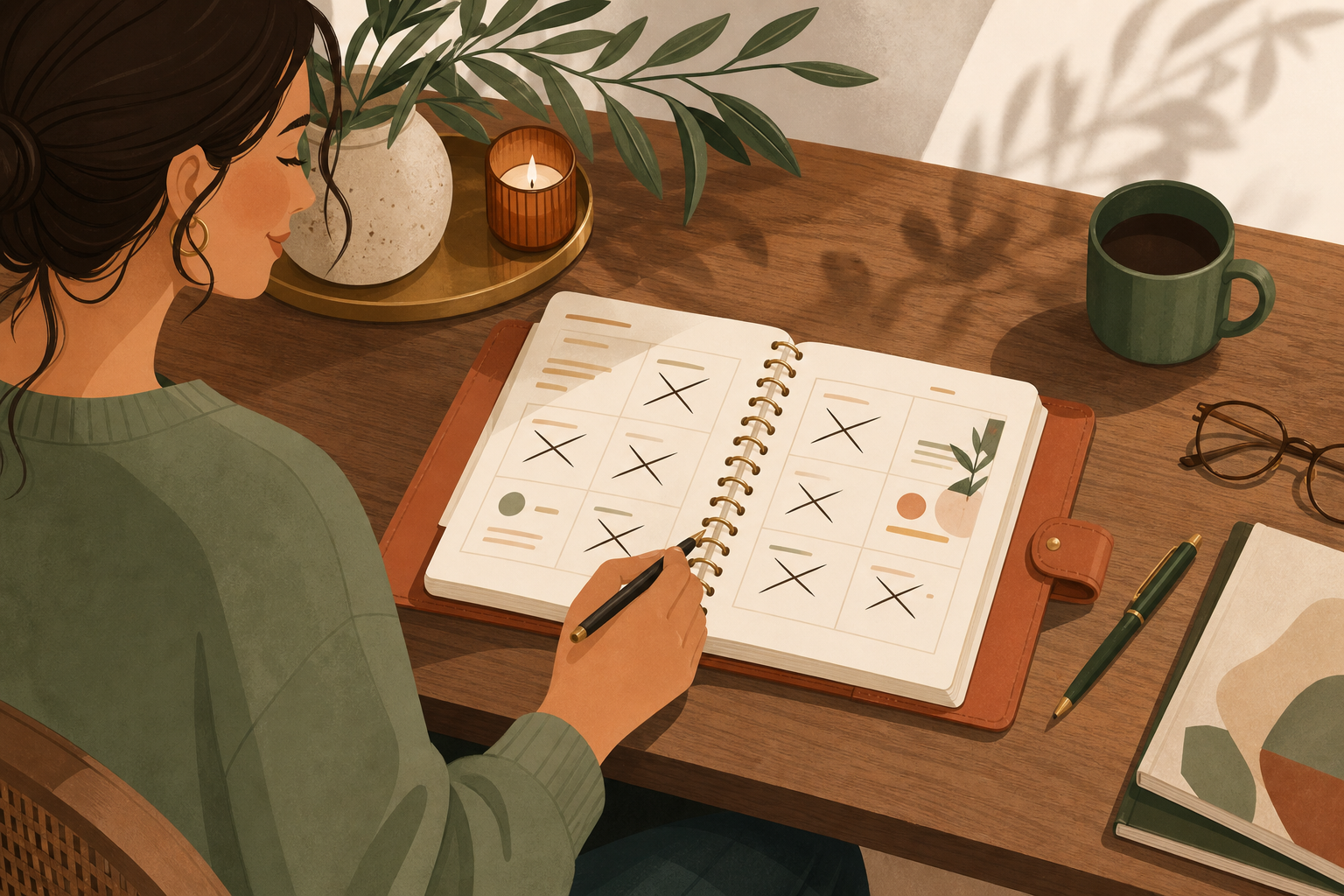
It is 11:40 p.m. on Tuesday. You have come home from overtime work and are eating a convenience-store rice ball while looking at the blank space in your habit tracker.
“I failed again today.” That one sentence can make you want to throw away tomorrow’s effort too. It is one empty white box, yet it starts to look like your life report card. You probably know this feeling.
Psychology recognizes that all-or-nothing evaluations of failure can make restarting harder. If you cannot do 30 minutes, it counts as zero. If you cannot continue for three days, it is failure.
With this grading system, one interruption easily becomes the conclusion, “I can’t do this.” Often, the interpretation of failure, more than the behavior itself, stops the next action.
Starting small is not indulgence. It is not merely about reducing the number of failures; it is about connecting the experience of “I did it” with a specific situation.
The behavioral-science idea of implementation intentions—deciding when, where, and what you will do—is practical here. “After I get home and wash my hands, I’ll sit at my desk and read for three minutes.” That is enough.
Reproducible matters more than impressive.
Why does a well-made plan still fall apart when I feel stretched?
Even so, this is not solved by making a more detailed schedule. It is tempting to think that once the calendar is organized, your mood will follow. But some days, a packed planner exhausts you before you have begun.
A plan is a map; it is not the body that has to walk.
Self-determination theory identifies a sense of choice, a sense of gradually becoming capable, and connection with others as conditions that help behavior continue.
Studying only to “become someone who earns more” or “not fall behind” can easily lose to streaming video on Friday night. The goal is not bad. The point is that running under threat is difficult to sustain.
For example, you open qualification-study materials on Sunday night, but all you can think is, “If I don’t do this, it’s over.” Your body may enter something closer to defense than learning.
You turn the pages, but nothing goes in. What may be missing is not grit, but the question: “Is this something I am choosing?”
It is too soon to decide, based on an action that did not last, that you are lazy. First, notice whose expectations you carried when you began and how tense your body is.
There is room to choose again there. A plan you can return to will take you farther than one designed to corner you.
FREE PROGRAM
A doorway to seeing your life anew — through the body
Add us on LINE to receive the free online lessons — the parts we couldn’t fit into this article.
Free to join, unsubscribe anytime. This is not medical treatment; results vary by individual.
Three things to review before throwing self-help away

Why is one specific triggering scene more useful than reading ten books?
Looking closely at one scene—“I go silent when someone disagrees with me in a meeting”—can connect to your life more than reading ten books. I feel quite strongly about this.
Abstract self-understanding feels good. Being able to say, “I crave approval,” can make things seem more organized. But learning that never comes down to a concrete situation loses its place to be practiced.
Your manager’s eyebrow moves slightly in a meeting, and suddenly you cannot speak. In the elevator on the way home, you replay it: “Was the way I said that wrong?” Once the scene is visible at this level, you can finally see where to work.
Is there someone you are always unable to find words around, for some reason?
The next time your manager asks for revisions, before apologizing immediately, notice once that the soles of your feet are on the floor. Then ask one sentence: “What should I change to bring it closer to what you intended?” This is not a dramatic transformation.
It is an opportunity for your body to learn a choice different from its reflex.
- Write down one time, place, and person that brings up the reaction.
- Catch the short phrase that comes into your mind in that moment.
- Put just one bodily change into words.
- Make the action you will try next time small enough to do in 10 seconds.
This is not a checklist for managing yourself. It is a gradual way of reading your own instruction manual. People rarely change through abstract words.
Not “I failed again,” but “In Tuesday’s regular meeting, my throat tightened the moment I felt criticized.” That level of detail is an entrance to change.
Why might naming a feeling help more than trying to get rid of it?
Self-help that tries to eliminate anxiety, anger, or impatience can become exhausting. If the goal is to erase a feeling, the moment it appears, you have failed.
I do not agree with the popular instruction to “always stay positive.” Telling humans not to have feelings is like telling them not to get wet on a rainy day.
Sometimes it is more useful to recognize, “Anxiety is here,” before trying to take a step despite anxiety. Recognizing and putting a feeling into words can shift you, even slightly, from being swept up in an emotion to being able to observe it.
Cognitive behavioral therapy records feelings, thoughts, and actions separately for this reason.
On Thursday evening, you open and close a proposal email in front of the send button. If your palms are damp, before concluding, “I can’t send it because I lack confidence,” try seeing it as: “My alert system is rising in a moment where I might be evaluated.” Simply not treating your feeling and yourself as exactly the same thing can add one more option.
Even when you understand all of this, there are days when you postpone a reply and, at night, sit listening only to the kitchen exhaust fan. The logic has not vanished.
The reaction is just strong in that moment. So I do not want self-help to become training to be someone who never wavers. I want it to be practice in knowing the way back after you do.
Why deeper change sometimes needs space outside everyday life

Why can trying to work it out alone keep me circling the same place?
Books and notes can help. But in the same room, with the same notification sounds and the same roles every day, familiar reactions can be too strong.
The more seriously you try to change yourself alone, the longer the meeting in your head can run. You are the chair, the note-taker, and the opposition all at once.
You check work notifications in the morning, meet other people’s expectations at noon, and think, “Tonight I’ll do something for myself.” Then you see the laundry, the dishes, and the messages you still have not answered.
Deep self-understanding is hard to do there. You are not weak; your environment is asking you to play the same old role.
The knowledge wall
Understanding can increase without reaching the body’s reaction in tense moments.
The environment wall
The same notifications, relationships, and schedule can easily call up an old autopilot.
The self-grading wall
If an unproductive day means disqualification, you may want to stop trying altogether.
Changing your environment is not avoidance. The brain may find it easier to try new perspectives and actions under conditions that feel safe. Physically stepping away from everyday roles can be one way to create those conditions.
I do not see a retreat as healing through escape from reality. I see it as a place to update how you meet your inner life. Not to break your everyday life, but to look again at what happens automatically within it from a little distance.
What is nehan’s “Journey to See Your Life Flash Before Your Eyes” designed to offer?
nehan’s Journey to See Your Life Flash Before Your Eyes is a two-night, three-day retreat in the forests of Yatsugatake. It is not simply a stay at an inn to refresh your mood.
Through a structure using sound, breath, and bodily sensation, it makes room to step back from your usual alert mode and examine reaction patterns that have lasted a long time.
Did you think, “So it’s just resting in nature?” Rest itself is not a bad thing. But the aim is not merely to look at scenery and return home. It is designed as an active, supported way to enter deeper inner territory that can be difficult to reach through everyday thinking alone.
Participants are not seeking “the correct answer.” They may find another entry point, through bodily sensation, toward what they understood in their heads but could not act on.
They may become able to create a little space instead of being swept away by patterns such as being thrown off by every remark from another person or putting their own wishes last.
Experiences and outcomes vary by individual.
In daily life, some people feel anxious simply by not replying immediately. Others say “Sure” before they have even considered declining a request. Rather than blaming these reactions as personality flaws, the retreat invites you to look at them again as responses learned over a long time.
That may be needed before adding more knowledge.
Step away from everyday alertness
Create distance from roles and notifications, and move toward a state where you can notice bodily tension.
Revisit the roots of your reactions
Gently approach feelings and memories that may have been difficult to organize through words alone.
Prepare to return to daily life
Develop a perspective for carrying insights back into your schedule and relationships.
You do not need to reject self-help. Books and videos can be useful entry points. But some people have reached the end of the phase of gathering more knowledge.
They have read enough, yet their bodies still produce old reactions in the same situations. What they need may not be the next book.
If what you want is not “to know more,” but the felt ability to make a different choice in the same situation, it may be time to change how you learn.
Self-help was not meaningless. You may simply have reached a point knowledge alone cannot cross.
FAQ
Q: If I think self-help is meaningless, should I stop reading books? A: You do not need to stop reading. It can be easier to use what you read when you connect it to one situation you want to change.
Choosing one idea from one book and deciding when you will try it can sometimes feel more useful than continuing to add information.
Q: Can I still create an opportunity to change if I always quit after three days? A: Yes. The reason you stopped after three days contains information about the size of the goal, your environment, fatigue, and other people’s expectations.
Rather than discarding it as failure, look at where you stopped. That makes it easier to adjust the next setup.
Q: Are retreats only for people with serious problems? A: Not necessarily. A retreat can be one option for people who repeat the same reactions at work or in relationships, or who have lost touch with what they want, to step away from daily life and review their condition.
If you have concerns about your health, consult a qualified professional before considering one.
The emptiness that remains after closing a book can also be evidence that you have not treated learning lightly. What you may need next is not more self-blame, but to understand the conditions under which your reactions can change.
nehan’s free online course explores, in more concrete terms, why understanding alone does not always lead to action and how to meet your everyday reactions.
It is for people who want to take their time and see whether this path fits them.
FREE PROGRAM
A doorway to seeing your life anew — through the body
Add us on LINE to receive the free online lessons — the parts we couldn’t fit into this article.
Free to join, unsubscribe anytime. This is not medical treatment; results vary by individual.
Sources/References
- American Psychological Association, explanation of Cognitive Behavioral Therapy
- Gollwitzer, P. M. “Implementation Intentions,” *American Psychologist*, 1999
- Wood, W. & Neal, D. T. “A new look at habits and the habit-goal interface,” *Psychological Review*, 2007
- Deci, E. L. & Ryan, R. M. *Self-Determination Theory: Basic Psychological Needs in Motivation, Development, and Wellness*, 2017
- LeDoux, J. E. *The Emotional Brain*, 1996
This article provides general information and is not medical advice. Results and experiences vary. If you have concerns about your health or condition, please consult a qualified professional.