

Key Takeaways
What is subconscious breathing, in practical terms?
- Subconscious breathing is an attempt to work with the body’s alert mode through breath before trying to persuade yourself with thoughts.
- When breathing slows and settles, autonomic nervous system activity may shift, creating a little distance from familiar reactive thoughts and feelings.
- Breathing alone does not rewrite lifelong response patterns. Deeper change needs a safe environment and gradual experience.
Why does breathing relate to the subconscious mind?

Is the subconscious mind really a hidden box inside your mind?
When people hear “the subconscious mind,” they may imagine a secret drawer somewhere in the brain—open it, and the answer to life appears. I think that framing sends us on a slight detour.
In the language of psychology and cognitive science, it is more useful to see the subconscious as a cluster of predictions, habits, and bodily responses that move before you consciously choose.
In other words, a part of you has already answered before your mind realizes it has “thought.”
At 9:12 in the morning, your manager messages: “Can we talk today?” You do not know what it is about, but your solar plexus tightens and you produce three worst-case scenarios.
A pay cut, a reprimand, that issue from before—you turn a meeting that has not happened into a three-part series in your head. You probably know this.
This is not because you lack willpower. The brain uses past memories to predict danger in advance. The brain is impatient, and it tends to prefer sounding an alarm—even an exaggerated one—over missing a threat.
It is like a smoke alarm going off because you burned toast. Loud, yes. But the mechanism itself is trying to protect you.
When people talk about “rewriting the subconscious,” many imagine repeating positive phrases. I want to push back on that a little. Words are not meaningless.
But the state of the body comes before words. I can say that quite clearly.
Telling an alert body “you’re okay” can be like trying to read directly beneath a blaring fire alarm. You can see the words, but they do not go in. On the way home, you may stand in a convenience store unable to choose dinner.
That is not always indecision; sometimes your body’s processing capacity is already full.
Can breathing tell the brain that it does not need to fight right now?

Breathing is an unusual function. You can change it deliberately, yet it continues while you sleep. The part you can steer and the automatic part live side by side.
That is why breath may offer a way to touch bodily vigilance that thought alone cannot easily reach.
Slow exhalation has been reported to relate to heart-rate variability and autonomic nervous system activity, including the vagus nerve, in ways that may reduce excessive bodily tension.
Heart rate rises slightly as you inhale and falls slightly as you exhale. The idea is to use that natural rhythm gently through breathing.
If we reduce this to “take a deep breath and relax,” we miss the important part. When the body is highly alert, the amygdala can more easily assign danger to ambiguous signals.
When exhalation softens and heart rate and muscle tension settle somewhat, the prefrontal cortex may have more room to reassess the situation. The reflexive thoughts—“it’s over,” “they hate me,” “I’ll definitely fail”—may become possible to put on hold.
At 10:47 at night, you look at the unwashed dishes and your mind expands all the way into tomorrow’s schedule. There are two cups in the sink and oil on the frying pan.
That is all. Yet you somehow arrive at, “Is my life really okay like this?” Have you ever done that?
When your breathing stays shallow, the amygdala may keep watch because there is still “an unresolved problem.” If you make the out-breath a little longer and wait for your shoulders to drop, there may be room to look again.
The dishes do not disappear. But the command that says, “I cannot sleep until everything is done,” may loosen a little. You might see the option of washing one cup and going to bed.
It is ordinary. Life is made of a succession of ordinary choices like that.
Breathing is not magic. It is not a tool for forcing the content of your thoughts into submission; it is an entrance out of the state of believing every thought too completely.
Are you thinking, “Isn’t this just another bit of mind-over-matter talk?” Fair enough. That skepticism is healthy. If a few breaths could resolve old wounds, relationships, and money worries, I would not trust it either.
That is exactly why it helps to separate what may change in the body from what breathing can and cannot do.
POINT
Working with the subconscious is not only about digging up memories. It can also mean cultivating a pause in which your body does not react at the same speed to familiar triggers.
How can you use breathing when you are overthinking at night?
Should you breathe deeply, or simply avoid rushing the exhale?

When people picture breathing exercises, they often imagine filling the lungs completely. You watch a video, straighten your back, and start to feel that you need to breathe impressively.
But when anxiety or urgency is strong, suddenly trying to take a big inhale can make some people feel worse.
In a state close to hyperventilation, carbon dioxide can fall too low, causing tingling in the hands and feet or lightheadedness. When you feel short of breath and work harder because you think, “I need to inhale more,” the body can become even more alarmed.
You are not running after a bath, yet your body is acting as if it is sprinting. You do not need to work hard at inhaling.
What I recommend is very simple: while sitting in a chair, make the exhale just slightly longer. It may feel almost disappointingly plain. But the things that continue are usually like this.
For example, inhale naturally through your nose for a count of four, then exhale at roughly a count of six. If counting feels difficult, three and four is fine.
You do not need to sit up straight like a soldier, either. Of course there will be days when you begin with rounded shoulders. If you turn breathing into another graded performance, you have missed the point.
At 11 p.m., you put your phone face down in bed, yet you keep remembering the message that has not been read. No notification arrives, but you turn the screen over and look again.
In that moment, count ten or so breaths and notice whether your jaw or tongue softens as you exhale.
The aim is not to make anxiety disappear. It is to recognize in your body: “Oh, I was clenching my teeth because I was anxious.” This is easy to get wrong.
When you try to remove the anxious part of yourself from the room, it may become louder because it feels pushed out. Awareness is small. But this kind of smallness is usually where your hand reaches the automatic mode.
What should you do when thoughts keep appearing during breathing?

When you turn your attention to breathing, thoughts may appear: “Is this doing anything?” “Tomorrow’s meeting will still go badly.” Of course they do.
If you could become thought-free the moment you started breathing, you might not be reading this article in the first place.
The brain’s default mode network is thought to be more likely to build stories about the past and future when you are doing nothing in particular. You remember something embarrassing you said five years ago while washing dishes, or rehearse an anxiety about three months from now while staring out a train window.
The brain is not very good at leaving empty space alone.
So thoughts arising during breathing are not proof that you have failed; they are the brain’s usual operating mode. If you start grading yourself—“I thought again, I’m not suited to this”—your breathing time becomes another venue for self-criticism.
You do not need another venue like that.
Imagine a Monday lunch break, eating an onigiri at the convenience-store seating area while regretting how you spoke that morning. When “That was the wrong reply” appears, do not judge whether the content is correct.
Briefly name it: “Regret is here,” then return to the exhale.
This repetition resembles decentering in cognitive behavioral therapy: practicing how to treat a thought not as fact itself, but as an event occurring in the mind.
Not “I am a person who failed,” but “A thought that I may have failed is appearing.” It may look like a tiny rewording, but your position changes. It is like moving from being swallowed by a movie screen to sitting one row farther back.
Sometimes you freeze at your desk late at night, unable to write even one reply. The coffee is lukewarm, and only your shoulders feel strangely hot. Breathing will not immediately produce an excellent answer.
But when you notice, “I’m trying to find the right answer too quickly,” you can choose to reply the next morning. It is not elegant. But this is what it means not to be completely swept away by your reaction.
- Rather than trying to increase the amount you inhale, make the exhale slightly longer.
- If counting feels burdensome, notice the soles of your feet or the firmness of the chair.
- Do not chase away thoughts that arise; call them “thoughts” and return.
- If you experience dizziness, intense shortness of breath, or strong anxiety, stop and return to your usual breathing.
Why can trying to change through breathing alone leave you stuck?
Is “you will change if you do it every day” actually true?

People often say that anyone can change if they simply keep up a few minutes of practice each day. I think that is only half true. I will say it plainly.
A breathing habit can become a foundation. But long-standing reactions involve more than bodily sensation: memories of relationships, repeated interpretations, and the environment you are living in all become entangled.
“Five minutes a day will change your life” is convenient and reassuring. But it is unfair to make five minutes of breathing carry your entire life.
On the morning commute, for example, your partner asks, “Will you be late today?” and you reply sharply. They may only be checking the schedule, but what reaches you first is, “I’m being blamed again.” Later, you look back and dislike yourself: “Why did I speak like that?” You may have had a similar moment.
Even if breathing helps you settle in that moment, if you receive words as blame in the same way each time, another small fight can begin when you get home.
Breathing can be a brake. It does not automatically decide where you are going. A car with only brakes, no map, and no destination would be difficult to drive.
If breathing practice did not last for you, perhaps you were not lazy. Perhaps you gave breathing too much to carry. The more tightly you grip it—“This has to fix my life”—the more rigid your breath may become again.
Using a tool as a tool sounds simple, but that distance is surprisingly difficult.
I think many modern struggles eventually come down to not knowing who you really are, and not yet having an experience powerful enough to move you beyond what you can explain with your head.
Work anxiety and relationship friction look like separate problems on the surface. But if you keep reacting without knowing what you fear or want, the same pattern returns in different forms.
Breathing can be an entrance. But an entrance is not the house itself.
The wall of trying to breathe correctly
When you focus too much on numbers and posture, the practice itself becomes another graded performance.
The wall of making calm the goal
When you try to drive out unpleasant feelings, the moment a feeling appears becomes a failure.
The wall of returning to daily life
You may manage it alone at night, then find old reactions returning in meetings or conversations with family.
Why do deeper response patterns need a setting that can hold the experience?
Automatic reactions—the kind often called subconscious—do not move easily through understanding alone. This is what I most want to convey.
You may understand, “Maybe I am still carrying my parent’s words,” or “I’m afraid people will dislike me,” and still freeze when someone disagrees with you in a meeting.
A message remaining unread can still leave a weight in your stomach. Understanding something with your head and changing your life are different things.
This is not empty self-help; reactions extend across layers of body, feeling, and memory.
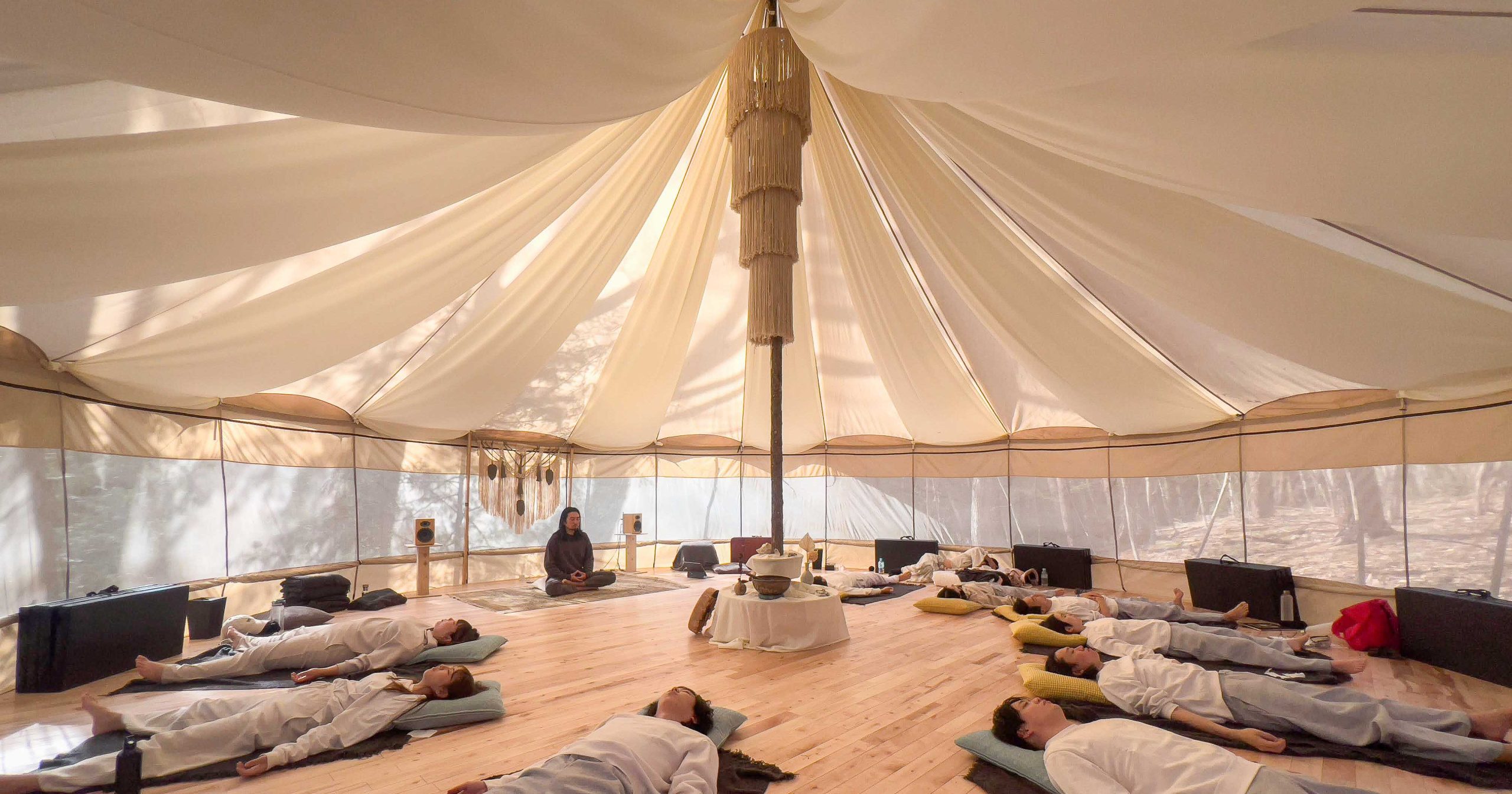
That is why nehan does not design the two-night, three-day *Journey to See the Life Flash Before Your Eyes* in the forests of Yatsugatake as a simple holiday.
Using sound, breath, and bodily sensation, it is a setting for approaching, step by step, reactions that you understood intellectually but could not shift.
The *Journey to See the Life Flash Before Your Eyes* is a two-night, three-day retreat program in the forests of Yatsugatake. It creates distance from emotions and old beliefs that can be difficult to notice alone, and offers an opportunity to bring a different starting point for everyday choices home with you.
What happens differs from person to person. Not everyone has the same feelings or returns with a dramatic answer.
Still, someone who could only blame themselves for “reacting to the same thing again” may notice the bodily tension or wish that comes before that reaction.
Someone who has pushed themselves with “I have to do this properly” may discover that they actually wanted to rest. Someone who thought they were angry may notice that they had been scared for a long time.
These discoveries feel different from forcing out a correct answer at a desk.
You follow work notifications until Friday evening, plan household tasks on Saturday, then begin fearing Monday again on Sunday night. You hear the washing machine stop and feel your mood drop because the weekend is already ending.
In that cycle, it is hard to make time to look carefully at what is happening inside. You cannot look because you are busy. And without looking, you become busy again.
That is the value of changing the environment and observing your reactions intensively in a supported setting. It is not escaping reality. It is time to revisit the mechanics of your reactions with your whole body, so you do not keep repeating them in daily life.
A retreat is not the consumption of healing; it is a training ground for updating how you live inwardly. That is my view.
Relationships
You may find it easier not to immediately decide that another person’s words are an attack, and to have options before replying.
Work
You may notice the habit of filling your schedule out of urgency and find a reason to reset priorities.
Yourself
You may be able to look at the harsh voice toward the “not doing well enough” version of yourself from a little farther away.
Daily habits
You may find it easier to use breath and bodily sensation as signals that something is becoming unsettled.
FAQ
Q: How many minutes should I practice subconscious breathing? A: More than duration, the guide is whether you can observe your body’s response without strain.
A few breaths are enough at first. Repeating it briefly in the same context—at bedtime or during a lunch break, for example—can lower the effort of starting.
Q: My thoughts do not stop when I breathe. Does that mean I am not suited to it? A: Thoughts arising are a natural response. Notice that a thought has appeared, then return to your breath or the sensation in your feet.
That back-and-forth is the practice. This is not a competition to reduce thoughts to zero.
Q: What should I consider if breathing alone does not feel like enough? A: When everyday reactions feel strongly fixed, you do not have to carry them alone.
You can consider support from a trusted professional or a safe program. If you have health concerns or intense distress that continues, consider speaking with a medical professional.
Settling your breath is not the task of remaking you into someone else. It is an entrance for stepping half a pace back from the story that starts automatically, and recovering your own felt sense.
From there, why do you repeat the same reactions, and what can you bring back into daily life? We cover the practical framework and the design of the experience in more detail in our free online course.
This article is for general informational purposes and is not medical advice. Individual experiences and results vary.
FREE PROGRAM
A doorway to seeing your life anew — through the body
Add us on LINE to receive the free online lessons — the parts we couldn’t fit into this article.
Free to join, unsubscribe anytime. This is not medical treatment; results vary by individual.
Sources/References
- Zaccaro A, et al. *How Breath-Control Can Change Your Life: A Systematic Review on Psycho-Physiological Correlates of Slow Breathing*. Frontiers in Human Neuroscience, 2018.
- Lehrer PM, et al. *Heart rate variability biofeedback: how and why does it work?* Frontiers in Psychology, 2020.
- Farb NAS, et al. *Interoception, contemplative practice, and health*. Frontiers in Psychology, 2015.
- National Institute of Mental Health: Anxiety Disorders(General information on anxiety and bodily responses)