


Key Takeaways
What does it mean to live your own life?
- Living your own life begins not with searching for the “right answer,” but with noticing—through your whole body—what you are responding to.
- Living by other people’s standards is not a character flaw. It is a combination of the brain’s predictions about avoiding rejection and habits learned over time.
- Before making major decisions, returning small everyday choices to yourself can gradually build the feeling that you are holding the steering wheel of your life.
Have you ever wanted to live your own life, only to realize that you spent the day prioritizing someone else’s schedule, mood, or the answer they were probably expecting?
You got things done. You did not inconvenience anyone. But when you put your phone face-down before bed, you may have wondered, “Where was I today?”
I do not think living your own life means dramatically turning everything upside down. I think it is almost the opposite: not making yourself absent in small moments. It is the accumulation of that.
The Moments When You Lose Sight of Your Own Life
What does it mean to take responsibility for your own choices?
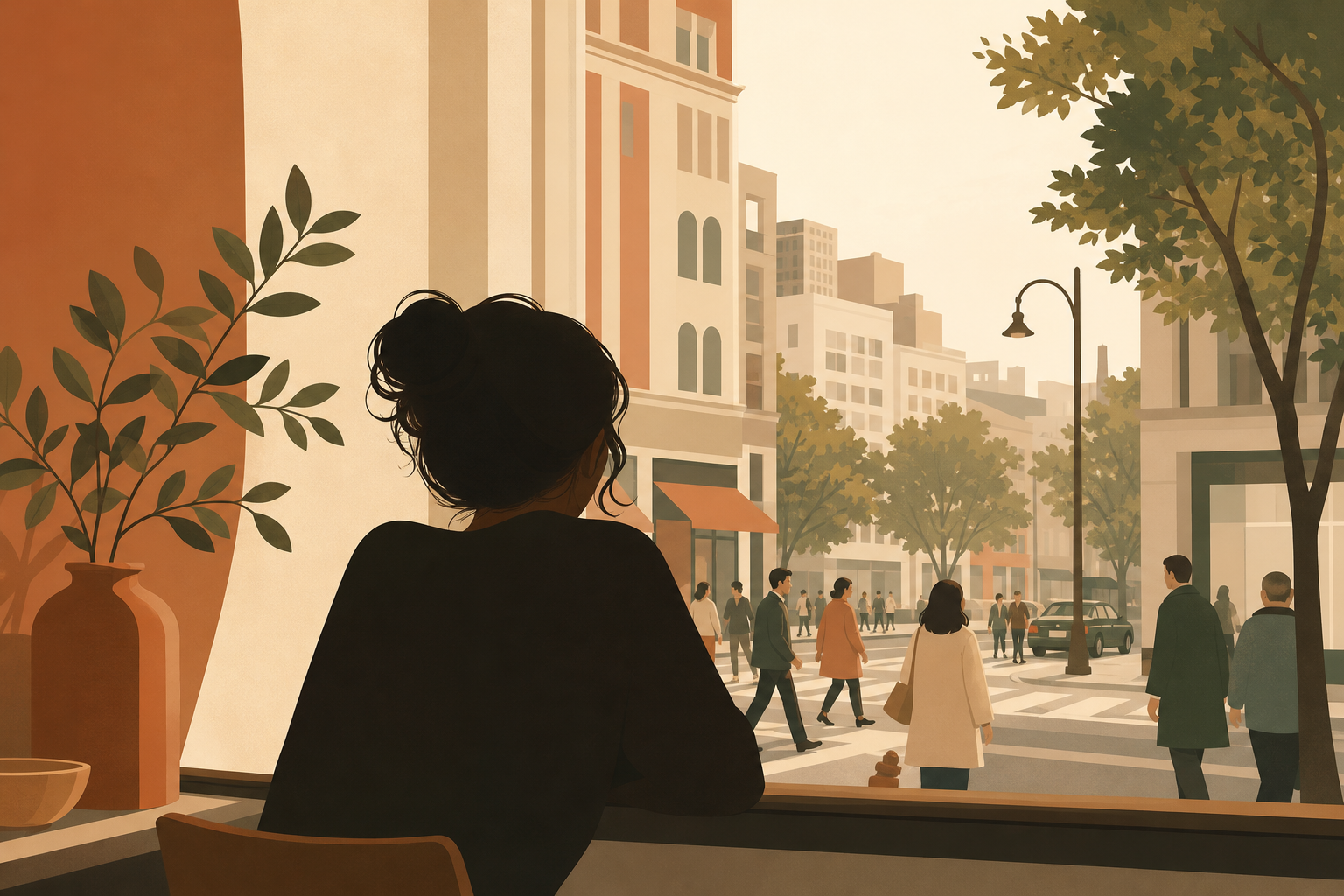
Living your own life does not mean quitting your job or ignoring your family’s opinions. It means being able to say, “This is my choice right now,” rather than putting every outcome down to other people’s expectations or the atmosphere around you.
It is Friday at 7 p.m., and a colleague invites you for drinks. There is no obvious reason to say no, and going would keep things smooth. But your stomach feels heavy, and what you really want is to go home alone, do the laundry, and sleep early.
Do you ignore that feeling and reply, “I’m in”? Or do you decline briefly? Life is often made in screens like that reply screen.
I am not saying that declining is always the right thing to do. If you want to go, go. The difference is whether you can ask yourself, even for one second, before your finger moves automatically: “What do I want?” You probably know the feeling of pressing Send and immediately thinking, “Why did I take that on again?”
People often say that you need a firm dream or mission to live your own life. I do not think so. In reality, few people wait until their dream is clear and then act.
More often, action comes first, and only afterward do you realize: I hated that direction. Or: I actually like this more than I expected.
No path, job, or relationship comes with a label saying “correct.” It is a little like buying an unfamiliar seasoning at the supermarket and finding, once you use it at home, that it does not suit you after all.
Some life choices cost more than seasoning, of course. That is why you look at what happened after choosing, then choose again. The point is to return that sense of agency to yourself.
Why can’t you tell what you want to do?
When people say, “I don’t know what I want to do,” it does not necessarily mean they feel nothing. Sometimes the circuit that says, “That’s impossible,” “My parents will worry,” or “Do something more useful,” moves too quickly.
The grading starts before the feeling can even register.
It is 7:30 on a Monday morning. You are on a packed train, opening and closing a job-search site on your phone. You cannot say you hate your current job. But after looking at the listings, your fingers somehow feel cold.
The task is not to decide immediately whether you should change jobs. The task is to separate the questions: “What am I afraid of?” and “What draws me, even a little?”
Did you think, “Here we go again—another vague lecture about finding what you love”? That response makes sense. You need money to live. You have responsibilities.
Everyone knows that reality cannot be decided by “what I like” alone.
But considering reality is different from silencing your response from the start. When those become the same thing, a person can spend years making “problem-free choices” while being the only one who remains unhappy.
Psychologist Carl Rogers proposed that when people prioritize outside evaluations over their own experience, the gap between their self-image and lived sense of self widens.
They accept only the version of themselves that earns praise and keep rejecting the version that causes inconvenience. They may look as if they are choosing, while feeling as though they are constantly in a job interview—even on their days off.
It is Sunday afternoon, and a voice in your head keeps assessing: “Is this meaningful?” You watch a video, take a nap, pull out supplies for a hobby, and still cannot settle.
That may not be laziness. It can be the habit of placing the ruler of evaluation ahead of your own felt sense.
What you want may not have disappeared. The voice of the internal grader may simply have become too loud to hear anything else.
Why Other People’s Expectations Stay in Your Head
Why does the brain predict the answer that avoids rejection before your honest answer?

I think dismissing an other-directed life as weak willpower is only half true. The brain can treat the possibility of isolation or rejection as danger, building predictions from past experience about how to behave safely.
In predictive coding, the brain is understood not as merely receiving the world, but as assigning meaning ahead of time.
Your manager says, “Got a minute?” Before hearing what it is about, your chest tightens. If you were criticized for a mistake last month, the prediction—“Maybe I’m in trouble”—arrives first.
Even if they only want to ask where to get lunch, your body may be in alert mode for a few seconds.
The same thing can happen when you repeatedly open an unread chat thread for no reason. Before the fact that nothing has arrived from the other person, the prediction “Maybe they dislike me” moves your body first.
You know you are overthinking it, but your hand reaches for the phone anyway. You have probably been there.
Under intense stress, the amygdala has been reported to be involved in detecting danger, while flexible judgment by the prefrontal cortex becomes harder to access.
That is why simply telling yourself to calm down and think about what you really want does not work every day. A brain that senses danger prioritizes the answer that avoids rejection now over what may feel right in the long run.
So start by not blaming yourself. Before beginning the review meeting of “I accommodated someone again,” try noticing: “My brain is checking for safety right now.” That alone creates a little space between you and the reaction. Without that space, there is no choice.
Why do “shoulds” play automatically?
If you grew up being praised for “reading the room” or “being good at putting up with things,” your response to prioritize others may have become fast.
That is not inherently bad. It can become a real capacity to care for people. But if it is the only response available in every situation, it is less freedom than autoplay.
It is 10 p.m. in the kitchen. Your partner has left dishes in the sink. You are tired, but say, “It’s fine, I’ll do it,” and begin washing them. Listening to the tap running, you notice that you are angry.
By the next morning, you tell yourself, “They must have been tired yesterday,” and erase your own anger. Small swallowed moments like this can, years later, turn into: “What was it that I disliked again?”
Anger is not always a sign that you want to blame someone. It can be information: “I am taking on too much here,” or “I wanted us to decide this together.” The dishes themselves are a small matter.
But dishes, favors, sudden overtime, family gatherings—when small “sure, it’s fine” responses pile up every week, the ability to feel your own wishes grows dull.
In cognitive behavioral therapy, automatic thoughts are brief judgments that arise before you are aware of them: “If I say no, they will dislike me,” or “I have no worth unless I meet expectations.” They are not facts so much as shortcuts you have used for a long time.
When people write them down, they are sometimes surprised by the harsh rules they have imposed on themselves. The rules in your head can resemble a pretty exploitative workplace.
Are you following rules such as “Requests come first,” “Smile even when exhausted,” and “Cause zero inconvenience”—twenty-four hours a day, without anyone asking you to?
And when you break them, do you punish yourself? That is too strict.
Recovering your own center does not mean destroying those rules. It means becoming able to review them when needed.
POINT
The first step in reclaiming your life is not blaming others. It is identifying the reaction: “What am I afraid of that makes me choose this?”
FREE PROGRAM
A doorway to seeing your life anew — through the body
Add us on LINE to receive the free online lessons — the parts we couldn’t fit into this article.
Free to join, unsubscribe anytime. This is not medical treatment; results vary by individual.
Why Living by Your Own Values Is Not Selfish
Can your wishes and consideration for others exist together?

If you worry that putting yourself first will make you selfish, you may already be someone who thinks a great deal about other people. Selfishness means pushing through your own wants without seeing another person’s circumstances or dignity.
Living your own life means placing your circumstances on the same table after seeing theirs too.
Your mother asks about your Sunday plans, and you automatically say, “I’ll keep it open.” But you actually have a hair appointment booked. Simply saying, “I can come in the afternoon,” creates a choice that is not all or nothing.
Not disappointing someone and not erasing yourself can coexist.
Some people start imagining the other person’s facial expression immediately: “Would that sound rude?” I understand. But sharing part of your schedule is not an attack.
Your plans are written in your calendar too. The possibility that someone may be slightly disappointed does not carry the same weight as putting yourself last every single time.
Self-determination theory suggests that autonomy, relatedness, and competence are associated with a person’s sense of acting from within. Autonomy does not mean doing everything alone.
It means having the sense that you are choosing with understanding.
You can decide after talking it through. You can ask for help. The point is not to give away the steering wheel of your choice.
It is normal for someone driving to ask the passenger, “Should we turn right here?” But it is different if they hand over the wheel every time and ask the passenger to choose the destination too.
Being in relationship and giving up the driver’s seat are not the same. Autonomy is not isolation; it is participation with consent.
Why does searching for a big answer make you freeze?
“I’ll change jobs once I find what I truly want to do.” “I’ll choose someone I can never regret choosing.” Life is often discussed as if it were a game where you must get the right answer in one attempt.
I think that is one reason people stop moving. Life is not a final exam. It is a long experiment in which you can choose again along the way.
As I write this, I realize that people searching for “their own life” often want a correct map. But the more you want a map, the more easily you postpone sensing where you are standing now.
On a Saturday afternoon when it looks like rain, choosing between a walk and a movie at home can be practice in asking which feels more natural today.
You may think, “A walk or a movie is not going to change my life.” Of course it will not suddenly change your job. But if you settle every time for “either is fine,” you do not develop the ability to read your own “which one do I prefer?”
It is like trying to lift 100 kilograms on your first day of strength training. Start with a lighter weight.
Some people sit for a few minutes in a convenience-store parking lot on an overbooked evening, without even starting the car. The coffee is lukewarm.
Their shoulders are hard as stone. They thought they were doing what they wanted, then notice they had been running only on the momentum of being unable to say no.
It does not look impressive. But without pauses like that, you will usually miss your own voice.
Please do not rush toward a big answer. The more you rush, the more your brain searches for an answer that cannot fail, returning to its usual other-directed pattern.
Choose one small thing again in a way you can manage now. That is enough for life to begin moving.
Three Ways to Notice “I Chose This” in Daily Life

Where do you make yourself absent from morning to night?
You do not need to change your whole way of living at once. For one week, write down just one moment each day when you wondered, “Which do I really want?” Do not review whether the outcome was good or bad.
Mark the bodily sense just before the choice: a tight throat, shallow breathing, a small sense of relief. Information without words can be surprisingly honest.
These questions can help you observe:
- When did you say “I’m fine” automatically?
- What were you afraid of losing with the person you could not refuse?
- After choosing, did your body feel more open or more contracted?
- If no one were evaluating you, what would you use tonight for?
At lunch, before following colleagues into a set-meal restaurant, pause once. You may notice, “I actually want ramen.” You do not have to go eat ramen.
But accommodating without noticing and accommodating after you have noticed feel very different inside.
In a meeting, someone asks, “Does anyone have anything to add?” Something you want to say flashes through your mind, then you immediately pull it back: “It’s not worth saying.” Record that moment.
Not to blame yourself for not speaking, but to see what words appeared, where your body tightened, and what you predicted would happen.
The places where you erase yourself rarely appear as clearly as a drama scene. They are more often mixed into “Whatever works,” “Anything is fine,” and “I’ll do it.” So one moment a day is enough.
Write a brief note in front of the bathroom mirror or on the station platform. That plainness is what works.
How can small actions give the brain a new prediction?
If your brain predicts that expressing a wish will make people reject you, that prediction often remains even if you argue against it in your head. It is more likely to shift when you express a small preference and accumulate real experiences of “I was not rejected” or “We were able to talk about it.” This is not about getting rid of fear.
It is about expanding the range of choices you can make while fear is present.
This is not a matter of grit. The brain learns from the gap between prediction and reality—what is called prediction error. You predict, “If I express what I want, the relationship will fall apart,” but the other person says, “Okay, maybe another time.” Repeated differences like that can gradually update predictions about danger.
By contrast, simulating the situation hundreds of times in your head does not easily rewrite the old prediction.
At the salon, say, “Could you make my bangs a little shorter?” At a restaurant, ask for water. Before sending a follow-up message to a friend who has left you on read, wait ten minutes.
These may sound so small that they feel almost silly.
But the capacity to return your life to yourself grows only in ordinary moments like these.
You may wonder, “What does asking for shorter bangs have to do with my life?” It does connect. The circuit that swallows what you want is not completely separate in every setting.
A bodily memory that it was safe to express a small wish becomes footing when you need to express a more difficult one next time.
Notice the reaction
When discomfort or urgency appears, put it into words without sorting it into right or wrong.
Choose again in a small way
Put one of your wishes into action within a range that does not break the relationship.
Receive the result
Notice the difference between what happened and what you predicted, and use it for the next choice.
Even if it does not go well once or twice, that is not failure. In real life, someone may react badly when you express a wish. That is exactly why you do not need to conclude, “They looked unhappy, so I was wrong.”
They have their circumstances. You have yours. Learning to hold both can lead toward relationships that are neither immature nor built on your disappearance.
What Kind of Space Helps When You Understand but Keep Going Back?

Why do old roles return so quickly in everyday environments?
Observation and small choices can help. But at work, you become a subordinate; at home, a parent; at your family home, a child. When the environment stays the same, it is natural for the brain to return to the same predictions.
You do not need to be discouraged and think, “I failed again.”
On Sunday night, you open materials for next week’s meeting and the rested feeling you had disappears. The notification sound, the cluttered desk, the usual chair—these can connect to past tension and pull your body back into its old mode.
Everyday life contains too much information to counter with willpower alone.
The moment you enter your family home, things you can normally say may suddenly become impossible to say. In a company meeting room, opinions you could hold at home may shrink away.
This is not because your will is insufficient.
Environmental cues—including place, smell, tone of voice, and even seating order—can be connected with roles from the past. The brain replays the same reactions in the same places because it is efficient.
It is useful, and it can also be troublesome.
That is why people who are in a hurry for answers may benefit from spending time away from their usual roles. This is not escapism. It is time to review your own responses outside those roles.
I see retreat not as consuming healing, but as a training ground for updating how you relate to your inner life.
I do not believe that simply resting in nature changes everything. Rest is good. But long-standing reaction patterns are not so simple that a pleasant view will conveniently undo them.
You need to enter the deeper inner places that everyday thinking does not easily reach, actively and in a safe setting. Only then can what you understand in your head begin to move into the choices your body makes.
What does nehan’s retreat work with beyond determination?
The Journey to See Your Life Flash Before Your Eyes is a two-night, three-day retreat in the forests of Yatsugatake. Through sound, breath, and bodily sensation, it creates distance from emotions and old reaction patterns that are difficult to access in daily life.
It is not a place to force yourself into positivity.
We have designed a distinct, step-by-step approach so that something different can begin from the body in relation to what you understood intellectually but could not act on.
Some people arrive tense with the thought, “I have to change myself.” But change does not happen by scolding yourself. First, it is more important to create a state where you can look without running away at what frightens you, where you unconsciously shrink, and what you actually wanted.
Determination alone can fade by Monday morning. A felt experience received by the body tends to stay longer.
Someone who has long felt, “I have no value unless I meet expectations,” will not instantly become a different person. But there can be a moment when they can see that sentence not as their whole self, but as an old reaction.
Once that distance exists, they may speak in the next meeting instead of swallowing their words, or write and send a message declining a request.
Change often appears in the specifics of the next day.
On Tuesday afternoon, you can reply to a requested task: “Today is difficult, but I can do tomorrow morning.” After dinner, facing the dishes, you can say, “Let’s do this together.” In moments that once looked like nothing, your choice returns to you.
This changes a life more reliably than a dramatic declaration.
What about you? Is it really that there is no answer available to you right now? Or does your usual role interrupt before you can feel the answer?
Stop looking for the answer for a moment, and look at the reaction. Your life is not somewhere far away. It is in the next sentence you send back.
FAQ
Q: Do I need to quit my current job to live my own life? A: Leaving your job is one option, but it is not the first answer. Separating what is difficult about work—the tasks themselves, relationships, or fear around evaluation—can make the next choice more concrete.
Q: Can I still live my own life if I prioritize my family? A: Choosing your family can also be your own life if you are choosing it with understanding.
It becomes painful when you cannot feel that you chose it and there is no room to decline or talk things through.
Q: I do not understand my honest feelings at all. Where should I begin? A: Before searching for a big dream, try writing down the moments in a day that felt unpleasant and the moments that felt slightly easier.
Honest feelings often appear not in impressive words, but in small reactions—like wanting to put your phone down before sleep.
Living your own life is not about making a dramatic decision. It is about knowing your reactions and increasing the room to choose again. In our free online course, we share how to approach the deeper places that are difficult to access in everyday life.
I want you to understand a little more concretely why intellectual understanding alone did not lead to action, and what might become possible from there.
FREE PROGRAM
A doorway to seeing your life anew — through the body
Add us on LINE to receive the free online lessons — the parts we couldn’t fit into this article.
Free to join, unsubscribe anytime. This is not medical treatment; results vary by individual.
Sources/References
- Deci, E. L., & Ryan, R. M.『Self-Determination Theory: Basic Psychological Needs in Motivation, Development, and Wellness』
- Rogers, C. R.『On Becoming a Person』
- Arnsten, A. F. T. “Stress signalling pathways that impair prefrontal cortex structure and function,” Nature Reviews Neuroscience, 2009.
- Gross, J. J. “Emotion Regulation: Current Status and Future Prospects,” Psychological Inquiry, 2015.
- Friston, K. “The free-energy principle: a unified brain theory?” Nature Reviews Neuroscience, 2010.
This article provides general information and is not medical advice. Results vary from person to person. If you have concerns about your health or condition, please consult a qualified professional.