


What is a heartbreak trip, and will going actually make you feel better?
What does “heartbreak trip” mean?
A heartbreak trip (*shoshin ryoko* in Japanese) is a trip you take to rest after a breakup or a parting has hurt you. Honestly, going won’t make the pain disappear.
What stepping out of daily life can do is give you a little room to look at your feelings from further away.
Why does being away from home feel different after a breakup?
At home, a single toothbrush holder is enough to bring it all back. You probably know this. A place you’ve never been has none of those triggers.
Your head comes along with you, though. Your phone is an easy trigger too, so our article on digital detox may help.
- In daily lifeYour room and your phone trigger memories
- Leaving on a tripYou step away from the triggers and gain some room
- Looking from a distanceYou can see your feelings from a little further off
- ReframingThe way you see what happened may shift
How should you choose where to go on a heartbreak trip?
Should you pick a heartbreak trip destination by place name or by conditions?
Choose by conditions, not by place name. The places to avoid are different for everyone. Four checks are enough:
- No memories of the two of you there
- Not too crowded
- Nature or hot water nearby
- Easy to reach, and easy to leave
How far away should a heartbreak trip be?

For now, a hot-spring town one express train away is about right. If you think “I want to go home,” you can be home soon. That reassurance matters more than the view.
Should you go on a heartbreak trip alone or with a friend?
How do you decide between going alone and going with someone?
Decide by the state you’re in right now. If you want to cry or stay quiet, go alone. If talking would make things lighter, invite one person you trust, and only one.
Is a group trip a good idea after a breakup, and what if going alone feels scary?
A big group isn’t something I’d recommend after a breakup. Laughing to match the mood of the room is not rest.
If going alone makes you nervous, a day trip or a single night is plenty to start with.
What should you do during a heartbreak trip?
What can you do on your own during a heartbreak trip?

There are three things you can do on your own during a heartbreak trip. All of them are plain. But when you’re hurt, the plain things are the ones that do the work.
Leave the schedule open and rest
One sight a day at most. A day that ends in a nap is fine.
Write what comes to mind on paper
The notepad at the inn is enough. Don’t tidy it up.
Come back to what your body feels
Walk, soak in hot water. Notice the soles of your feet, the heat of the bath.
Is it okay to leave a heartbreak trip unplanned, or to not cry?
You may feel the urge to fill a heartbreak trip with plans. The open time is the substance of the trip, though. And if the tears don’t come, nothing is wrong with you.
For more on writing, see our article on writing, talking and feeling.
FREE PROGRAM
A doorway to seeing your life anew — through the body
Add us on LINE to receive the free online lessons — the parts we couldn’t fit into this article.
Free to join, unsubscribe anytime. This is not medical treatment; results vary by individual.
I came home from the trip and felt low again. Was it pointless?
If you sink again after coming home, did the trip mean nothing?
A trip that ends with you feeling low again was not pointless. A trip is time to rest. Sorting out your feelings continues after you get back.
You open the front door and the room is exactly as you left it. Of course you sink there. [Slotter et al. (2010)] also reported that after a breakup, a person’s sense of “who I am” can become blurred.
What can you do once you’re back from a heartbreak trip?

Sinking after you come home from a heartbreak trip is not going backward. It’s the order things come in. Keep just one small thing going, such as writing three lines before bed.
If you find yourself overthinking once you’re back, try the difference between introspection, self-criticism and overthinking.
When should you seek help before taking a trip?
POINT
You can’t sleep, you can’t eat, or the wish to disappear won’t go away. If that continues, turn to a medical institution or a public support line before a trip. In Japan, lines such as Inochi no Denwa and the Yorisoi Hotline can be found through the Ministry of Health, Labour and Welfare’s [“Mamorou yo Kokoro”] page. Outside Japan, contact your local services.
Going on a trip yourself, talking to a professional, joining a program: how do they differ?
Is one of the three options better than the others?
A solo trip, professional support and a guided program are not ranked. You choose by the state you’re in now. You might think, “Seeing someone over a breakup is overdoing it.” But decide by what you’re missing right now.
Who is each option suited to?
Going on a trip yourself suits people who can move a little once they’ve rested. You get rest at your own pace. The caution is that the old thoughts tend to return once you’re home.
Talking to a professional suits people whose sleep or eating has fallen apart. You get someone it’s safe to talk to. Fit varies from person to person, and it takes time to attend.
Joining a program-style retreat suits people who circle the same spot when they’re alone. You get several days of facing yourself with a guide. It is not suited to the period right after a breakup, when you’re badly shaken.
Do you have to choose just one?
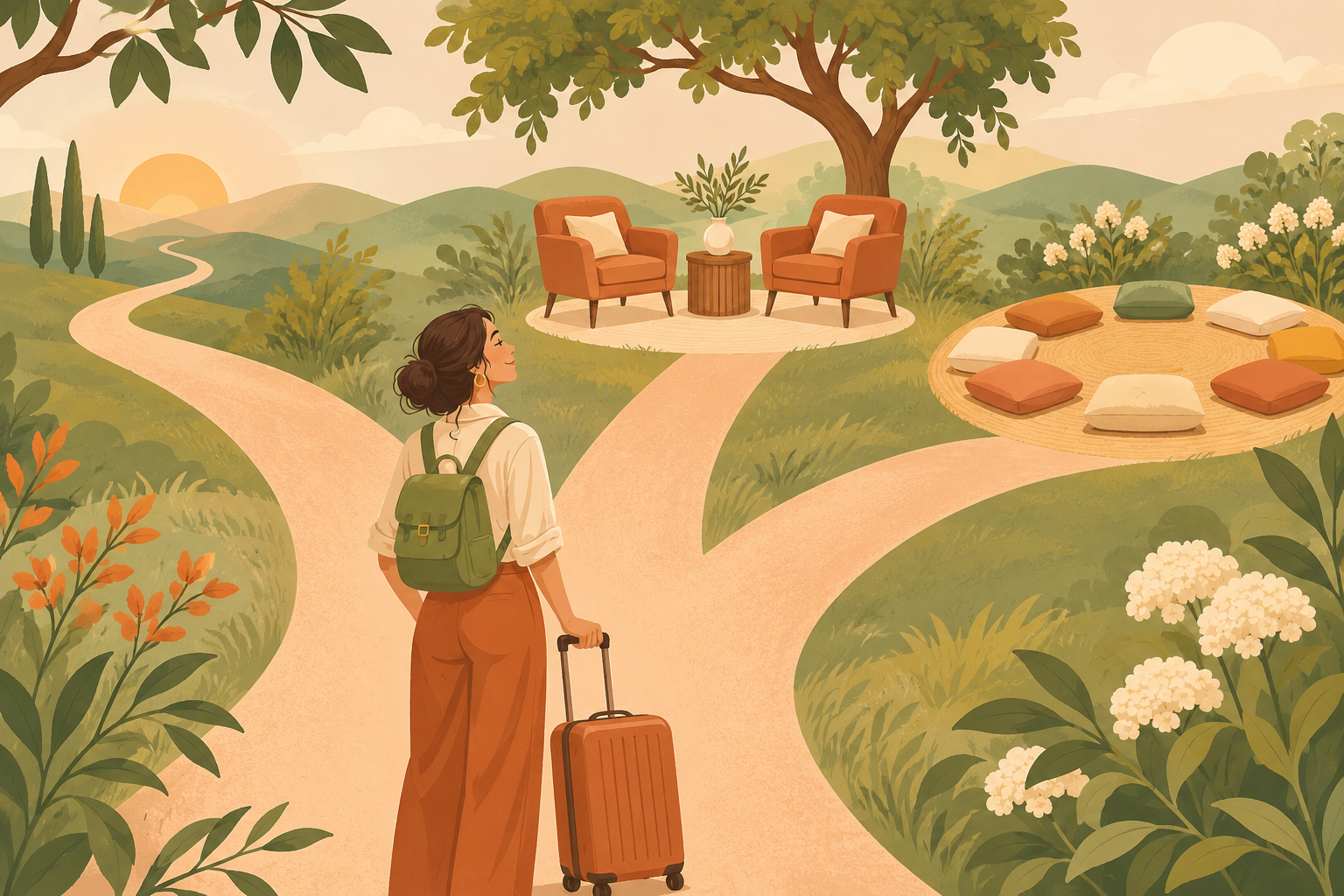
You can combine a solo trip, professional support and a guided program. You don’t have to settle on one.
On my own I keep returning to the same feelings. Is it okay to go straight into a three-day, two-night program?
Can you join a three-day, two-night program without any lead-up?
You can join a three-day, two-night program without any lead-up. But if the breakup has only just happened and your mind and body are badly shaken, rest comes first.
If a trip on your own is enough for you, that’s fine.
What should you check before choosing a retreat?
Some people take trip after trip and still find themselves thinking the same thing on the train home. For them, a few days away spent facing themselves is one option.
Check five things when choosing. The organizer’s background. Whether you can decline partway through. The price and cancellation rules. The follow-up afterward.
The intensity of any breathwork, and who stays with you. Five conditions for choosing a three-day, two-night stay to face yourself can serve as a yardstick.
What is nehan’s Self-Transformation Retreat?
nehan’s Self-Transformation Retreat is three days and two nights in Kobuchizawa, Yamanashi Prefecture. Unlike a trip to rest at an inn, it is a place to face yourself from the state of your body and awareness, not from your head.
A guide is with you, and the 14 days after you return are part of the program. Only if you want to know more about it, you can look at the Soumatou journey and participants’ stories.
FAQ
Q: How many nights should a heartbreak trip be? A: There’s no rule. For a first one, a day trip or one night is enough.
Q: Won’t it be lonely to go on a heartbreak trip alone? A: Feeling lonely is natural. Choose an inn where you can sense other people around, and decide in advance who you can call at night.
Q: If I couldn’t cry on the trip, was there no point in going? A: There is a point even if you can’t cry. For more, see how the body works when tears won’t come.
Q: Can I take a heartbreak trip for something other than a breakup? A: Yes. If you’ve been hurt, the reason doesn’t matter.
Q: What’s the difference between a heartbreak trip and the Self-Transformation Retreat? A: A heartbreak trip is rest at your own pace. The Self-Transformation Retreat is a residential program where you face yourself alongside a guide.
Q: How much does it cost to join? A: We share that at the diagnostic session.
FREE PROGRAM
A doorway to seeing your life anew — through the body
Add us on LINE to receive the free online lessons — the parts we couldn’t fit into this article.
Free to join, unsubscribe anytime. This is not medical treatment; results vary by individual.
Sources/References
- Slotter, E. B., Gardner, W. L., & Finkel, E. J. (2010) “Who Am I Without You? The Influence of Romantic Breakup on the Self-Concept.” Personality and Social Psychology Bulletin, 36(2), 147-160. https://doi.org/10.1177/0146167209352250
- Ministry of Health, Labour and Welfare (Japan), “Mamorou yo Kokoro” (guide to support lines)
- Japanese dictionary entry for “shoshin” (傷心)
- nehan’s official public overview (Self-Transformation Retreat)
This article is general information, not medical advice. How people respond varies from person to person. If you have concerns about your health, please consult a professional.




