

Key takeaways
- Breathing practices during menopause are a non-drug option that may help when hot flashes and night sweats leave the body stuck in a state of alert.
- The key is not taking a huge breath in. It is letting the exhale run a little longer, without making your breathing too fast.
- You do not have to make breathing carry everything. Walking, warmth, and being touched by someone can also help ease physical tension.
2:17 a.m. You wake up soaked in sweat, and the back of your pajamas feels cold against your skin. You go to the kitchen for water, and the white light from the refrigerator is strangely bright. Then you look at the clock: you have a meeting first thing tomorrow. Your breathing gets shallower, and now sleep feels even further away.
This is not just about feeling hot, is it? The moment you see the time, your mind clocks in on its own: *I only have a few hours left. Will I be any use tomorrow?* Your body is in the middle of the night, but your brain has already rung the workday bell. You probably know this.
What makes menopausal symptoms so hard is not only the symptom itself. It is the prediction that follows: *Here it is again. What if tomorrow is like this too?* That anticipation tightens the body one more notch. Then the loop keeps going.
It would be wrong to treat breathing as a cure-all. But breathing is one of the few ways into the body that we can influence directly. You can try to change your thoughts, but a body drenched in sweat at night is not especially interested in logic. The speed of your breathing, though—you can touch that, even a little. Breathing practice during menopause is a way of easing the autonomic nervous system’s alert mode through your breathing pace and exhale, creating a little space in the chain of reactions around symptoms.
When people dismiss it as “just mindset,” it is irritating
Has anyone ever said, “Just take a deep breath,” and made you a little angry? When sweat is pouring out and your face is burning, life would be much easier if one sentence could solve it. You may have thought, *Here we go again—another lecture about positive thinking.* That caution makes sense. Honestly, being annoyed is a reasonable response.
People often talk about breathing practices as if they are a way to make your attitude more positive. I do not see it that way. Breathing is not grit or self-suggestion. It is a fairly concrete way of working with the body’s alarm system. If we leave that vague, the conversation gets turned into: *It is your fault for not being able to calm down.* That is not true.
Vasomotor symptoms such as hot flashes are thought to involve systems related to temperature regulation, hormonal fluctuation, and autonomic nervous system activity. The brain receives changes in skin temperature and the body’s internal state, then activates vascular responses to release heat. When palpitations and anxiety overlap, the amygdala may become more likely to pick up signals of danger, making the sympathetic nervous system’s accelerator easier to press. A flush appears → you panic → your heart rate rises → you feel even hotter.
Have you ever felt your face get hot and, within seconds, found your mind jumping to, *What if I faint? What if everyone is looking at me?* This is not because you lack willpower. The amygdala is like a smoke alarm that has become too sensitive. Sometimes it goes off because you burned the toast a little. It picks up bodily changes as danger early, which makes the sympathetic accelerator easier to engage.
In 2013, Carpenter et al. examined paced respiration—slow, steady rhythmic breathing—in a 16-week randomized controlled trial involving 218 participants. Compared with usual care, the study reported statistically significant differences in both the frequency and severity of hot flashes. The outcomes were self-reported, and the influence of expectation cannot be fully separated out. Even so, it is worth noticing that a small intervention in breathing rhythm may be related to both the experience and frequency of vasomotor symptoms.
Picture 3:00 p.m., standing in line at the supermarket. Your neck and face suddenly heat up, and the few seconds while the person in front of you searches for coins feels endless. If you lift your shoulders and force a big inhale, some people become more prone to hyperventilation and that restless feeling in their hands. Rather than working hard to inhale, lightly hold the handle of your basket. Let the air come in naturally through your nose, then exhale slowly and a little longer through your mouth or nose. Extend only the exhale by a small amount. This is not “stop worrying.” It is an attempt to shift the relationship between breathing and heart rate in a steadier direction.
You may be thinking, *But I cannot do that in public.* You can. From the outside, you just look like someone waiting in line. You do not need to perform a dramatic breathing technique. Drop your shoulders one level and do not rush the exhale. That is enough.
POINT
Deep breathing is not a competition to fill your lungs to their limit. Keep your breathing slow within a comfortable range, especially by not rushing the exhale. If you feel dizzy or short of breath, stop. It can be that ordinary.
Before “breathe deeply,” learn “do not speed up”
When people hear “breathing practice,” they often imagine sitting up straight, inhaling for a set number of seconds, holding, and so on—as though it needs to be done properly and impressively. But after trying different approaches, I have come to think that giving a perfect form to someone lying in bed drenched in sweat at night is not very kind. Before long, they are counting seconds and grading themselves for not sleeping: *I could not do four seconds. My exhale was shorter.* No. Your breathing does not need to become homework.
Let me be clear: on a menopausal night, the goal is not to become an A-student at correct breathing. It is to avoid revving up breathing that has already become fast. The harder some people try to inhale deeply, the more their chest and shoulders tense. For a body already on alert, that effort can become another push on the accelerator.
With slower breathing, a response called respiratory sinus arrhythmia—where heart rate fluctuates with the breath—can be observed. During exhalation, vagal braking is more likely to engage, moving the heart rate in a downward direction. Of course, menopausal symptoms cannot be neatly explained by breathing alone. But this may offer a way in for easing back some of the acceleration still held in the body.
Think of it like driving downhill. This is not about suddenly slamming on the brakes. It is more like lifting your foot slightly off the accelerator. By waiting a little longer with the exhale, you offer the connection between heart rate and breathing a condition that says: *There is no need to rush.* It is unglamorous. But the body often responds to unglamorous things.
In everyday life, these signs can help:
- If your shoulders rise toward your ears every time you inhale, take in less air.
- If you push the exhale out with a forceful “whoosh,” let it leave more thinly and quietly.
- If it feels as though you are breathing many times a minute, wait just a little longer before the next inhale.
- If you start grading whether you are doing it right, stop counting.
At 6:40 p.m., you are warming miso soup when someone in your family asks, “How was your day?” It is not a bad question, but some days your answer comes out sharp. You do not need to reflect on your whole life in that moment. Put down the ladle, feel your feet on the floor, and do not rush two or three exhales. This is not an operation to erase anger. It is a way to make a few seconds in which the prefrontal cortex can reassess what is happening—a pause before immediately answering the alarm the amygdala has sounded.
You are probably thinking, *What could a few breaths possibly change?* Not everything. But if there are three seconds before “Why would you say it like that?” comes out of your mouth, the atmosphere after dinner can change quite a bit. You have probably had a night when, right after saying something, you thought, *That was not what I meant to say.*
Writing this, I realized that the value of breathing practice may not be becoming a calm person. It may be having one more option: not throwing a word that hit a nerve straight back at the other person. That is practical enough.
It is more sustainable when breathing does not have to carry everything

You often hear, “If you regulate your breathing every day, you will be fine.” I think that is half a lie. When breathing is given all the responsibility, a hard symptom day gives you one more thing to blame yourself for: *I failed to do it.*
Even on a bad day, you can start pressuring yourself: *I have to breathe. I have to get myself together.* Then the thing meant to help becomes another supervisor. Menopausal symptoms are not a report card on your lack of determination. Some days you can lean on breathing. Other days, all you can do is warm your neck. Or tell someone, “I cannot manage much today.” That is okay.
In 2021, Deb and Gurumayum studied an intervention combining deep breathing and walking among postmenopausal women, reporting a significant reduction in menopausal symptoms compared with a control group. The sample was not large, and the study does not tell us about changes over a long period. Still, I like that it does not turn breathing and walking into separate tests of willpower. With walking, muscle contraction and breathing rhythm can synchronize, while neurotransmitters related to mood and the direction of attention may also shift. Attention moves from mental rumination to the soles of your feet and the view in front of you.
At 7:10 in the morning, while taking out the trash, turn one corner past your house. Keep your phone in your pocket. For just ten steps to the utility pole, walk without rushing the exhale. No workout clothes or app required. These ten steps can interrupt, even slightly, the time spent circling anxious thoughts in front of the bathroom sink. Small points of contact like this can last longer than grand habits.
Being told to walk ten thousand steps from the morning is enough to make anyone tired of the idea. There are days when even putting on socks feels like too much. So let it happen while you are carrying the trash bag out the front door. Feel your weight shift through the soles of your feet. Notice the temperature of the air, the utility pole outside your house. Even when attention simply moves from “the next hot flash” to what is physically here, the rumination loop may be interrupted a little.
Kawano et al. (2013) studied tactile care—care through touch—in 12 menopausal women. After the intervention, they reported a significant decrease in pulse rate, increased body-surface temperature, increased parasympathetic activity, and changes in psychological measures. Tactile stimulation may be related to oxytocin and relaxation responses. This was a small study, so it cannot be applied in the same way to everyone. Still, on days when you cannot focus on breathing, there is another doorway: asking someone you trust to touch your shoulder or hand, or simply holding your own arm in your palm.
Hearing “have someone touch you” may make you think, *I do not have anyone like that.* In that case, hold your own arm. Grip your upper arm with the opposite hand. Over your clothes is fine. Touch is a straightforward way to bring attention back to the body when your thoughts have taken you far away.
Kato (2010) also reported on warm compresses applied to the back of the neck in three menopausal women, finding increased parasympathetic activity and pleasant sensations. When warming the back of the neck makes some people feel as though their breath can settle a little lower into the abdomen, it may not be only a matter of mood. At 10:00 p.m., if you look at the sink full of dishes and feel defeated, warm a towel and place it on the back of your neck. Notice the smell of steam as you exhale slowly. The dishes will not disappear. But there may be room for your body to come out of battle mode a little.
Sometimes just seeing that sink makes you twenty percent more tired, does it not? Before doing the dishes, warm the back of your neck first. You are allowed to reverse the order. If you power through housework while your body is still on alert, you may simply end up exhausted when it is done.
When you wake in the night
Before looking at the clock and grading yourself, repeat a few unhurried exhales.
When you flush while out
Move somewhere cooler if possible, lower your shoulders, and slow only the pace of your breathing.
When you feel on edge
Combine breathing with a short walk, warmth at the back of your neck, or the sensation of your hands.
When you are about to carry it alone
Bring a record of your symptoms and put what is happening into words with a healthcare professional or someone close to you.
Your mind may understand, but your body is still sounding yesterday’s alarm

A 2025 systematic review and meta-analysis found that mindfulness-based interventions were associated with statistically significant changes in menopausal symptoms, mental health, and quality of life. The content and quality of the studies varied, so the findings need to be interpreted carefully. Still, it is interesting—and a little counterintuitive—that training attention back toward present bodily sensations may also be related to physical symptoms.
There are moments when you want to say, “I understand it in my head. I know I should not worry so much.” But understanding something mentally and having the body stop its alarm are different things. When we confuse the two, more knowledge can become another way to blame ourselves: *I know this, so why can’t I do it?*
The brain is not processing only what you feel right now. It creates predictions first—*What if I cannot sleep again? What if I start sweating during the meeting?*—then compares them with bodily sensations. From the perspective of predictive coding, the meaning of a hot flash can become amplified not only by the flush itself but also by difficult memories from the past. That is why returning attention from “the worst possible future” to “the temperature of the air moving through my nose right now” may create some room for the reaction to ease.
The brain is not so much predicting the future as getting ahead of things based on past experience. Maybe you sweated during a meeting before and felt embarrassed. With that memory, your body braces before the next meeting. Nothing has happened yet, but the alarm is already ringing. This is why “I will try not to think about it” is not especially effective. Bring attention back to the thighs touching the chair, the air through your nose, your feet on the floor. That gives a concrete piece of different information to a reaction that has expanded through prediction.
When a symptom appears, what do you predict? Does your mind jump all the way to, *I will inconvenience everyone,* or *I will not be able to do anything anymore?*
Try writing it down once. It can be surprising to see how “I am hot” has quietly jumped to “I might lose my job.” The jump itself is not wrong. Your brain is trying to protect you. But you can make room not to treat that prediction as fact. Returning to breathing and bodily sensation is for that room.
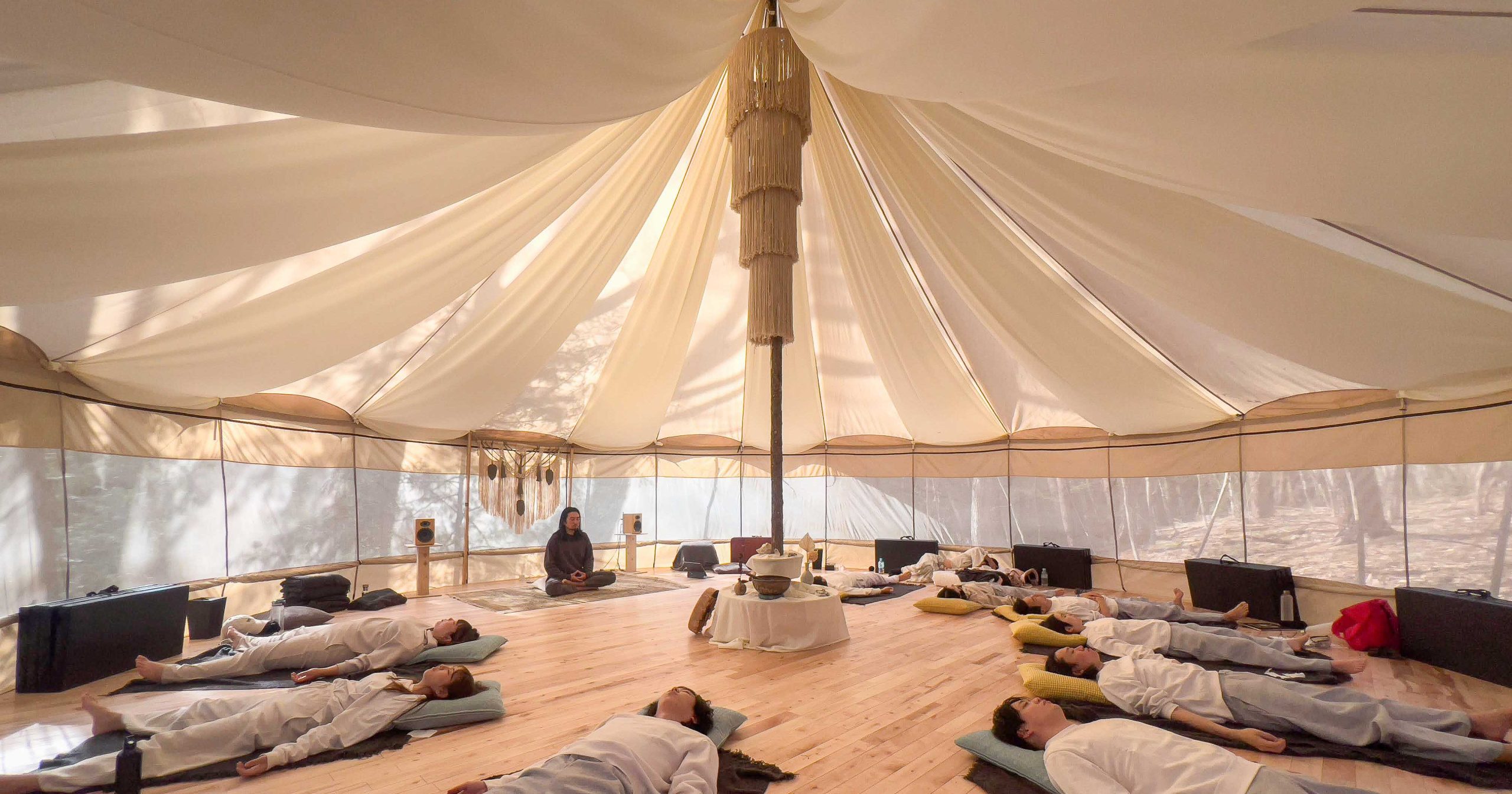
At nehan, we do not work with these repeated reactions—things you understand intellectually but keep finding yourself in—by simply adding more knowledge. Our two-night, three-day Journey to See the Flickering Images of Your Life, held in the forests of Yatsugatake, is a retreat designed to create distance from old response patterns through sound resonance, work with breathing, and bodily sensation in gradual stages. It is not simply a stay in nature to rest. We look at the process of stepping away from everyday alert mode, meeting emotions and memories again through the body, and carrying that experience back into daily life.
I do not think of retreat as healing through escape from reality. I think of it as a training ground for updating how we live inwardly. Repeating “I am okay” in your head does not easily stop yesterday’s alarm. Only when you touch body, emotion, and memory—and gain a little distance from your usual reactions—do everyday choices begin to change. Without working at that level, it is easy to be pulled back into the same responses the moment you return to your usual busyness.
If you experience strong palpitations, shortness of breath, chest pain, or symptoms that continue to interfere with daily life after beginning breathing practices, please do not try to carry it with breathing alone. There may be causes other than menopause. Choosing to consult a healthcare professional is not weakness; it is a practical choice.
Breathing can help. But do not make breathing carry everything. Even if you look at the clock on a sleepless night, even if you cannot manage a smooth exhale, you do not need to decide that your body is broken. Start with the next breath, and do not rush it quite so much. Some nights, that is enough.

FAQ
Q: How should I start breathing practice during a menopausal hot flash? A: You do not need to take a big inhale. Start by softening your shoulders and jaw, then letting your exhale run a little longer. Stop if you feel discomfort, dizziness, or tingling in your hands or feet. Keeping a record of symptom severity and frequency can also make it easier to explain what is happening when you seek support.
Q: How many minutes should I do it for? A: Rather than trying to do it for a long time and giving up, it is more realistic to use it briefly while waiting at the register, just after getting into bed, or at a red light. If staring at the clock makes you anxious, you do not need to insist on a certain number of minutes. Simply noticing that your breathing has sped up is an entry point.
Q: Are breathing practices and mindfulness the same thing? A: They are not the same. Breathing practice is a way of working with your physical state through breathing rhythm. Mindfulness is the practice of observing present sensations, thoughts, and emotions without judging them. Together, they can help you reframe a moment when symptoms feel overwhelming as, “A flush is here right now.”
Changing one breath does not have to carry your whole life. But you can create a path back to where the reaction begins—from the body side, too.
What comes next is how to meet the long-repeating tension, and the sense of “I understand, but I keep going back,” that so many people know. In our free online course, we share the sequence for working with layers that can be difficult to reach through everyday effort alone.
FREE PROGRAM
A doorway to seeing your life anew — through the body
Add us on LINE to receive the free online lessons — the parts we couldn’t fit into this article.
Free to join, unsubscribe anytime. This is not medical treatment; results vary by individual.
Sources / References
- Carpenter JS, et al. (2013). A 16-week randomized controlled trial of paced respiration and menopausal vasomotor symptoms involving 218 participants.
- A 2025 systematic review/meta-analysis on mindfulness-based interventions, menopausal symptoms, mental health, and quality of life.
- Deb S, Gurumayum S. (2021). A study on the combination of deep breathing and walking in postmenopausal women.
- Kawano et al. (2013). Report on the physiological and psychological responses to tactile care for menopausal women.
- Kato (2010). Report on warm compresses to the back of the neck, autonomic nervous system activity, and pleasant/unpleasant sensations in menopausal women.
This article provides general information and is not medical advice. Individual responses vary. If you have concerns about your health, please consult a qualified healthcare professional.