

Key Takeaways
What is a retreat for rethinking your life really for?
- A retreat for rethinking your life is designed time away from habitual reactions, not a place to force an immediate answer.
- When you overthink and cannot decide, stress responses, attentional bias, and predictions based on old memories may all be involved.
- When choosing one, look beyond the scenery: consider safety, the quality of dialogue, and support for returning to ordinary life.
Why do people search for a life-rethinking retreat when they are already exhausted?
Monday, 8:42 a.m. You are on a packed train, looking at your phone, when you remember the email you still have not answered. Or it is 11 p.m., and you stop halfway to washing the glass sitting in the sink.
“Is this really okay?” usually does not show up when life feels spacious. It tends to arrive when simply keeping things moving takes everything you have.
You have taken time off. You have travelled. You have talked to friends. Yet the sense that you are choosing your own life is still thin. On Sunday evening, looking at next week’s calendar alone makes your mood sink.
You open the unread-message thread again for no particular reason. I think that is when people search for “a retreat to rethink my life.”
Is not knowing your real self at the root of modern problems?
I genuinely think many modern struggles eventually come back to not knowing your real self. Work anxiety, difficult relationships, uncertainty about your path: they look different on the surface.
But when you lose sight of what you fear, what you want, and where you are pushing too hard, you begin building a life out of other people’s answers.
What Happens at a Retreat for Rethinking Your Life?

Is a retreat simply a trip where you change your surroundings?
A retreat for rethinking your life is an overnight program designed to take you intentionally away from everyday roles and information, so you can observe your thoughts, feelings, and bodily responses again.
Sightseeing is not the main event. You step out, for a while, from your job title, your role as a parent, and the feeling of being measured by how fast you reply—and ask, “What am I actually reacting to?”
It is Friday at 7 p.m. You have left the office, but Slack notifications keep sounding. You go to a café on Saturday afternoon, while rehearsing next week’s meeting in your head.
If that is your state, changing only the view means carrying the same conference room with you. Even with a forest outside the window, it is hard to rest if your manager’s voice is still reading minutes in your head.
Did you think this was just about staring blankly at beautiful scenery? Half right, half wrong. Scenery can help, but I think “go into nature and you will be fine” is only half true.
Forests and the sea are wonderful. Still, if you take photos and leave with the same urgency, the same reactions may restart on Monday. The environment is an entry point, not the change itself.
Do you need to decide whether to change jobs, leave a relationship, or move?
When people hear “rethink your life,” they often picture big decisions: Should I change jobs? Stay married? Move somewhere else? But what matters first is often the automatic reaction before the decision.
Your stomach tightens when your manager says, “Got a minute?” An unread message becomes proof that someone dislikes you. It is payday, but checking your bank balance feels frightening.
Small reactions like these can narrow a life more than we realize.
You want to change jobs, but close the job site as soon as you open it. You try to tell your partner what you really feel, then suddenly say, “Never mind.” That may not be weak willpower.
Sometimes the body has already decided that something is dangerous. Is there a subject you avoid before you have even begun thinking about it?
Cognitive biases in psychology can fix an interpretation faster than the event itself. Your partner only says, “I’m tired today,” and you read it as, “They do not enjoy being with me.” The brain dislikes gaps, so it uses past experience to manufacture a plausible meaning on the spot.
To you, that meaning can feel like fact. It is a tough mechanism—like watching only a drama’s preview and deciding the ending.
Why can delaying a decision be the practical choice?

I understand the urge to ask, “So what are you going to do?” A calendar full of plans feels safer than empty space. It is like standing in an electronics store, looking at comparison charts and wanting the mark that says which option is correct.
But life uncertainty often cannot be settled with a specs comparison.
A parent or colleague asks, “You still haven’t decided?” and you reply, “I’m thinking about it.” Then, on the way home, you buy a sweet from the convenience store that you did not need.
When you are making small escapes like that, a grand declaration is often not what you need. It may be faster to see what you are escaping from.
A retreat may not hand you a conclusion. It may soften the tension that was making you rush toward one. “I want to quit” can become, “What hurts is that I cannot say no at this workplace.” When the shape of the problem changes, so can your next action.
It is not dramatic, but it is a turning point. Not rushing an answer is not avoidance; it is a very practical way not to define yourself carelessly.
Why Can’t Your Mind Switch Off, Even When You Rest?
Why does stress make worst-case scenarios feel so convincing?
When intense demands continue, the brain and body prioritize preparing for danger. Research suggests that heightened stress-related hormonal and nervous-system responses can increase attention to immediate threats, while making broad consideration and emotional regulation—functions associated with the prefrontal cortex—more difficult.
That is why, when you want to think calmly, only the worst cases may come to mind.
It is Sunday, 10 p.m. You are only putting out clothes for tomorrow, and thoughts start chaining together: “What if I freeze in the meeting? What if my evaluation drops?” While folding laundry, you are worrying about a failure months away.
This is not laziness or a character flaw. For a brain in alert mode, it is a fairly logical response. It is hard to focus on reading in a building where the fire alarm is ringing.
Many people say, “I know it is not a big deal in my head.” Exactly. Understanding something intellectually and the body’s alarm system are separate tracks.
Your neck is tight even though no notification has sounded; your breathing gets shallow before you open an email. It may not feel impressive, but it is not unusual.
Your body simply has not finished work yet.
Why does trying not to think about work usually fail?

People who overthink are often told, “Just do not think about it.” But tell yourself not to picture a white bear, and a white bear appears. It is known that attempts to suppress a thought can make it more persistent, because you need to monitor the thing you are trying to suppress.
At lunchtime, choosing an onigiri at the convenience store, you decide not to think about work. At the register, you start wondering about a number in the document you sent a client.
On the way home, you reopen an email you already sent. Your mind seems not to follow orders, but it is actually keeping watch over “work” the whole time. The brain is strangely diligent.
Telling yourself, “I am bad at switching off,” adds another log to the alert system. I do not recommend trying to erase thoughts. What helps is not forcing thoughts out, but changing the state in which they are happening.
Breathing, sound, bodily sensation, and contact with a person who feels safe may help loosen attention from one fixed point. Before arguing with the content of a thought, create conditions in which you are less likely to be swept up in it.
How do old memories shape the future you expect?
The brain does not simply store the past; it uses the past to predict what comes next. If an experience of being criticized after sharing an opinion remains strong, your body may contract just before speaking in a meeting.
Even if your current manager is not that person, the brain may get ahead of itself: “This could be dangerous again.”
At 9:55 a.m., your finger feels heavy over the button to join an online meeting. No one has said anything yet, but your throat is dry and you want to turn off the camera.
That is less a prediction of the future than past learning reading the present. A single old failure gets carried into every meeting. The brain may think it is being helpful, but it is exhausting to live with.
Rethinking your life can mean noticing this prediction without blaming it, and recovering room to ask, “Is the danger truly the same now?” Many life dilemmas may not come from having no choices.
They may come from the body shrinking before a choice is even made. In which situations does your breathing become shallow?
POINT
What comes first in time set aside to rethink your life is not a grand life plan. It is noticing the daily reflexes: what you react to, avoid, and rush. A little distance from those reflexes can change how your options look.
FREE PROGRAM
A doorway to seeing your life anew — through the body
Add us on LINE to receive the free online lessons — the parts we couldn’t fit into this article.
Free to join, unsubscribe anytime. This is not medical treatment; results vary by individual.
What Should You Look for Before Choosing a Retreat?
Should you choose by the number of days, or by what is actually designed?

For rethinking your life, options vary widely: stays centered on yoga, meditation, dialogue, creative work, fasting, hiking, or hot springs. The question is not which is superior, but whether it fits the problem you are carrying now.
Someone who needs distance from work information and someone who wants to examine a long-repeating relationship pattern may need different settings.
If “I am tired and need rest” is central, a stay with plenty of room for sleep, meals, and walks may fit. If “I do not know what I feel” is central, a setting with time to put things into words and guided support may be worth considering.
There is nothing wrong with taking photos of a breakfast buffet and calling it a trip. But if you want to touch a life dilemma, check what the program is for.
The booking page is beautiful, and the reviews all say, “It was amazing.” It is easy to want to book. But pause and ask, “Amazing in what way?” Do you need to recover from fatigue, see your reaction patterns, or rest without explaining yourself to anyone?
Choosing without a clear purpose can be like picking a restaurant for its atmosphere when you are hungry.
When I choose, I look for the following:
- Does the organizer clearly explain what the program aims to do?
- Are participants protected from having to speak or display emotion before they want to?
- Does the program consider not only the stay itself, but reconnecting with everyday life afterward?
- Is there someone you can consult about your health, medication, or psychological concerns?
Why can chasing a profound experience leave you lost at home?
It is tempting to think one intense, out-of-the-ordinary experience will move your life. I understand that. But I do not think collecting profound experiences is the point.
You leave a festival thinking, “Tomorrow I will become a new person,” then sit silently in the same meeting by Tuesday at 3 p.m. That does not mean the feeling was insufficient. It means daily circuits are strong.
When you return home, you open the usual front door, see the usual laundry, and receive the usual notifications. Your reactions can return easily in that moment, because habits and responses tend to solidify through repeated use in the same situations.
Some people feel work mode return the instant they unlock their front door. So look not only at what you felt during the stay, but at small changes afterward: Could you pause once when irritated? Could you say no?
Life is made on Tuesday evening, more than through dramatic declarations. It is plain, but true. Before automatically returning a work call at the convenience store, you take one breath.
Instead of reflexively saying yes to a request, you say, “Let me check and get back to you.” Small differences like these can become differences in how you live a few months later.
Why does nehan use a two-night, three-day format?
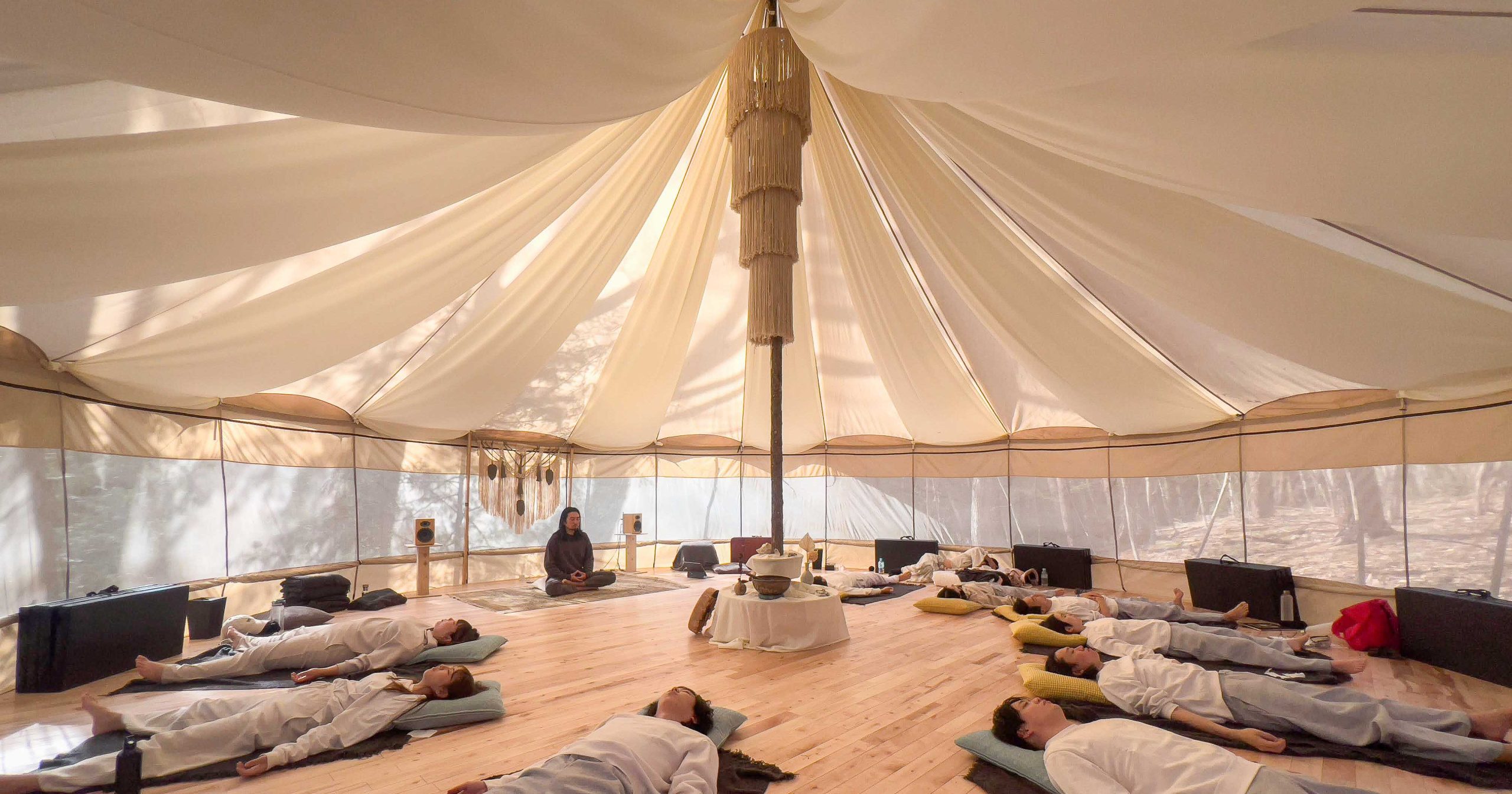
nehan’s Journey to See Your Life Flash Before Your Eyes, held in the forests of Yatsugatake, is a two-night, three-day retreat. It is a staged experience using sound resonance, breath-based practices, and bodily sensation to create distance from feelings and old reaction patterns that can be difficult to reach through everyday thinking alone.
We use two nights and three days not to send people home quickly with a conclusion. In daily life, roles and schedules push us toward the next action before we can notice our own responses.
Slowing down in a safe place, easing the body’s vigilance, catching feelings that were hard to put into words, and carrying that into daily choices: that order matters.
We do not aim to produce an answer from the beginning. Skip the sequence, and the head runs ahead on its own. What each participant receives differs, but approaching the body can sometimes create an opening in the feeling of “I know, but I still cannot move.” If you have understood something for years yet stop at the same point, I hope you will not treat this order casually.
Step away from everyday alert mode
Slow the pace of work and roles for a while, making the body’s responses easier to notice.
Create distance from old reactions
Do not judge feelings or memories as right or wrong; notice patterns that are narrowing your choices now.
Connect the experience to choices after returning home
Do not rush a major decision; cultivate small differences in conversation and work.
Why Is Thinking Alone Sometimes Not Enough?

Why do you return to the same conclusion even after journaling?
Journaling, meditation, and walking have value. Still, I do not think that simply increasing time alone will produce an answer. When you think alone, you use your usual thinking habits to inspect your usual thinking habits.
It is a slightly strange structure. If the ruler itself is bent, it is hard to know whether what you measure is straight.
At 9 p.m., you write, “What do I really want?” in a notebook. A few minutes later, the familiar objections line up: “But the mortgage,” “I will inconvenience people,” “It is too late now.” Writing can reveal things, but as long as the vigilant mind keeps chairing the meeting, the participants tend to be the same people.
You may have filled a notebook with thinking and still returned to the usual conclusion. That does not mean you are bad at writing. It may simply mean that the parts of you that do not want to fail or inconvenience anyone have grabbed the microphone first.
The value of a retreat is not getting a correct answer from outside. It is letting the usual chairperson rest a little, through a setting and the presence of other people.
When is deciding not to go to a retreat the wiser choice?
A retreat may fit better as an appointment to treat yourself carefully than as an escape route. Perhaps severe sleep deprivation has continued, strong anxiety is making daily life difficult, or you have concerns about medication or a health condition.
In those cases, it is worth speaking with the organizer or an appropriate professional first, and choosing what is manageable.
There may be nights when you think, “I am this exhausted; I need to do something big.” But booking in a rush can resemble buying shoes that do not fit during the final hours of a sale.
You are pleased when they arrive, then do not wear them the next week. Checking the format and timing that suit you may look like a detour, but it is more honest.
Going is not the only form of progress. Being able to say, “Medical care or rest may need to come first for me,” is also a real result of looking at yourself.
It defeats the purpose to search for a place to change your life and push yourself harder once you get there. Choosing what fits your present state may be modest, but recovering that sense is already the beginning of rethinking your life.
FAQ
Q: Is it okay to join a retreat for rethinking your life on my own? A: It is not unusual to come alone. In fact, solo participation can suit people who want to step away from their usual roles.
Checking the organizer’s safety measures, the amount of dialogue involved, and whether rooms are private or shared in advance can help reduce tension on the day.
Q: Can I return home without an answer? A: Yes. An immediate conclusion is not the only valuable outcome. If you can put words to what hurts or what you were rushing, the ground from which you think in daily life can change.
Some people find that their insights settle into place after returning home.
Q: What is the difference between a retreat and solo travel? A: Solo travel is appealing because of its freedom. A retreat differs in that the environment, flow of time, and connection with guides or other participants are designed around a purpose.
If you want to work with reactions that are difficult to access by yourself, the latter may be an option.
You do not need a grand declaration to rethink your life. It is enough to start by learning what has been driving you so hard.
At nehan, we offer a free online class for people who have reached a dead end trying to think their way to an answer. We talk about what a two-night, three-day journey works with and how it can be carried back into everyday life.
You can also use it to check the actual design and what to know before participating.
FREE PROGRAM
A doorway to seeing your life anew — through the body
Add us on LINE to receive the free online lessons — the parts we couldn’t fit into this article.
Free to join, unsubscribe anytime. This is not medical treatment; results vary by individual.
Sources/References
- McEwen, B. S. “Protective and Damaging Effects of Stress Mediators.” *New England Journal of Medicine*, 1998.
- Arnsten, A. F. T. “Stress signalling pathways that impair prefrontal cortex structure and function.” *Nature Reviews Neuroscience*, 2009.
- Wegner, D. M. “Ironic processes of mental control.” *Psychological Review*, 1994.
- Brewer, J. A. et al. “Meditation experience is associated with differences in default mode network activity and connectivity.” *Proceedings of the National Academy of Sciences*, 2011.
This article provides general information and is not medical advice. Results and experiences vary. If you have concerns about your physical or mental health, please consult an appropriate professional.