

What This Article Covers
- Two nights and three days is designed to help you step out of everyday alert mode and feel your own reactions again through the body. A mind that was chasing work notifications until Friday evening does not switch off the moment you check in. That is the starting assumption.
- When breath, sound, sleep, and a natural setting are combined, the circuits that keep the mind thinking may soften somewhat, making old feelings and beliefs easier to observe. This is not about forcing yourself not to think.
- A deep experience only gains value when you know how to handle it on Monday after you return home. How will you reply to that chat message on Monday morning? In the end, that is where change shows up.
Can two nights and three days create distance from everyday reactions?
You may be wondering, “What can really change in two nights and three days?” It is a fair question. Work anxiety, tension with your partner, and your credit-card bill will still be waiting when you get home.
Even the vegetables in the fridge will not wait for your self-reflection.
The point is not to erase your problems. It is to create a little distance from the self that reacts automatically. At 9:12 on Monday morning, you see a message from your boss: “Please revise the document.” Before you have even read it properly, your stomach tightens.
A retreat can restore enough room to notice that automatic response.
Have you ever had someone speak in a perfectly ordinary tone, yet somehow felt blamed—and then found your fingers frozen over the reply box? The issue is not just one chat message.
It is the familiar reaction that starts inside your body when that message arrives.
Why is three days not too short for this kind of work?
I think a surprising number of modern problems eventually lead back to not knowing your real self. Should you change jobs, end a relationship, try harder?
We rush toward answers before we can see what we fear or what we want. I do not think that is the right order.
Two nights and three days will not solve life’s problems by magic. But it is not too short a period for stepping slightly out of the self that has been swallowed by those problems. That small shift can matter.
Why One Night of Rest Often Isn’t Enough to Reset

Why does the brain replay a familiar state, not just familiar thoughts?
People often say that worries can be resolved by learning the right way to think. I do not see it that simply. Knowledge matters, but there are moments when you understand, intellectually, that you do not need to worry so much—and your body still contracts first.
The brain is highly energy-efficient. It quickly predicts danger or safety and reuses responses it has relied on many times before. In predictive coding, the brain is understood to anticipate and assign meaning based on past experience rather than simply receiving outside events as they are.
If the brain judged every moment from a blank slate, it would probably run out of battery. That efficiency is useful, but it can also make life hard.
When a reply is late, one person thinks, “They must be busy,” while another checks their phone for hours, thinking, “Maybe they dislike me.”
At 10:30 p.m., while brushing your teeth, you pull down the notifications again and again. There is nothing new to see, but you open them anyway. You may know the experience of reopening an unread chat screen for no real reason.
The problem is not only the other person’s reply. The brain may be replaying an old warning: “I might be left behind in situations like this. Prepare first.” The other person may simply be in a meeting, while your body has already sounded the alarm.
A short break can make it easy for the brain to return to familiar predictions as soon as work sounds and notifications disappear. You may have rested a little on Sunday night, yet wake up Monday morning with the same anxiety.
That is not weak will. It is one reason time is needed to change not only the environment, but the state of the body.
How can breath and body sensation reach vigilance before words do?
Several research reviews have reported associations between slow breathing, heart-rate variability, and measures of autonomic nervous system activity.
Breath is not a verbal attempt to persuade yourself to calm down. It may be an entry point for reassessing present safety from the body’s side.
This is not just a mindset exercise. Imagine dropping coins from your wallet at a convenience-store register while people line up behind you. Your face gets hot and your hands shake.
Thinking, “I should not care what people think,” is unlikely to convince your body.
The sound of a ten-yen coin rolling across the floor seems unusually loud, and you rush to pick it up. Rational thought and bodily vigilance can run separately.
When breathing stays shallow, threat-detection networks including the amygdala may continue signalling, “Hurry up. It is still dangerous.”
Words alone have limits. If you are repeating “I’m okay” while your shoulders are up near your ears, your body is clearly not convinced. Spending time with the breath can make it easier to notice shoulder tension, a blocked throat, or coldness in the pit of the stomach before the prefrontal cortex has assigned those sensations an emotional story.
That is when “I am angry” may become “Maybe I am scared and protecting myself right now.” It may sound small, but it is a major difference. Can you notice your jaw tightening just before you snap at your partner?
Can you see uncertainty beneath what you thought was anger when someone disagrees with you in a meeting?
The goal is not to eliminate reactions. The goal is not to hand them the driver’s seat completely.
Why do two nights of sleep matter after a meaningful experience?

There is a reason a two-night, three-day retreat includes two nights. Sleep is linked to memory organization and emotional processing, and may help carry information gathered during the day into the next day.
You do not need to turn what surfaced on day one into a polished conclusion right away. Sometimes it is better not to.
At night away from home, you may lie down and remember a conversation from earlier that day: “I was strangely angry then.” Without the white glare of fluorescent lights or the washing machine’s end signal, your own breathing may be the main thing you hear.
The next morning, the same memory may not feel as sharp.
You probably know this: you felt fine during the day, then just before sleep realized, “Maybe that one comment actually hurt.” Feelings do not arrive neatly, like minutes from a meeting. They come late, and often out of order.
Many people want to organize an insight into three lines in a notebook that same day: “This is who I am, and this is what I will do from now on.” When you reread it later, it often sounds slightly self-important.
What remains after giving it time is usually more ordinary.
Two nights let the excitement or resistance of day one pass once, then allow you to look at the same sensations again the next day. That is why it serves a different purpose from a one-night break.
What Can You Bring Home From a Two-Night, Three-Day Retreat?
What tends to happen on the first day of a retreat?
On the first day, everyday speed is still in the body. Even after arriving, part of your mind is tracking unanswered emails, the tofu left in the fridge, or your child’s changing schedule.
Being in nature does not suddenly make you empty-minded.
At first, some people become noisier in their heads: “I came all this way and feel nothing,” or “I made time for this, so why isn’t it working?” If you have spent years conscientiously keeping work and home running, you may even wonder whether you are resting properly.
When everyone else looks calm, you may feel left behind. That is not failure. It simply means the part of you that works hard is still out in front.
The brain has a default mode network that moves through your past and future when you are not focused on a task. Thinking itself is not the enemy. But on days when rumination is strong, this network can replay the same story endlessly.
It is the 10 p.m. kitchen scene: dishes in front of you, and you start replaying, alone, “They should not have said it that way.” It can look like problem-solving, but sometimes this replay only deepens the same emotional groove.
So day one is not about becoming positive or emptying your mind. It is a day to feel, first, how fast you have been running. It is unglamorous. But if you skip it and demand only the deepest part of day two, the mind usually gets ahead of you.
What may surface on the second day when usual thinking softens?

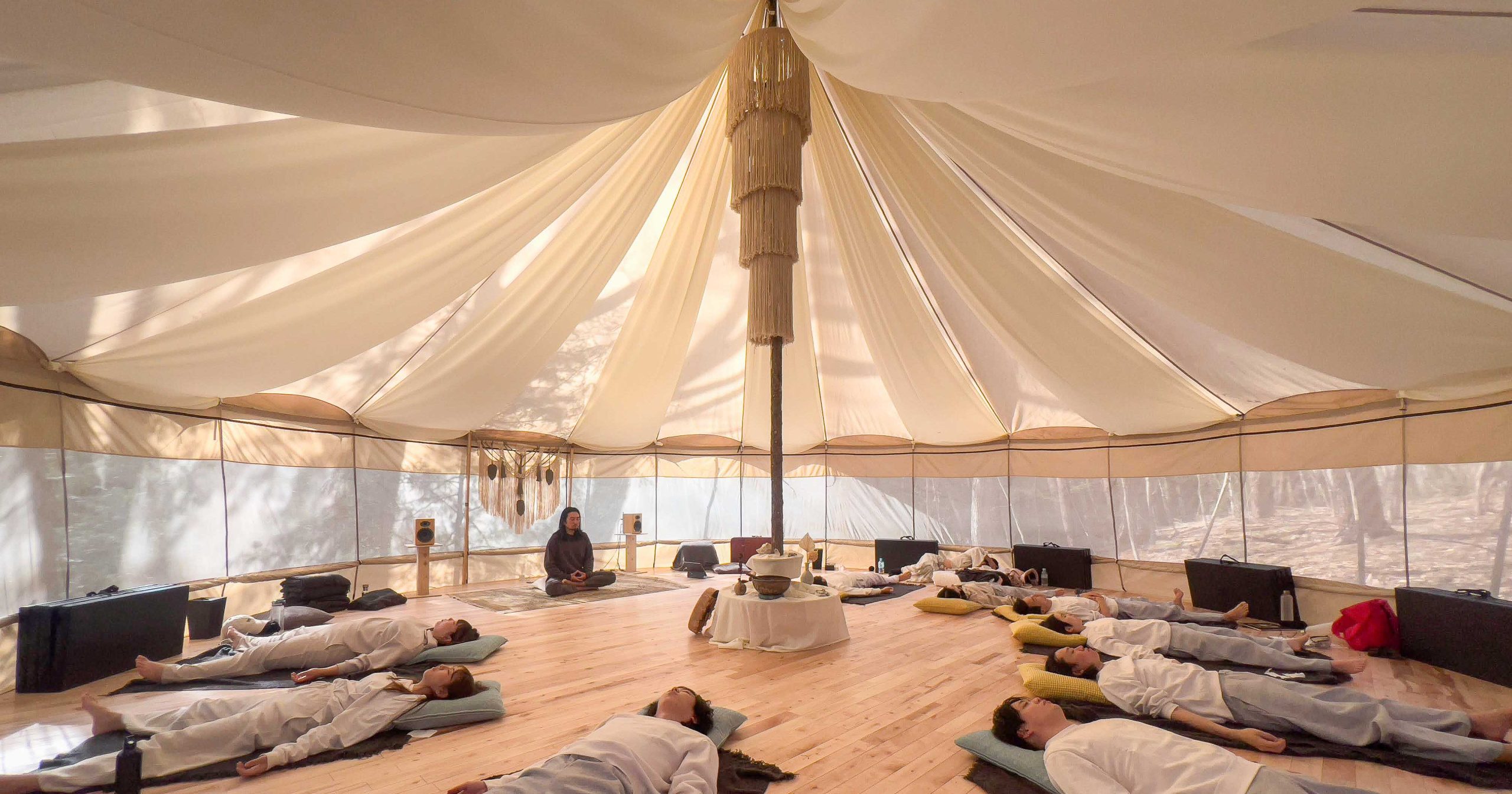
In nehan’s *Journey to See Your Life Flash Before Your Eyes*, we spend two nights and three days in the forests of Yatsugatake, gradually combining sound, work with the breath, and attention to bodily sensation.
We do not share every method here. The aim is not to become positive through sheer effort.
The aim is to create conditions where feelings and long-repeated reaction patterns that are hard to reach through ordinary thought can be viewed from a little distance.
On the second day, anger, sadness, or an odd tension may suddenly appear without an explanation you can easily give.
You may wonder, “This should not be such a big deal—so why is it catching on me?” It is time to look at a feeling you would normally overwrite by opening your calendar or messaging someone, rather than clearing it away immediately.
Theta waves are one type of brainwave observed around the transition into sleep and during deep relaxation. But this is not a simplistic claim that a particular brainwave can transform your life.
Brainwaves are one way of measuring a state; they are not a score for the value of an experience.
Let me be clear: selling the idea that you will change just by knowing the name of a brainwave is wrong. “Theta waves” is a useful label, but a label cannot live your life for you.
What matters is how you can observe reactions that have been automatic until now while in that state.
Are you thinking, “Isn’t this just another vague spiritual idea?” Honestly, that caution is healthy. Pleasant-sounding words do not make real difficulties disappear.
So rather than focusing on whether you cried or saw images, notice whether the words you use to blame yourself arrive one beat later after you return home.
When your child spills juice, is there one breath before “Come on!” comes out? That is where a practical difference appears.
Loosen everyday tension
Do not try to stop your mind from spinning; notice again the signs of vigilance your body is giving you.
Meet deeper reaction patterns
Feel into anger, anxiety, or habits of endurance that have been difficult to explain through logic.
Connect the experience to daily life
Turn what you notice away from home into small choices you can use in conversations at work or with family.
What is the purpose of the third day?
The third day does not require a grand declaration. It requires a marker you can reproduce in ordinary life. You get home to cardboard boxes by the entrance and unfolded laundry.
In a situation where you once might have exploded with, “Why am I the only one doing this?”, you drink water before choosing your first words.
Small, yes. But everyday life is often decided by that first sentence—whether things become tangled or not. You have probably had the experience of knowing three seconds after speaking that you should not have said it.
Being able to work with those three seconds changes life more than a dramatic life plan. I genuinely believe that. The more dramatically we talk about change, the more everyday life gets left behind.
I think the promise that you will be reborn in two nights and three days is half a lie. Rather than being reborn, you return: return to a sense you already had, then make it usable on Tuesday morning.
That is harder, and it is far more valuable.
The brain tends to return to familiar reactions. From the perspective of predictive coding, one new experience does not completely erase old predictions.
Day three is not for maximizing emotion; it is for deciding what you will not overlook when you get home.
Bring back a marker: “My shoulders are up again,” or “I am rushing to a conclusion again.” It is ordinary, but without this, the retreat remains only a weekend event.
FREE PROGRAM
A doorway to seeing your life anew — through the body
Add us on LINE to receive the free online lessons — the parts we couldn’t fit into this article.
Free to join, unsubscribe anytime. This is not medical treatment; results vary by individual.
The Reality of a Two-Night, Three-Day Retreat Before You Apply

Why can expecting a deep experience make your mind busier?
If you arrive braced for “I have to feel something” or “I have to bring home the answer to my life,” the brain enters evaluation mode. Attention then gets pulled away from bodily sensation and toward comparison: “Other people are crying, and I feel nothing.”
It is a little like watching the runner beside you during a school endurance run until you lose your breath. This happens more often than you might expect.
You leave ordinary life, only to begin a new assignment: “Am I doing this retreat correctly?”
Conscientious people are especially likely to do this. If you have ever wanted to organize a trip perfectly as if it were a work project, you can probably imagine it.
The depth of an experience is not measured only by tears or dramatic events.
Maybe you looked at an unread screen after returning home and did not immediately send another message. Maybe someone disagreed with you in a meeting and you noticed your jaw tightening.
Those changes do not photograph well, but they can have a real effect on daily life. Writing “photograph well” here makes me sound a little ordinary myself, but it is true.
Cognitive behavioral therapy also separates the event itself, how it is interpreted, and the action that follows. What may happen in two nights and three days is not that events disappear.
It is that a little space may emerge between the usual interpretation and action when a reply is late, someone disagrees with you, or the house is messy.
With that space, other choices become possible: not sending the follow-up message, stepping away before shouting, or leaving a conclusion until the next morning.
The wall of rushing toward an answer
When you decide, “I will reach a conclusion in these three days,” the mind starts grading before you can feel.
The wall of seeking only the extraordinary
When only intense stimulation is valued, small changes after returning home are easier to miss.
The wall of carrying it alone again
When you return to the same environment and put no words to the experience with anyone, old reactions can more easily regain the upper hand.
What practical and health considerations should you check first?
Making space for two nights and three days is not easy just because you want it. There are remaining vacation days, caregiving or childcare arrangements, food for the pet, and the train home.
Looking honestly at your actual life before applying does not mean you lack commitment. It means you are not treating yourself carelessly.
You may think, “Should I go even if I have to push myself?” But there is no need to turn pushing through into a virtue. If you pack in work until late the night before departure, then come home to all the household load immediately returning to you, it is worth considering that whole design.
Make your decision by looking not only at the days of the retreat, but also at the reality before and after it. I think that is the more honest approach.
If you have concerns about your health, or are in ongoing consultation with a medical provider, tell the organizers in advance and consult a qualified professional as well.
A retreat is not a substitute for medical advice. Creating a safe setting comes before creating an atmosphere. It may sound like a formal disclaimer, but it is not right to ignore your body and push on because “I already signed up.”
Trying to arrange your inner life while your body is saying no gets the order backward. Only with safety can you lower vigilance a little and look at yourself.
POINT
The value of two nights and three days is not escaping everyday life. It is becoming more able to choose your response after you return to it. Rather than whether the experience was dramatic, compare what you would have done before with what happens one week later.
What nehan Puts Into Two Nights and Three Days

Is the Journey to See Your Life Flash Before Your Eyes simply a vacation stay?
*Journey to See Your Life Flash Before Your Eyes* is a two-night, three-day retreat in the forests of Yatsugatake. Through sound, breath, and attention to bodily sensation, it invites you to revisit your reaction patterns from a state of awareness that differs from the usual one.
It is not simply a chance to rest somewhere with a beautiful view.
Built on attention to safety, it is designed as an active process of turning inward. Retreats are sometimes understood as vacations spent relaxing in nature.
There is nothing wrong with that, but it is not all that nehan offers.
I see retreat not as escapist healing, but as a training ground for updating one’s inner life. The place you can reach by resting is not always the place that is difficult to reach through ordinary thinking.
We do not push you to decide whether to quit your job, divorce, or become someone else while you are away. Decisions made when feelings are running high can look different by the following Tuesday.
But the experience may create an opening: distance from the borrowed answer that comes out the moment someone asks, “What do you really want?”
What you choose after that is something you develop in your own daily life. You may say you want stability when what you really want is recognition. You may say you want more freedom when you are simply afraid of being hurt where you are now.
This is not an accusation. When we make major life decisions with borrowed words, a mismatch often appears later. That is why we need to know our own reactions first.
Who may benefit from more than another piece of knowledge?
You may have read enough books and watched enough videos. You may have tried cognitive behavioral therapy ideas, meditation, and journaling. Yet after a call from your parent, you suddenly snap at your child.
You understand it in your head, but your body moves first.
For someone who knows that feeling, there should be an option beyond adding one more book of knowledge. I do not mean to dismiss knowledge. Cognitive behavioral therapy and meditation can both be useful.
But even when you can label something as an automatic thought, the speed at which your stomach tightens and your voice becomes sharp may not stop. Understanding something with your mind and having your life change are different things.
When body, feeling, and memory are touched, the flow of reaction can begin to change. I will say that plainly.
- People who repeatedly feel similar anger or anxiety in the same kinds of relationships
- People whose work never stops in their mind, even while resting, and who feel rushed on Sunday evening
- People for whom “I have to do it properly” has become a reflex, and who no longer know what they want
- People who want to check in with a sense that is not someone else’s right answer before making a major decision
What about you? On Sunday evening, does simply thinking about tomorrow’s schedule make your stomach feel heavy? Do you meet other people’s expectations, but suddenly have no words when someone asks what you want?
If that sounds familiar, it is not indulgence or weak will. It is okay not to have an answer yet. At the very least, you can step down from blaming “I want to change but cannot” on weak will.
Two nights and three days is not time for turning you into someone else. It is time to properly look again at the self beneath your usual reactions.
FAQ
Q: Can everyday reactions change in only two nights and three days? A: People experience change differently. Two nights and three days may be an entry point for noticing reaction patterns and feeling alternative choices in the body.
What environment you return to, and how you work with what you noticed, also changes how it lands.
Q: Can I participate without experience in breathwork or meditation? A: This is not a place to compete over how much experience you have. The retreat is facilitated so that first-time participants can take part, but please tell the organizers in advance about your physical condition or any concerns.
There is no need to force a deep experience.
Q: Is it okay to make a major decision immediately after participating? A: Your perceptions may feel fresh just after the retreat, so we recommend observing them in everyday life for several days to a week first.
Notice whether the feeling remains on a crowded morning train, over dinner with family, or in front of a work email. That can make it easier to distinguish an impulse from a genuine wish.
What happens during the two nights and three days, and why do we combine breath and sound? We cover the fuller picture—not just a surface explanation—in our free online course before you participate.
This is especially useful if you are someone who wants to understand something before acting. Take your time to see whether it is the right setting for you.
FREE PROGRAM
A doorway to seeing your life anew — through the body
Add us on LINE to receive the free online lessons — the parts we couldn’t fit into this article.
Free to join, unsubscribe anytime. This is not medical treatment; results vary by individual.
Sources/References
- Zaccaro A, et al. “How Breath-Control Can Change Your Life: A Systematic Review on Psycho-Physiological Correlates of Slow Breathing.” *Frontiers in Human Neuroscience*, 2018.
- Raichle ME, et al. “A default mode of brain function.” *Proceedings of the National Academy of Sciences*, 2001.
- Walker MP, van der Helm E. “Overnight therapy? The role of sleep in emotional brain processing.” *Psychological Bulletin*, 2009.
- Barrett LF. “The theory of constructed emotion: an active inference account of interoception and categorization.” *Social Cognitive and Affective Neuroscience*, 2017.
This article provides general information and is not medical advice. If you have concerns about your health, please consult a qualified professional. Individual experiences and results vary.