

Key Takeaways
- When choosing a retreat at a turning point, look beyond luxury to whether its design helps you step back from your current patterns of reaction.
- The right setting differs depending on whether you need a change of pace or want to revisit a long-running uncertainty or tension.
- Checking operational safety, the stages of the experience, and support after returning home can reduce the gap between expectation and reality.
Is a retreat at a turning point about changing your surroundings?
Choosing a retreat at a turning point is not simply about seeing unfamiliar scenery. It is about placing yourself somewhere your usual automatic reactions can loosen, even slightly.
Get that wrong, and you may stay in a beautiful hotel, eat well, take photos—and still return to the same struggle on Monday.
Travel is not the problem. A trip and time spent reconsidering how you move through life can look similar, but they are not the same thing. You may be wondering whether to change jobs.
After a breakup, your apartment may suddenly feel too large. You may have started worrying about your parents.
At times like these, the same meeting runs in your head for days. You are the chair and every attendee, and no conclusion ever comes. Have you ever had that?
The same question returning while you brush your teeth or wait in line at the register.
Why does stepping outside daily life sometimes help?
At 7:42 on a Monday morning, leaning against the door of a packed train, you think, “Is this really okay?” Then you arrive at work: chat messages, meetings, a convenience-store rice ball for lunch.
By evening, you have forgotten that you had the thought at all.
Daily life has a force that keeps us from thinking things through. Laundry piles up, replies arrive, and dinner needs deciding. That is exactly why stepping outside it can matter.
Still, I do not agree with the idea that changing your environment is enough to change a person. Scenery can be a prompt, but it cannot make decisions about your life for you.
What matters is creating a little space between your reflex and yourself in moments when you would normally answer immediately.
Should you begin by deciding who you want to become?
You do not need to declare that you want to become a new person before looking for a retreat. Start by naming what you may be reacting to too strongly.
Is it a short reply from your manager that makes your stomach sink? Is it being unable to stop watching videos once you get home? Is it searching for someone else’s right answer whenever you need to decide?
“I want to change myself” sounds admirable, but the phrase can be too big. What you need may not be a personality overhaul. It may be asking, “Why do I become this unsettled just because they have not read my message?”
You probably know this: opening the chat screen repeatedly late at night and rereading the last message you sent. If you ignore the reaction happening there and try to leap straight toward an ideal self, it usually becomes painful.
A popular inn or impressive nature may make for a satisfying trip, yet the old circuit can return at Shinjuku Station on the way home. The sunrise in the brochure is less real than the version of you opening an email after you return.
What Happens in the Brain When Life Seems to Need a Turning Point?

Is a turning point one decisive day or a change in your options?
I think a turning point is not one dramatic day of finding the answer. It is a period when another option becomes available in how you respond to the same event.
Someone who cannot say no sees a request email and, instead of replying at once, makes a cup of tea first. It looks small, but the direction can change there.
At 10 p.m., standing in front of a sink full of dishes, your partner says, “Can you help?” You feel a jolt. Where you once had two options—say nothing or speak harshly—you can say, “I feel blamed right now.”
Turning points begin in seconds like these, before you rewrite the signboard of your life. You may wonder what a few seconds could possibly change. Fair enough.
But when you have lived on reflex for a long time, those seconds are significant—like a car that has finally been given brakes. The destination does not change immediately, but you can turn or stop.
Why does ongoing tension make familiar answers feel safer?
When we perceive threat or strain, vigilance systems involving the amygdala become active, and the body tends toward sympathetic nervous system dominance.
Heart rate rises, breathing becomes shallow, and the prefrontal cortex has less room for planning and flexible appraisal. In a genuinely dangerous situation, this is a reasonable response.
The problem is when every work notification or unread message begins to be treated as danger. At 3 p.m., your manager writes, “Can we talk later?” It may only be a scheduling question, but your brain hurriedly searches through past mistakes.
You get home, leave your phone face down, and still cannot quite taste dinner.
That is not weak will. It is a brain habit of rushing to predict. From the brain’s perspective, finding what hurt before and preparing early is part of its job; it is not trying to make your life difficult.
But if the alarm keeps sounding when there is no fire, it drains the capacity to think clearly. When the body has remained on alert, the brain is more likely to choose a familiar answer than a new one.
Why can understanding something still leave the reaction in place?
You can understand that you should not overthink and still have your body freeze first. Memories with emotion often remain linked not only to the story of an event, but to a tone of voice, a smell, posture, or the tightening in your upper stomach.
There are moments when sound advice alone cannot reach an old reaction.
You look at a crowded calendar, your shoulders lift, and you do not notice your coffee has gone cold. Your mind says, “Calm down,” while your finger refreshes notifications.
It is not especially graceful, but it is not unusual either. Cognitive understanding and vigilance held in the body do not change at the same speed.
I do not believe the self-help idea that correcting your thinking solves everything. Knowing something with your head and having your life change are different things.
When bodily vigilance comes down, and emotions and memories can be handled without rushing to tidy them away, a new perspective can finally enter. If you have gathered plenty of knowledge and still stumble in the same place, you do not need to blame yourself.
POINT
When choosing a retreat, do not only ask whether you will hear deep stories. Ask how the overall experience is designed to help a tense body feel safe and to let you look at emotion and memory without rushing toward a conclusion.
Three Criteria That Are Easy to Miss When Searching for a Retreat
Which type of retreat fits your purpose and current capacity?
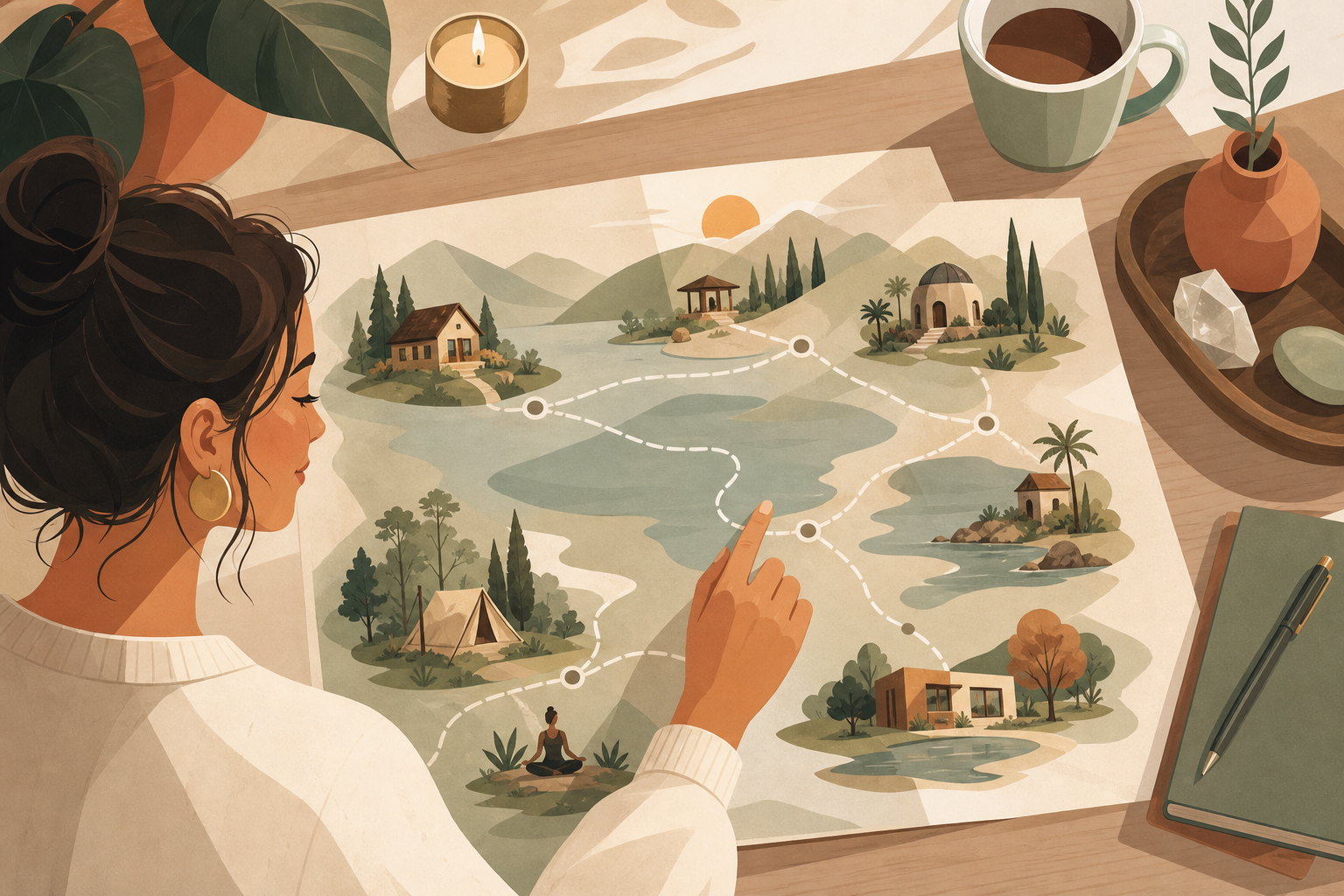
Retreats include those centered on yoga and meditation for deeper rest, those that restore the senses through activities in nature, and those that work with life themes through dialogue and reflection.
None is inherently better. Start with what you need now and the level of intensity you can actually hold.
On Friday night, you browse booking sites and think, “Morning yoga by a waterfall sounds nice.” But if what you really want is to sort through the resignation you have kept postponing, look beyond exercise schedules and meal photos.
Check whether there is time for reflection and whether someone will accompany the process. The dappled sunlight in brochures tends to look good everywhere.
On the other hand, if you are not sleeping, your meals are irregular, and you have no energy for deep conversation, you do not need to force yourself into a heavy life theme.
Rest may be the right fit first. Wanting an experience powerful enough to change your life makes sense, but someone who is exhausted may need not an extraordinary experience, but two nights of proper sleep.
For people who need rest
When sleep deprivation or information fatigue is high. A stay with little scheduling may fit well.
For people who want to restore their senses
When you need distance from screens and work, and want to use your body by walking, making, or eating.
For people who cannot decide
When you want to revisit a life crossroads or recurring relationship patterns through dialogue and reflection.
For people seeking deeper change
When you want to approach reaction patterns that you understand intellectually but still cannot shift, through a gradual experience.
How can you assess safety beyond a retreat’s gentle atmosphere?

“Small and homey” does not tell you the quality of an operation. The more a program works with the body or emotions, the more you should check whether health concerns and medical history are discussed beforehand, whether you can rest during the program, whether participation is ever pressured, and whether emergency procedures are stated.
Safety comes from concrete options, not atmosphere.
Maybe the application page explains every item to bring, but gives no contact for health questions and no cancellation policy. It is okay to ask. A slow reply does not automatically make a program unsuitable, but if questions are treated as a nuisance, confusion on the day may be left behind too.
Some people hesitate, wondering whether asking will make them seem like a difficult participant. You do not need to hold back here. Being able to ask is part of safety.
In a place that handles deep experiences, if participants cannot say “I need to rest” or “I do not want to do this now,” I do not consider that kindness.
A quiet, soft atmosphere and safe operations are separate things.
- Before joining, are the content, intensity, and contact point for questions clearly stated?
- On the day, can you observe, rest, or opt out?
- Are the facilitators’ roles and number explained?
- Is there guidance for what to do if feelings remain unsettled after returning home?
Can you picture how the retreat will meet your Monday morning?
One or two nights outside ordinary life can feel intense. But the value of an experience is not measured only by whether you cried at the venue or felt clear afterward.
The question is what you can remember the next morning at home, with the washing machine running and unread emails waiting. Look for language and reflection practices that connect the experience to daily life.
You arrive at the station on Sunday evening, buy milk at the supermarket, and go home to a child’s homework or work messages. A retreat that does not dismiss that life as noise makes it easier to place a turning point in reality.
Keeping the special time connected to ordinary living is unglamorous, but it is often where the difference lies.
If every insight disappears the moment you open Slack on Monday morning, it has not yet taken root in life. That does not make the experience meaningless.
But without support for bringing it into everyday language and action, people are more likely to return to familiar reactions. You have somewhere to return to, so choose by looking at how you will return.
If you are seeking a retreat at a turning point, I would put this first.
FREE PROGRAM
A doorway to seeing your life anew — through the body
Add us on LINE to receive the free online lessons — the parts we couldn’t fit into this article.
Free to join, unsubscribe anytime. This is not medical treatment; results vary by individual.
Is “Anywhere in Nature Is Fine” Really True?
Can nature restore attention without resolving your dilemma for you?

One view is that being in forests or near water creates distance from urban advertising, notifications, and traffic noise, easing the fatigue of having to direct attention continuously.
When you put your phone away and listen to leaves brushing in the wind, the sentences in your head may become a little shorter. That is one strength of natural settings.
Someone who has been looking at a screen since morning may sit on a bench and watch the sky for twenty minutes, and their breathing may change. Attention that has been pulled by notifications can finally return to their own side.
Nature can reduce the amount of information without requiring you to achieve anything. That part is real.
Nature does not make your decision for you, though. You may look at a lake and think, “Maybe I should quit my job,” then feel frightened the next day when the mortgage payment notice arrives.
Are you thinking, “Isn’t this just another version of vague spiritual advice?” Honestly, that skepticism is healthy. Feeling moved by scenery and having the capacity to sustain a choice are different things.
Crying in nature does not automatically tell you whether a company is one you should leave or a relationship you should discuss. The feeling is real.
Judgment still needs the conditions of your life and observation over time. When you do not turn nature into a cure-all, you are more likely to receive what it can actually offer.
Can intense experiences make you rush a decision?
At a turning point, it is easy to want one powerful experience that delivers an answer all at once. But making a major decision while sleep and meals remain disrupted can leave you with doubts later.
When excitement or relief is strong, the brain may overestimate the meaning of what is directly in front of it.
On Saturday night, someone’s words make you feel saved, and you start writing a long resignation letter on the bus home. The feeling may be real, but sending it can wait until the next morning.
A good retreat does not push you toward a decision; it gives you room to observe your response before deciding.
Have you ever felt that, because something has finally moved in you, you must act immediately? Strong release and a judgment you can live with over the long term are not the same.
It is a little like wanting to rearrange every piece of furniture when you have a fever. Some things still make sense in the morning; others leave you wondering why you bought them.
The bigger the choice, the more you can let the high of the experience sit for a night or two.
What do you need at a turning point besides an answer?
People often say a turning point requires boldness. I think that is only half true. Before boldness, you need to know specifically what you fear and what you have been trying to protect.
A decision made with low resolution may look like momentum, but it is hard to distinguish from escape.
Under “I want to quit my job,” is it discomfort with the work itself, fear of one manager, or lack of rest? The action to take changes completely depending on the answer.
“I want to leave my partner” can be the same: do you truly want it to end, or do you first need to say the anger you always swallow?
Writing this, I realized that choosing a retreat is not a game of guessing which place will change you. It is choosing a place that will not handle your current self carelessly.
If that feeling is present, something is more likely to stay with you even without dramatic staging.
My view is that many modern struggles eventually lead back to not knowing your real self. It may sound blunt. But many people lose touch with their own sense of things while layering on other people’s expectations, choices that appear correct, and a life they saw on social media.
A retreat should not be a place that hands out answers. It should be a place for recovering that sense.
If You Are Considering a nehan Retreat, What Should You Know?
Is The Journey to See Your Life Flash Before Your Eyes a vacation?
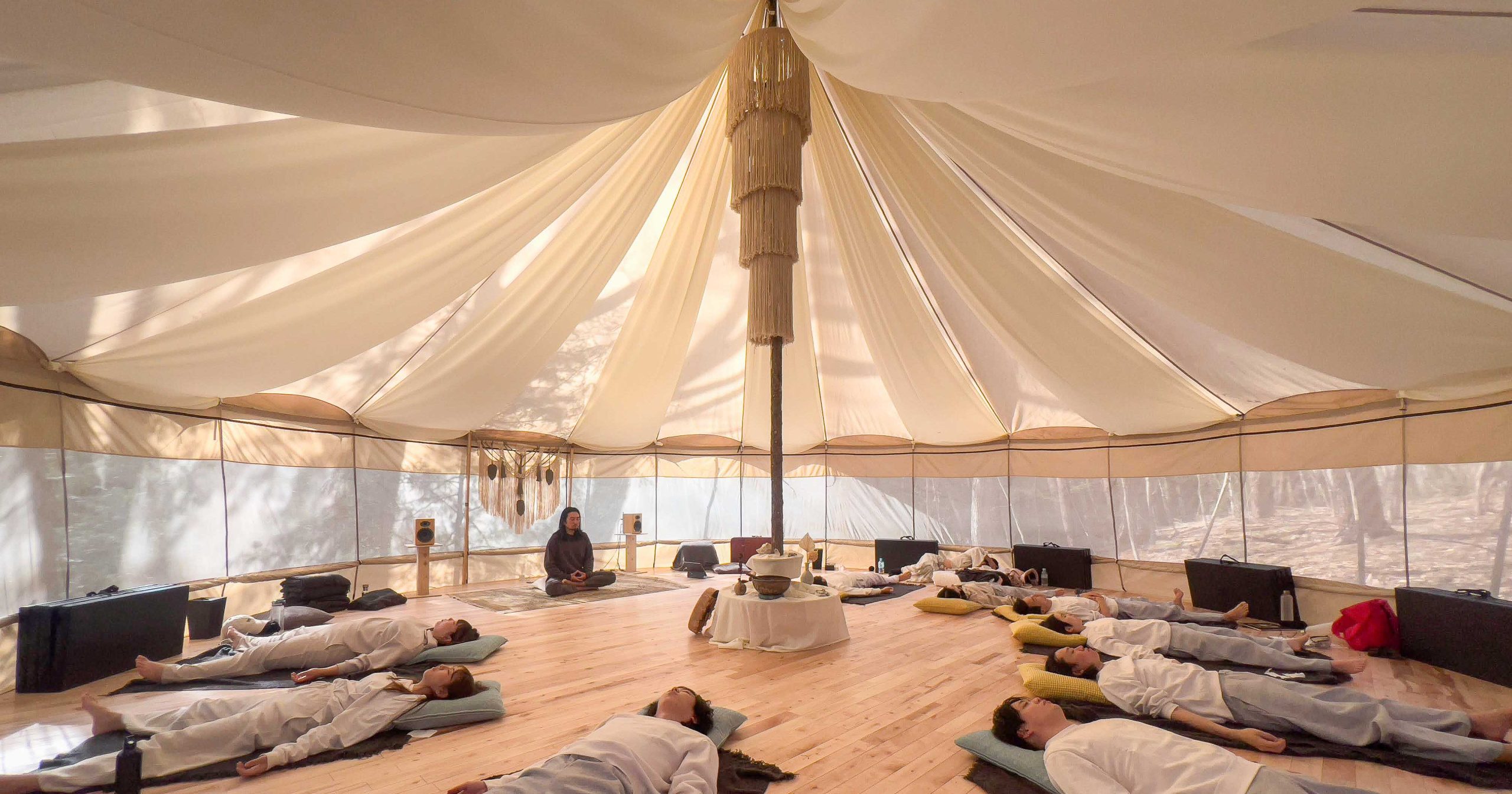
*The Journey to See Your Life Flash Before Your Eyes* is a two-night, three-day retreat in the forests of Yatsugatake. It creates distance from emotions and old beliefs that are difficult to reach through everyday thinking alone, then helps participants reconsider choices in daily life.
Resting in nature is not the whole purpose.
In a safe setting, participants actively meet what is inside them through a gradual process that includes bodily sensation, breathing, and a sound environment.
This is not simply an overnight plan for resting in nature. nehan is not a lodging facility or event venue; it is designed as a place for people who feel their lives have stalled to recover their own sense of things.
In daily life, roles and schedules can press us to produce an answer before we have felt what is happening. Over two nights and three days, we gently restore that order.
What may happen afterward is not that you suddenly become someone else. You may understand in your body why certain words make you freeze each time, begin a conversation you have long avoided with a little more calm, or leave some space in a schedule you had been filling with urgency.
Experiences and outcomes vary by individual.
Monday will not suddenly become free of fear. Difficult emails still arrive, and housework and work do not disappear. But when you see the same email, you may not immediately be swallowed by “I have failed again.” You may notice, “My body just tightened.” It is a modest difference, but lives often bend through differences like that.
Step away from everyday vigilance
Loosen the state of constant tension created by information and roles, making room to sense your own responses.
Look at deeper themes
Create distance from recurring emotions and beliefs without rushing toward an intellectual conclusion.
Bring it back to daily life
Shape insights into something usable in situations involving work, relationships, and choices after returning home.
What should you do if you feel unsure before applying?
“I think I want to go, but I am scared.” That uncertainty is not bad. First, write down what you are afraid of: being with strangers, having emotions move, or returning home and finding that nothing has changed.
Once the fear becomes specific, you can see what you need to ask.
Stopping in front of the apply button even though you want change is probably not a weakness. Being cautious about touching what is inside you is a natural response.
It is better to ask questions while you are still afraid, understand what you are choosing, and then decide than to arrive on momentum while pretending the fear is not there.
We provide explanations and opportunities to consult precisely for that reason.
When you are in a hurry for a turning point, please do not leave your own sense of things behind. As you read the description, does your body contract, or does your breathing become a little deeper?
That response is information too, not just an idea to argue away.
How can you distinguish a useful challenge from a retreat that is not right for you?
If you use only “what does not scare me” as the standard, you may never take a step outside your usual safe zone. It is difficult to tell the difference.
That is why I do not want you to reduce it to “I am scared, so I will go” or “I am scared, so I will not go.”
Ask what exactly scares you, whether the place respects that fear, and whether it seems able to hold you—including after you return home. Choose after checking those things.
Chosen this way, a retreat is not an escape route; it can become footing for returning to the next version of everyday life.
FAQ
Q: I do not think I am at a major turning point. Can I still choose a retreat? A: Yes. You do not need a major event. A period when you feel, “I have been rushing for a long time,” or “I am exhausted from reacting to the same thing” can also be a reason to pause.
It can help to distinguish first whether you need rest or reflection.
Q: Will I stand out if I come alone? A: Many retreats have people who come alone, and you can check whether the organizers operate with that in mind.
Look for descriptions of how small groups are facilitated and how social interaction is handled, and whether you can ask questions beforehand.
Q: Can I make a major decision after a retreat? A: Right after an experience, emotions and perception may still be moving. Depending on the decision, it is generally wise to give it a few days or more, then see whether the same feeling remains amid ordinary days with sleep, meals, and work.
Choosing a retreat that fits you is also practice in not handing your life over to someone else. In our free online course, we speak frankly about what nehan values in designing these two nights and three days, and about the kinds of people who are likely to hesitate.
It is not meant to rush you into applying. It is time to give you more material for choosing.
FREE PROGRAM
A doorway to seeing your life anew — through the body
Add us on LINE to receive the free online lessons — the parts we couldn’t fit into this article.
Free to join, unsubscribe anytime. This is not medical treatment; results vary by individual.
Sources/References
- McEwen, B. S. “Physiology and Neurobiology of Stress and Adaptation: Central Role of the Brain.” *Physiological Reviews*, 2007.
- Nader, K., Schafe, G. E., & LeDoux, J. E. “Fear memories require protein synthesis in the amygdala for reconsolidation after retrieval.” *Nature*, 2000.
- Kaplan, S. “The restorative benefits of nature: Toward an integrative framework.” *Journal of Environmental Psychology*, 1995.
- Creswell, J. D. “Mindfulness Interventions.” *Annual Review of Psychology*, 2017.
This article provides general information and is not medical advice. If you have concerns about your health or condition, please consult a qualified professional. Individual experiences and results vary.