

Key takeaways
- A 2-night, 3-day retreat at a life turning point is not where you receive an answer. It is time to step away from your usual patterns of reaction.
- Change is more likely to begin when your body senses enough safety to revisit old predictions—not when you simply collect more information.
- When choosing a retreat, look beyond beautiful nature. The design of the stay, and how it connects back to life at home, make a real difference.
It is Monday morning, 8:42 a.m. You are standing on the train platform and read a short message from your manager: “Can we talk today?”
That is all. But your throat goes dry. In a few seconds, your mind has played through a transfer, your evaluation, the household budget, and that one thing you said months ago that you should not have said.
Have you ever done that? Nothing has happened yet, but you have already run all the way to the worst possible ending. The train arrives exactly on time, while your mind has gone several days ahead without you. At moments like this, the problem usually is not a lack of information.
Calm down. Do not overthink it. Look at job listings, maybe. Intellectually, you have already considered plenty of options. But when your body has sounded the alarm first, every option can start to look like either escape or failure. Even deciding what to make for dinner in front of the refrigerator can feel strangely heavy.
A 2-night, 3-day retreat at a life turning point is a short, focused stay that takes you out of your usual place, role, and volume of information—so you can soften the body’s vigilance and automatic reactions, and revisit your choices.
Did you think, “Changing your life in two nights? That sounds like empty self-help”? Fair enough. That skepticism is healthy. If someone says everything will change your life, that is usually the suspicious part. Two nights and three days are not a magic number. Going to the woods and taking a deep breath will not make a problem at work disappear. Your unread email is still unread after you breathe mountain air.
But I do not think what you need at a turning point is to think harder. The world tells you to gather information, compare options, and find the correct answer. But if that alone were enough to get you moving, you would probably have moved already. Asking the mind to reach the right conclusion while the body is registering danger is, most of the time, too much to ask.
Still, stepping away from daily life for a few dozen hours can have a surprisingly practical purpose.
Why you keep reaching the same conclusion at home
“If I could just have time alone to think, I would know what I really want.” You go to a café on a day off, open your notebook, and somehow end up looking at your phone until it is time to leave. That is not because your willpower is weak. Often, it is not that you lack thinking time. You are simply continuing to think inside the same circuitry.
I see a large part of life’s confusion as coming from two things: not knowing yourself as well as you think you do, and treating “I understand it intellectually” as the same thing as “my life has changed.” That may sound a little blunt. But if you have learned more and still wake up with the same anxiety every morning, knowledge alone is probably not the whole issue.
The brain is a prediction-making organ. It uses past experience to get ahead of what may happen next. That is useful for avoiding danger: not touching a hot frying pan, being careful around someone who gave you a hostile look. Without this kind of learning, daily life would not work.
But when you are tired, predictions can lean toward the negative. When the amygdala is especially sensitive to threat, the urgent response—protect yourself, now—can take priority over the prefrontal cortex’s more flexible judgment. It is less like holding a thoughtful meeting in your head and more like trying to do your household accounts while the fire alarm is going off. Of course it is hard to make a calm decision.
Picture 11 p.m. You are standing at the sink with dishes still waiting, and your partner says, “Can you take out the garbage tomorrow morning?” It is a small request, but something in you snaps: *I am the one carrying everything.* This does not necessarily mean you are a bad person. Sleep deprivation and tension may be making your brain interpret the words as closer to an attack. The next morning, sitting in front of a bowl of miso soup with steam rising from it, last night’s anger can feel a little strange. Have you had that experience? “Why was I that upset?”
Daily life contains too many cues that keep these reactions in place: the same desk, the same notification sound, the same commute, the same atmosphere of “I have to reply properly.” Some people feel their shoulders rise the moment they open their laptop. Environments become linked to memory, calling up the same emotions and behaviors. This is not a matter of grit. It is a learned response.
That is why, at a crossroads, what you may need is not to force yourself to find the right answer. You may need to physically leave the place where the reaction starts running. This is not a simplistic claim that your home is bad or your workplace is bad. It is that, in those places, your body may automatically launch the version of you it knows best. Stepping outside of that, even briefly, can change what you are able to notice.
POINT
The value of two nights and three days is not simply getting more rest. In a place where cues tied to roles and deadlines are quieter, the brain may loosen its usual defensive mode enough for you to pick up your own signals again.
Day one, day two, and the morning you return: the sequence a short stay needs

People often say, “Just go into nature and you will reset.” I think that is only half true. If you are following work chats all the way into bed at a beautiful inn, you have simply moved your remote office somewhere with a better view. Fresh highland air is not a bad thing. But if your mind is still in the meeting room, you may come home with souvenirs and unanswered emails. More cookies, perhaps, but not much else.
You probably know this: you look back at photos from a trip and realize, “I was supposed to be having fun, but I was thinking about work the whole time.” Your body traveled, but your attention stayed behind. It is not unusual.
Two nights and three days is long enough, at least, to let go of the expectation that you need to arrive and immediately uncover a profound answer. On the first day, the tension of travel often remains. You put down your bags, but your body is still moving at the speed of the station or the office. You may find yourself reaching for your phone for no clear reason: *I have not replied. What is on tomorrow’s calendar?*
By day two, sleep, food, and a sense of safety in the surroundings may finally begin to register in the body. For some people, something that had not yet become words starts to surface. You may realize, “Actually, I did not like that.” Not as a dramatic revelation, but as an almost ordinary, anticlimactic fact.
On the morning you leave, there needs to be room to consider how that realization will connect with the life waiting for you. Skip that part, and the retreat becomes a pleasant weekend memory. Monday morning, back on the train platform, your old reactions can take over again. Before leaving, it helps to look not only at what you will change, but what you will reduce; who you need to speak with and how; and the situations in which you begin to rush yourself.
Of course, this will not unfold in the same order for everyone. Some people are simply exhausted and sleepy on the first day. Some cannot find words until the final day. That is fine. Once you start grading your own change, the old pattern of “I have to produce results properly” has already returned.
Even so, compared with a one-off event lasting only a few hours, having time for both a shift in state and reflection matters. Memory research suggests that when a memory is retrieved, it can become temporarily unstable and may be updated as it becomes linked with new perspectives or emotions. When an old belief such as “I cannot say no” or “I will fail again anyway” comes up, the point is not to hold another self-criticism session. It is to have a chance to view it again alongside a different bodily state or a different kind of contact with other people.
Slow the pace of daily life
Through travel, meals, and sleep, create a little distance from the feeling of being chased by notifications and roles.
Notice old reactions
Revisit recurring responses around relationships, work, or anxiety about money, including what happens in the body.
Connect it to the place you return to
Do not leave insight as a mood. Shape it into something you can work with in conversations and plans after you return home.
One thing matters here: this is not about forcing yourself to dig up painful memories. Seeking intense experiences before there is a sense of safety can make you brace even more. There is no need to lie in an unfamiliar futon at night and pressure yourself to cry, or to have some grand awakening. That urgency itself may be your familiar reaction of needing to achieve something.
The more urgently people want a turning point, the more they tend to want an event that looks like one: a dramatic decision, a clean declaration, a photo worth posting. But I think it is worth questioning that a little. The moments when life begins to move are not always flashy.
It may be Wednesday at 6 p.m., after you get home, choosing dinner at the supermarket. You think, “I do not have to push myself and buy extra things today.” That small choice can show a greater difference from your old self than a big declaration. You decline an invitation that did not seem important enough to decline. You open the screen with the unread message less often. On Sunday night, you do not drive yourself hard in preparation for the week ahead. It is unglamorous. But this kind of unglamorous change can work on you over time.
Four things to look for when choosing a 2-night, 3-day retreat

When you are at a turning point, every search result using words like “healing,” “detox,” or “your authentic self” can look promising. When you are tired, it is easy to be drawn in by soft photographs and appealing meals. I understand that. But if you choose based on scenery and food alone, the gap between expectation and experience is more likely to show up.
Are you looking to recover sleep? To examine a habitual way of thinking? To talk with someone? If you choose without making that clear, you may end up ordering a lavish set meal when what you really needed was a bowl of udon. There is nothing wrong with the set meal. It was just not the order you meant to place.
- What is the stay for? | Does its central focus—rest, creative work, meditation, dialogue, physical activity—fit the question you are carrying?
- Is safety taken seriously? | Are the group size, the facilitator’s experience, the policy on voluntary sharing, and guidance around physical condition clear?
- Is there a design for the experience? | Does it go beyond a nature walk, with a process for working with inner responses and reflecting on them?
- Does it account for returning home? | Does it consider how you will work with what you notice after you return to ordinary life?
For example, someone unsure whether to leave a job may go to a retreat involving intense exercise from morning to night. What they come away with may be a sense of achievement—and nothing wrong with that—but they may never actually touch the question of whether to resign.
On the other hand, someone who needs to move their body may go to a program built around sitting and talking for long hours, only to feel confined. You do not need to conclude, “I am bad at introspection.” That is like walking a long way in shoes that do not fit, then blaming a lack of determination when your feet hurt.
A retreat is not simply good or bad. It is a matter of fit with the question you have right now. Let me be clear about this: even if reviews are excellent and a program is popular, do not choose it if it does not fit your current state. A place that sells intense disclosure or intense experiences is not always deeper. The difference lies in whether it takes safety seriously, does not force emotion out of people, and considers the time before and after the stay.
When you are tired, have you ever thought, “If I am going all the way there, I should choose something dramatic”? But if recovery is what you need now, you are allowed to choose recovery. If you need the capacity to revisit your question, choose a place built for that. This is not about pushing yourself. It is about not misreading where you are.
A trip to rest and a trip to revisit your reactions are slightly different

This is not about one being better than the other. Sometimes you need a weekend of sleeping at a hot spring. Eight hours in a futon, breakfast in the morning, and no thinking at all. If that gives you enough strength to return, it is a good trip.
But if the same anxiety returns every Monday morning no matter how often you rest, there may be a layer that rest alone has not reached. Some people blame themselves: “I rested, and now it is back again.” This is not the moment to blame yourself. It is the moment to ask whether you are trying to heal a broken bone with cold medicine.
In cognitive behavioral therapy, there is the idea of an “automatic thought” between an event itself and an emotion. Your manager replies slowly, and you interpret it as, “They have given up on me.” Anxiety rises, and you check your email again and again. It is noon, you are waiting at the convenience-store register, and you have opened your phone five times. That state.
The event is simply that the reply is late. But the brain uses past experience and current fatigue to fill in the blank with the most frightening meaning. The stronger that interpretation becomes, the more checking behavior increases. The reply still does not come, so the anxiety rises further. Automatic thought, emotion, and behavior become connected in a loop.
What a retreat can work with is not changing your manager. It is creating some distance from the meaning-making that races through you in that moment. It is not about denying the part of you that thinks, “They have given up on me.” It is about finding enough space to notice, *Ah, that prediction is running in me right now.* It sounds small, but in daily life it can be surprisingly difficult.
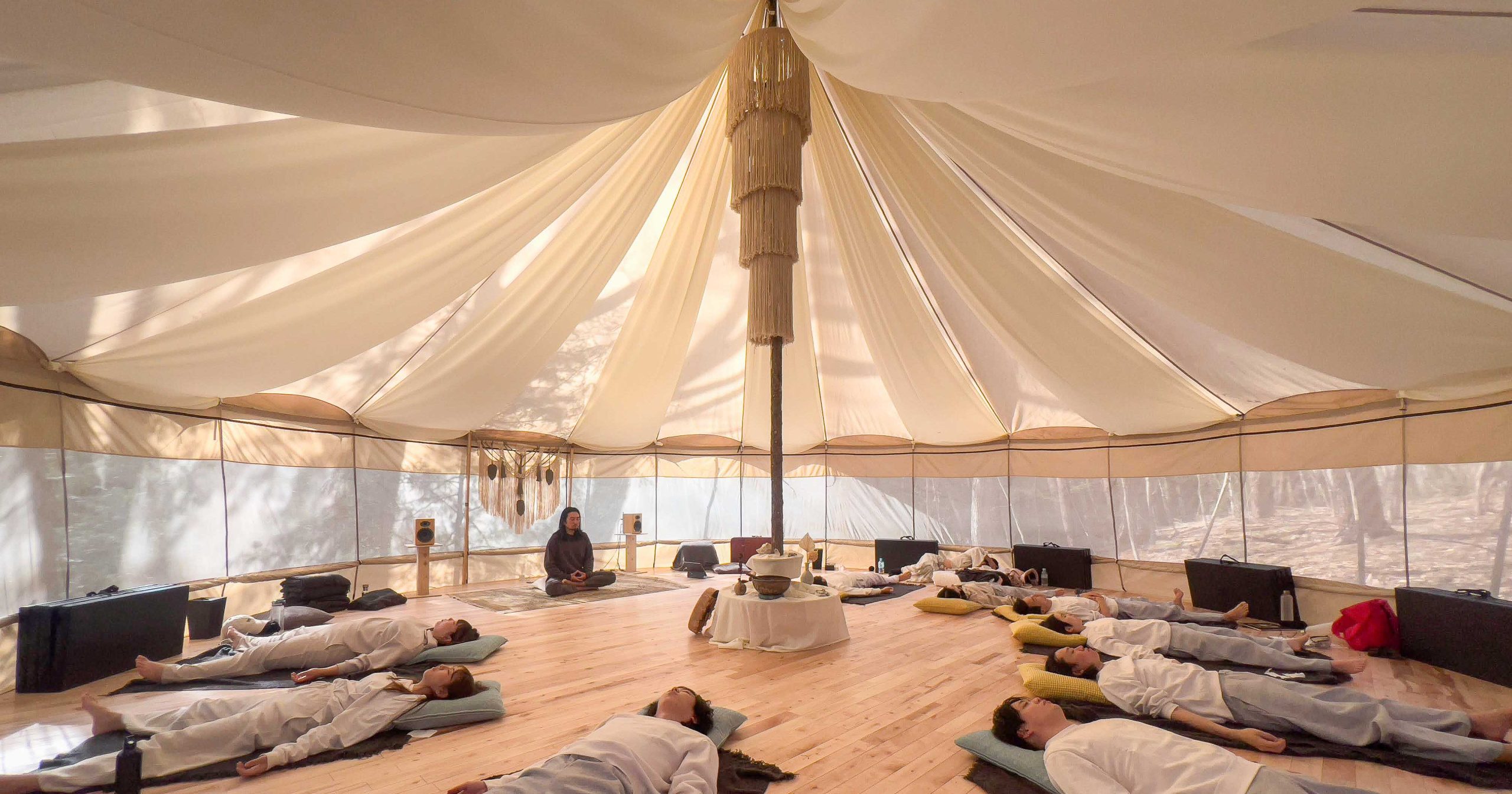
nehan’s Journey to See Your Life Flash Before Your Eyes, held in Yatsugatake, is not designed simply for enjoying a stay or a view. Over two nights and three days, it uses a gradual process involving sound, breath, and bodily sensation to approach reactions that have not shifted even when you understand them intellectually. Long-held tension around “I have to do this” may soften, making it easier to distinguish your own wishes from your fears. For some people, this can create an opening for change. Experiences and outcomes vary from person to person.
Some of you may be thinking, “So this is just about making your thoughts more positive?” It is not. The point is not to replace your thoughts with forced positive language. If you are afraid, you are afraid. If you dislike something, you dislike it. You work with that without leaving your body behind. Then you do not treat the conclusion that appeared automatically as the only fact.
I see a retreat not as healing that helps you escape reality, but as a training ground for updating the way you meet your inner life. Understanding something in your head and having your life change are different things. You can add correct answers in your mind, but if you never meet the body, emotions, and memory, old reactions can be remarkably persistent. It is precisely because you have somewhere to return to that time away can matter.
Do you need rest right now? Or do you want to step a little away from the self who keeps repeating the same reaction, and choose again for yourself? You do not have to rush an answer. But do not carelessly put that question aside. It may be part of what your next turning point needs.
FAQ
Q: Is two nights and three days too short for a life turning point? A: This is not a stay intended to resolve every life issue in three days. Two nights and three days is a realistic amount of time for taking distance from daily stimuli and first revisiting your reactions and priorities. What you do and the environment you return to also affect how change is experienced.
Q: Do I have to talk about my worries in front of other people at a retreat? A: It depends on the program. Before joining, it can help to check the scope of sharing, whether the group is small, and whether there is a policy of respecting what participants do not wish to discuss. A setting that assumes forced disclosure may not fit you right now.
Q: Is it really okay to step away when I have work or family problems? A: Stepping away briefly is not the same as abandoning a problem. When your judgments are tangled, taking a little distance to revisit priorities can change the conversations and decisions you make when you return. If there are circumstances that require contact, it is a good idea to discuss them with the organizer beforehand.
If you have read this far and thought, “Maybe I need time to revisit the root of my reactions more than I need rest,” I hope you will not treat that feeling carelessly.
In the free online course, we explain more specifically why we return to the same reactions even when we understand things intellectually, and what a 2-night, 3-day design is intended to make possible. It is not there to rush you into joining. Use it as material for deciding whether this is a place that fits you now.
FREE PROGRAM
A doorway to seeing your life anew — through the body
Add us on LINE to receive the free online lessons — the parts we couldn’t fit into this article.
Free to join, unsubscribe anytime. This is not medical treatment; results vary by individual.
Sources / References
- McEwen, B. S. (1998). Stress, adaptation, and disease: Allostasis and allostatic load. *Annals of the New York Academy of Sciences*.
- Nader, K., Schafe, G. E., & Le Doux, J. E. (2000). Fear memories require protein synthesis in the amygdala for reconsolidation after retrieval. *Nature*.
- Beck, J. S. 『認知行動療法実践ガイド:基礎から応用まで』星和書店。
- Kaplan, S. (1995). The restorative benefits of nature. *Journal of Environmental Psychology*.
- 厚生労働省 e-ヘルスネット「ストレス」関連情報。
This article provides general information and is not medical advice. If you have concerns about your physical or mental health, please consult a qualified professional. Individual experiences and results vary.