

Key takeaways
- Seeking out a retreat during a life transition does not mean you want to run away. It may mean you need time to reconsider things outside your usual patterns of reaction.
- When a major decision leaves you unable to move, the issue is often not weak willpower. Your brain and body may be staying in a state of alert.
- A good retreat is not a place that hands you an answer. It is designed to help you see your own patterns and return to your next choice.
Monday morning, 7:42. You are brushing your teeth, checking your phone, and there is a message from your manager: “Can we talk sometime today?”
Nothing has even been said yet, but your upper stomach tightens. You open a job-search site. Close it. You reply “I’m fine” to your partner. Then that night, you find yourself typing “life transition retreat” into the search bar again.
Has that ever happened to you? A notification is only one line, but it occupies a corner of your mind for the rest of the day. You are eating dinner, taking a bath, and still wondering, “What was that about?” From the outside, nothing has happened yet. That is what makes it quietly exhausting.
It is also a very natural sequence of events.
People who look for retreats during a life transition are not simply looking for a travel destination. They are people who want to step back from everyday roles and deadlines for a while, and look again at what they are reacting to. Whether to stay in a job. What to do about a relationship. Whether to move. More than the answer itself, they may no longer know what they truly do not want.
People often say, “When you are lost, take action.” I think that is only half true. Action taken while your shoulders are still raised in alarm is more likely to be a reaction than a choice. You submit your resignation, then wake up shaking with anxiety the next morning. You start a side business on impulse, and it stops three weeks later. Action is not the problem. But before stepping on the accelerator, you need to know which pedal your foot is on right now.
When you are in a hurry, “I have to decide something” can look like the sensible thing to do. But you do not need to make a major turn in your life while pressing the accelerator with the brake still on. It is better to first look at what you are afraid of, and what you may be trying to get away from. A decision made without looking at that will carry the same reaction with it, even if you change the place, the company, or the person.
“Changing your environment will change you” is not quite enough
When you hear “retreat,” you might picture slowing down in the woods and emptying your mind. Rest certainly has value. But at a turning point in life, rest alone may not be enough.
It is Friday at 10 p.m. You are looking out the window of a hotel on a business trip. There are no work notifications, no household tasks, and you feel strangely light. “Maybe I really could quit this company,” you think. But on Sunday evening, you are back home. Three glasses sit in the sink, laundry is piled on a chair, and the moment you open next week’s schedule, the old urgency returns.
It felt easier while the scenery had changed. Yet once you return to life, the same thoughts start playing again.
This is not only a matter of needing more rest. On white hotel sheets, “I want to live more like myself” can feel possible. Then it is Sunday at 6 p.m., there are dishes to wash and an unanswered email in front of you, and suddenly you feel smaller. You probably know this: a decision that seemed possible while traveling can feel far away the moment you open your front door.
The brain has a network of activity called the default mode network (DMN), which is involved in memories of the past and simulations of the future. Even when you seem to be doing nothing, the brain may be running stories on its own: “What if I fail next time?” “If only I had said that back then.” The DMN is not the villain. We need it to make plans and learn from experience. But when fatigue and anxiety build up, the same anxious storyline can circle around again and again.
Before bed, you open an unread chat thread for no particular reason. You scroll back through a conversation from three days ago and replay it: “Did that come across strangely?” This is the kind of thing a brain with an active DMN does. It is a useful prediction system, but when you are exhausted, the screenwriter can get out of hand and write nothing but worst-case endings. The brain is not always easy to deal with.
So the goal is not to force yourself not to think. You need to be in a state where you can notice that your thoughts have started running. It is easy to assume that stopping thoughts is the answer, but the more you try, the more “I must not think about this” becomes a new thought. The brain is not always easy to deal with.
If you are choosing a retreat, it can help to look beyond beautiful scenery and consider the following:
- Is there enough time away from everyday stimulation, rather than too little?
- When feelings come up, is there facilitation that offers support, including attention to safety, rather than leaving people alone with them?
- Is it designed not just to feel good in the moment, but to support choices after returning to daily life?
- Does it avoid imposing an answer about how you should live, and instead help you work with your own felt sense?
What are you looking for? Rest? Material for a decision? Or time to face something honest that you have kept putting off?
If what you truly want is simply to sleep without thinking about anything, that is completely fine. But if you feel, “Even after sleeping and resting, I come back to the same place,” then you may need something a little different from a vacation. You may need to intentionally create conditions in which your usual self does not automatically take over.
POINT
What can help at a life transition is not simply the unfamiliar setting, but conditions that make it harder for your usual self to play on autopilot. Place, time, distance from other people, and the state of your body: the combination changes what you can see.
Being unable to decide does not mean your brain is lazy

When we face major uncertainty, threat-detection circuits that include the amygdala can become more sensitive, and the body may move into a state of sympathetic nervous system readiness. Your heart rate rises, your breathing becomes shallow, and your field of attention narrows. In this state, functions associated with the prefrontal cortex—such as comparing several possibilities or pausing before acting on an impulse—can become harder to use.
In other words, you have not become less intelligent, and your willpower has not disappeared. It is like trying to calmly do your household budget in a room where the fire alarm is going off. Your brain and body are saying, “End the danger first.” Demanding that you produce the correct answer to your life in the middle of that is a fairly rough request.
At 3 p.m., someone suddenly says in a meeting room, “The structure for next term is changing.” On the way home, you put a large bag of potato chips—the kind you do not normally buy—into your basket at the convenience store. When you get home, you sign up with a recruiting agency. Thirty minutes later, you open the page to cancel your account, thinking, “Maybe I can’t do this after all.”
This is not a character flaw. It can make sense as a brain trying to bring uncertainty to an end as quickly as possible.
It is not because you are indecisive. Many people decide, reverse the decision, decide again, then reverse it again. They get exhausted by the back-and-forth and tell themselves, “I really am hopeless.” But sometimes it is simply a brain that has been kept in uncertainty for too long, scrambling to find an exit.
In cognitive behavioral therapy, a thought that arises is treated not as fact itself, but as one interpretation. Thoughts such as “This transfer means my career is over” or “If I say no, they will dislike me” can feel completely real under intense tension. But when you create some distance—by writing them down, talking with someone, or checking in with bodily sensations—a small gap can appear between interpretation and fact.
The moment you write “If I say no, they will dislike me” on paper, it changes from an absolute command inside your head to one sentence placed in front of you. You can begin to ask, “Will literally everyone dislike me?” or “Have there been times when I said no and the relationship did not fall apart?” You may notice that your breathing is shallow or that your hands are cold. Then you can step, even slightly, outside the state in which the thought and you were completely fused.
That gap is the entrance to a turning point.
As I write this, I keep thinking that before life changes, what often comes first is not dramatic certainty. It is, “Today, I was able to put my usual reaction on hold just once.” You do not send the reply immediately; you drink a cup of tea first. Before declining an invitation, you simply say, “I’ll get back to you tomorrow.” It is not flashy. But that one time can be enough to make a difference.
Old beliefs are difficult to let go of through persuasion alone

“Just have more confidence.” “Try to think positively.” Sometimes advice like this can help us move. But with reactions that have been in place for years, words alone may not reach far enough.
Imagine someone who was strongly criticized whenever they made mistakes throughout elementary school. As an adult, a colleague merely asks them to revise a document. Intellectually, they understand that it is an ordinary request, yet the back of their neck becomes hot and “I’m not good enough” arrives first. Memory remains connected not only to the story of an event, but also to the body’s response.
Only one part has been corrected in red, but they cannot open the document again until lunch. The other person only said, “Could you check this number?” Yet the body gets ahead of the situation: “I am going to be criticized again.” You may understand, almost laughably, that the response is disproportionate, but it does not stop. You probably have situations too where you think, “Over something like this?” and yet, for some reason, you shrink sharply.
Memory research includes the idea of reconsolidation: when a memory is recalled, it temporarily becomes more malleable and may be updated through the way it encounters new information. This is not about erasing the past. It is about the possibility that, when you encounter a similar situation, your body has some room to learn again that it is not the same danger as before.
I do not want this to be misunderstood. It does not mean you have to dig up everything from the past and neatly resolve it. The past does not disappear like a deleted file. But when you encounter the same correction in red, the same silence, or the same “Can we talk sometime?”, there may be a possibility of relearning that your body does not have to sound the alarm every time. In daily life, that difference can be substantial.
What you need at a life transition is not to win an argument against yourself. It is to build new experiences in which you can refrain from fully believing an old belief when it appears. Skip this step and set only impressive goals, and then a Slack notification arrives at 6 p.m. on Tuesday and everything returns to where it was.
Are you pushing yourself with, “If I understand it, I should be able to do it properly next time”? You sit in front of cold coffee late at night, and the internal review meeting just keeps going. Honestly, if that alone could change us, none of us would struggle this much. People do not act in the order they understand things. Their options expand in the order their bodies can feel safe enough. That is not just a nice idea. When you consider how the brain and memory work, it is a fairly practical one.
A retreat is not a place to decide your life

This is easy to misunderstand. Decide in two nights and three days whether to quit your job. Receive the answer that fate has been holding for you. Put that kind of expectation on a retreat, and it becomes another form of pressure.
The way I see it, a retreat is not a vacation for escaping reality. It is a training ground for updating how you relate to your inner life. But not a boot-camp version built on grit. It is a place to step away from your usual alert state, safely work with the connections among bodily sensation, feeling, and memory, and reconsider your own reactions.
The world often acts as though the most valuable place is one where you can get an answer quickly. I do not see it that way. At a life transition, what you need is not to be given the correct answer. You need to return to a state where you can choose without being swept up in your own reactions. Even if someone tells you, “You should quit,” or “You should stay,” they are not the one who will live your life for you.
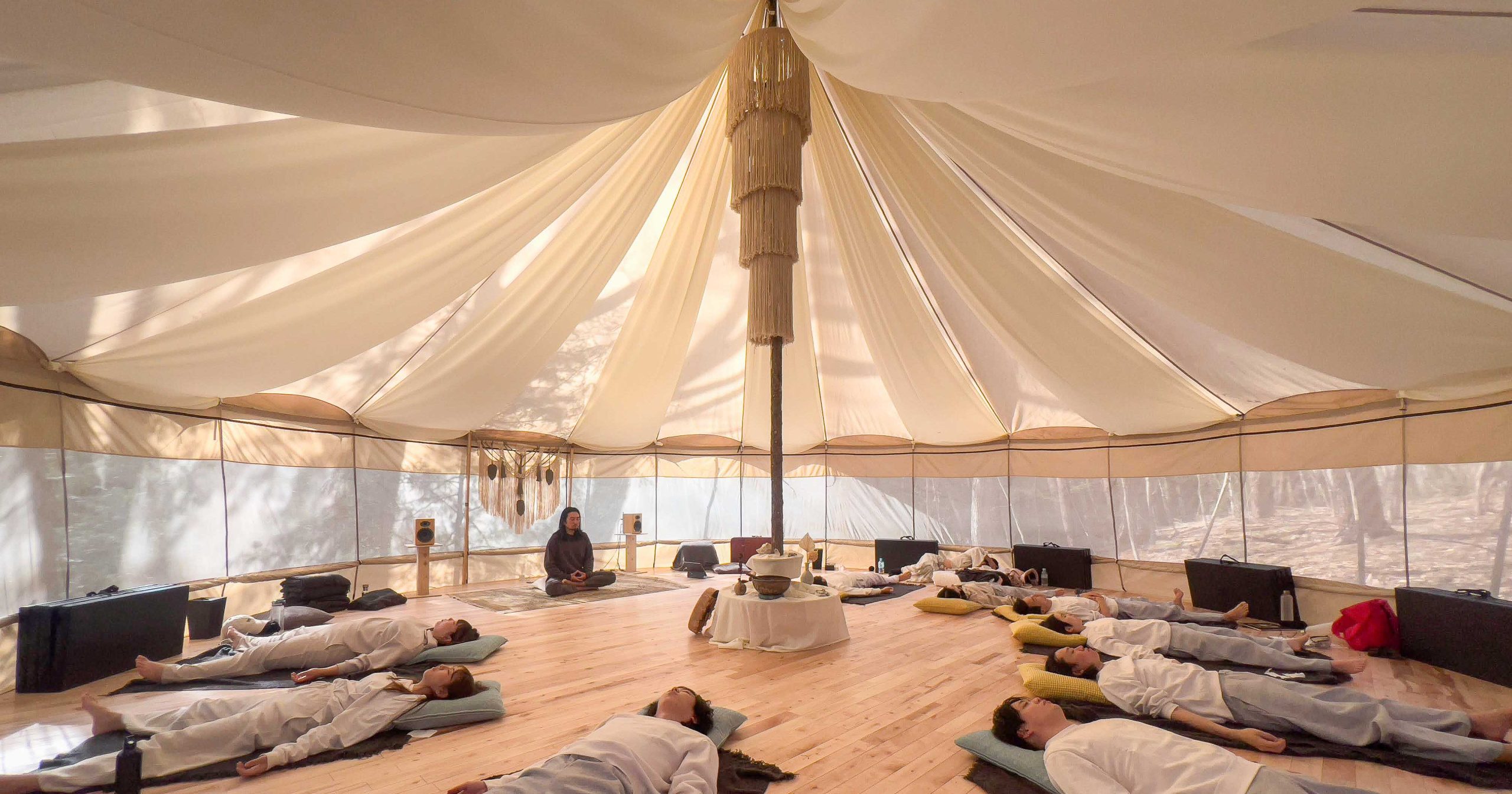
nehan’s *A Journey to See Your Life Flash Before Your Eyes* also unfolds over two nights and three days in the forests of Yatsugatake, combining sound, breath, and approaches to bodily sensation in stages. The aim is to approach, from another angle, themes you understood intellectually but still could not move on. It is intended to create distance from long-repeated reactions such as “I can’t say no,” “I never stick with anything,” or “I have to meet expectations,” so that you can take home an opening to choose again for yourself.
From morning to night, you respond to notifications, adjust yourself to other people’s expectations, and think through tomorrow’s plans before sleep. When you are inside that circuit, your own voice can be surprisingly hard to hear. When someone asks, “What do you want to do?” you may not have a polished answer. You may have nothing come up at all. There is no need to be ashamed of that. It happens especially to people who have carried roles for a long time.
The details of the method are not shared here, but the experience is designed around a flow like this:
Ease everyday vigilance
Step back from roles and notifications, creating conditions in which the body can more easily recognize the present environment as safe.
Meet deeper reactions
Make time to observe feelings and old beliefs that could not be fully organized through words, without forcing them into a conclusion.
Connect it to daily life
Find ways of relating to your own reactions, and your next choices, that you can use on the Monday after you return home.
Are you thinking, “This is probably just another vague talk about the mind”? That skepticism is reasonable. Talking about feelings alone does not change the reality of the next day.
If Monday morning holds getting your child ready, a crowded train, meetings, and evening shopping, an insight you cannot use there is likely to become decoration. It felt good in the forest. You cried. You felt clear. That alone is not enough. When you come home, start the washing machine, and see notifications lined up on your phone, can you pause for one beat and notice your own reaction? That is what I mean by a retreat.
That is why a good setting needs design, not sentimentality. Sleep, food, connection with other people, the amount of stimulation, reflection. When people are working with what is inside them, conditions matter more than resolve. It is like cooking: put good ingredients into a scorched frying pan, and they will usually burn. First, check the heat. Change the pan. Life transitions often begin to shift from these ordinary details.
FAQ
Q: Is going to a retreat during a life transition a form of running away? A: Taking some distance from daily life is different from continuing to avoid reality. If you use the time not to neglect work or family problems, but to pause reactive judgment and consider what you will choose after returning, it can serve a different purpose from escape.
Q: Can I consider joining even if I do not know exactly what I need to decide? A: Yes. Some people begin looking when they cannot yet put into words what is difficult. Maybe Sunday evenings feel heavy for no clear reason. Maybe you are tired from continually meeting other people’s expectations. That vagueness itself can be an entrance to the work.
Q: Will all my uncertainty disappear after a retreat? A: A retreat cannot promise that uncertainty will disappear. But when uncertainty takes over, it may become easier to recognize what you are reacting to. Each person’s experience and results will vary.
You do not have to settle on one answer about your turning point tonight. But if you have been running the same thoughts in the same place for a long time, there is value in changing the place where you think.
In our free online course, we explain a little more concretely why knowledge and determination alone can be slow to change our reactions, and what you can use as a guide after returning to everyday life. We also talk about the thinking behind the two-night, three-day design of *A Journey to See Your Life Flash Before Your Eyes*.
FREE PROGRAM
A doorway to seeing your life anew — through the body
Add us on LINE to receive the free online lessons — the parts we couldn’t fit into this article.
Free to join, unsubscribe anytime. This is not medical treatment; results vary by individual.
Sources/References
- National Institute of Mental Health, “5 Things to Know About Stress”
- McEwen, B. S. “Protective and Damaging Effects of Stress Mediators,” New England Journal of Medicine, 1998.
- Raichle, M. E. et al. “A default mode of brain function,” Proceedings of the National Academy of Sciences, 2001.
- Nader, K., Schafe, G. E., & Le Doux, J. E. “Fear memories require protein synthesis in the amygdala for reconsolidation after retrieval,” Nature, 2000.
- Beck, J. S. 『認知行動療法実践ガイド:基礎から応用まで』
*This article is for general educational purposes and is not medical advice, diagnosis, or treatment. Individual experiences and results vary. If distress feels overwhelming or affects daily life, consider consulting an appropriately qualified healthcare or mental health professional.*