


Key points
- Life is running. The fear still won’t leave. In that case, it’s usually not about the amount of money, but about how safety is felt.
- A bigger balance doesn’t change what produces the fear. The numbers alone rarely finish the job.
- Put the fear into words, let the body feel safe again — and, for people who keep slipping back, we’ll cover the next option in order.
Why doesn’t money anxiety go away even when you have savings?
Does a bigger balance stop the “what if”?
The anxiety isn’t coming from the balance. It’s coming from the thought “it might not be enough.” A balance has an upper limit. Imagination doesn’t. That’s why adding money never stops the imagining.
The tendency to find not-knowing deeply hard to bear is called “intolerance of uncertainty.” The experience of more money bringing no less fear is thought to be connected to this tendency (see sources at the end).
- Check the balance — You confirm the number and feel a moment of relief
- The "what if" starts running — Imagination has no ceiling, so it doesn’t stop
- The body braces — To a danger in the head, the body responds as if it were real
- You want to check again — The relief doesn’t hold, so you go back to the balance
Why does the relief only last a moment?
Start of the month. You open the statement envelope from the mailbox. You see the number, and for a second you relax. Then, the moment you set the envelope down, it starts: “What about retirement?” “What if I get sick?”
You’re trying to beat imagination with a balance. You can’t. You probably know this already — the relief has never once lasted past the envelope.
What is money anxiety really? It doesn’t feel like a numbers problem.
Why does money become the container for other fears?
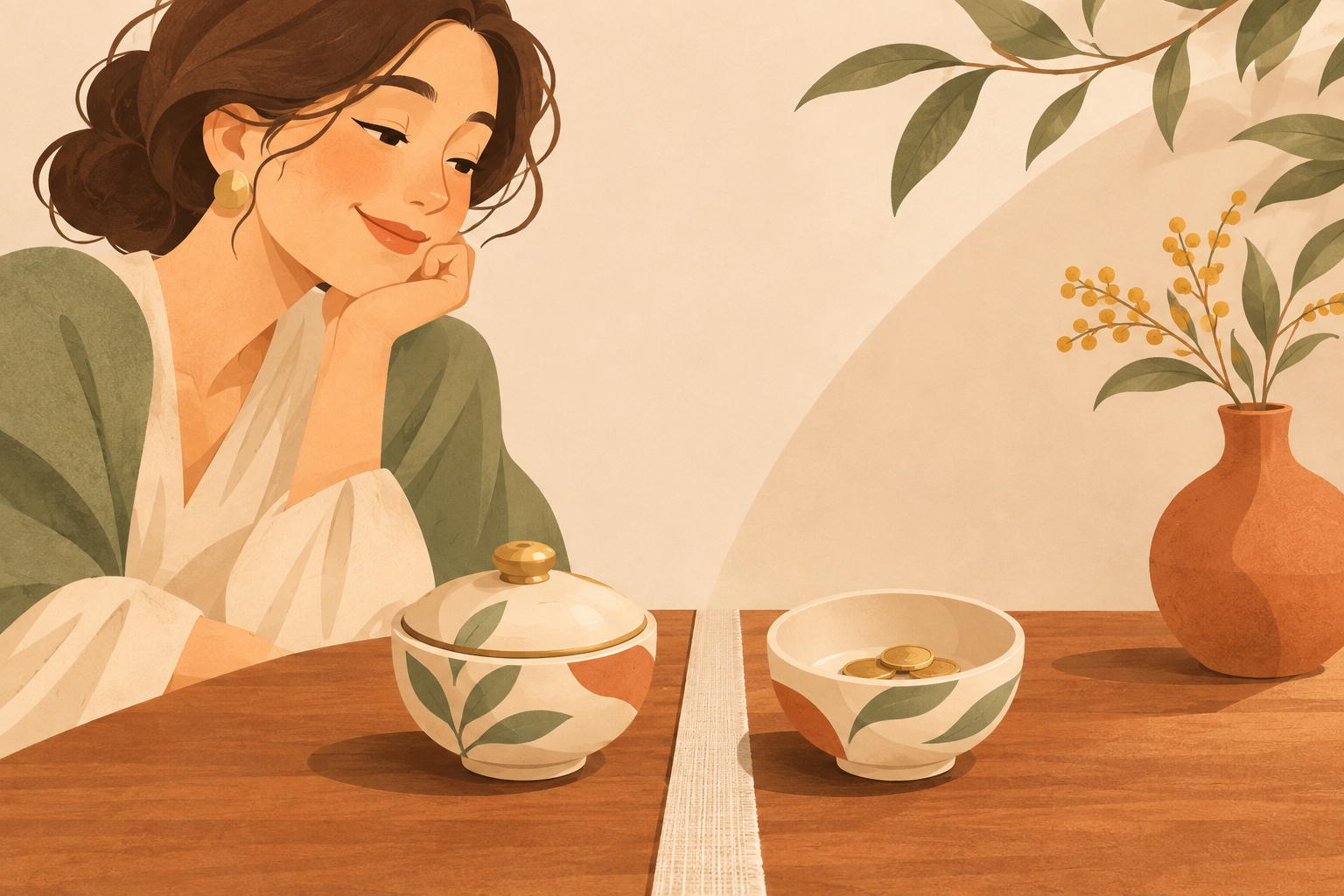
That instinct is usually right. Money easily becomes a stand-in for a different fear: the fear of being left behind, the fear of having no one to lean on, the fear that failure won’t be forgiven.
The dinner table where your parents went quiet at the end of every month — your adult body still remembers it.
Why doesn’t calculating ever change the fear?
Calculation calms the head, and only the head. Understanding something and having the fear actually change are two different things.
If someone asks “Are you okay?”, you say “I’m fine,” and your chest tightens afterwards — the source of the fear may not have found its words yet. How to know your true feelings and values is one place to begin.
Every time I spend, I get scared. Is not being able to spend also part of the anxiety?
Why does a 1,200-yen lunch leave a small regret?
Yes — same root. The fear of spending comes from the belief that “once it goes down, it never comes back.” A 1,200-yen lunch. You can afford it, and still, after paying, there’s that small regret. You know the feeling.
How does separating protected money from spendable money help?

One clue: separate the money you protect from the money you’re allowed to use. Draw a line — “I don’t touch this,” “this one can go down.” Just having that boundary makes it a little easier to breathe for many people.
FREE PROGRAM
A doorway to seeing your life anew — through the body
Add us on LINE to receive the free online lessons — the parts we couldn’t fit into this article.
Free to join, unsubscribe anytime. This is not medical treatment; results vary by individual.
Where do I start if I want to ease money anxiety on my own?
What are the three steps?
Three things. Done in order, they work on the head and the body at the same time.
Write the anxiety down on paper
Put into words “what, when, and how it would hurt.” The parts you can’t write are the parts imagination has inflated.
Notice where your body tightens
The instant you look at the balance — shoulders, or the pit of the stomach? Notice it, exhale slowly, and rest.
Spend something small
1,000 yen is enough. Let the body learn: “it went down, and I was still okay.”
How small should the spending step be?
The first step you can do on the commuter train. The trick is to not make the third step big. Small, and often. Safety isn’t reasoning; think of it as something the body gets used to.
How is working alone different from a professional or a retreat?

When is a financial planner the right call, and when a counsellor?
Choose by purpose. If the numbers need sorting, a financial planner. If the fear runs deep, a counsellor. If you understand it all and your body still won’t settle, a few days away, facing it directly, may fit better.
Working alone suits people who can keep writing, resting, and spending small; what you gain is gradual familiarity inside daily life. Working with a professional suits people who can’t tell on their own whether the issue is the numbers or the fear underneath; what you gain is sorted numbers, or a fear that has finally been put into words.
What does a retreat offer that solo work doesn’t?
A retreat suits people who already understand all of this, and whose body keeps slipping back anyway. What you gain is insight from a state where you’ve stepped out of your environment entirely — not just out of your head.
When money anxiety keeps me awake, how do I recognise that I’ve reached my limit?
Which signs mean it’s time to stop carrying this alone?
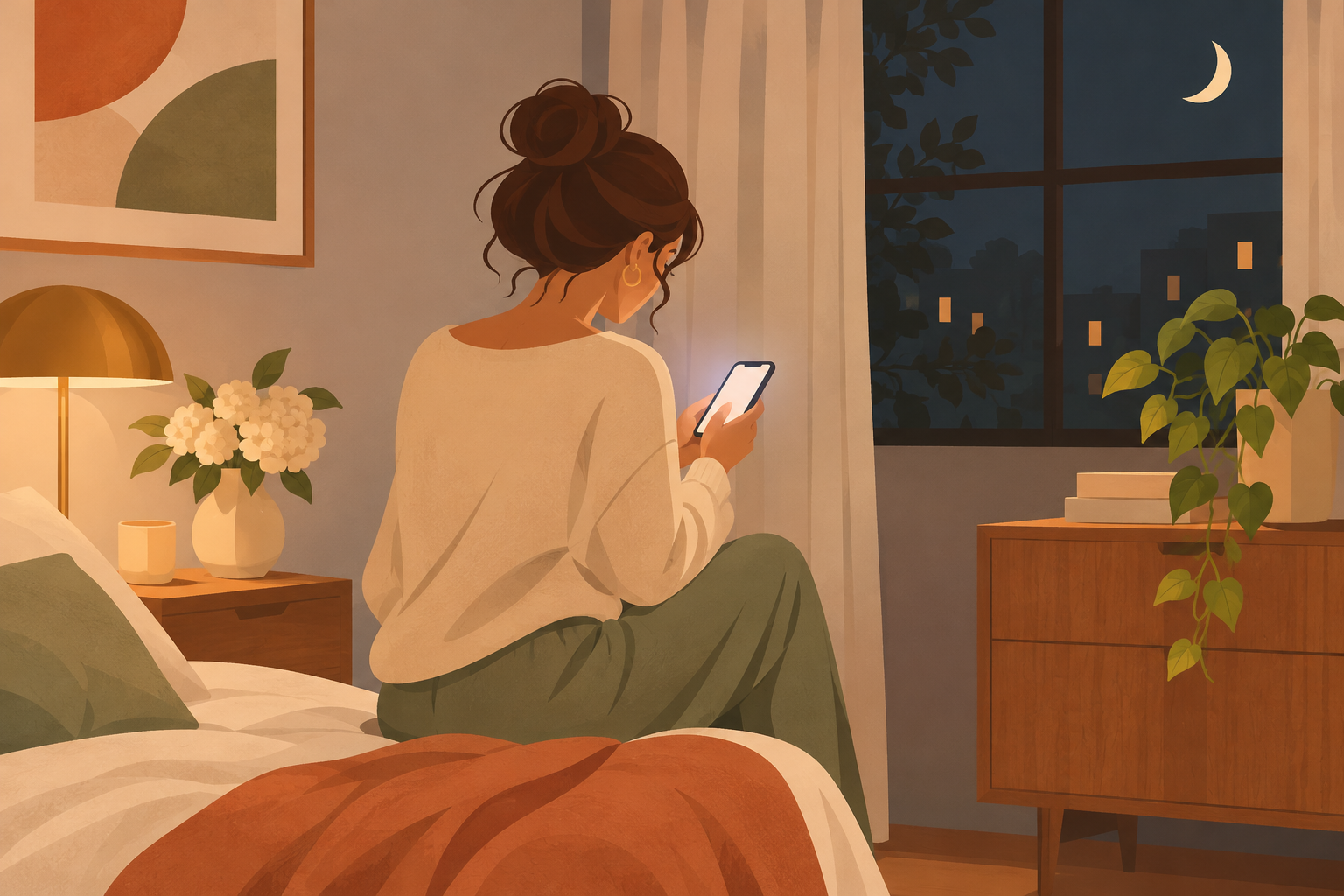
If the following continue for around two weeks, the period of handling it by yourself is over. Reach out to your family doctor, a psychosomatic medicine clinic, or the Ministry of Health, Labour and Welfare’s “Mamorou yo Kokoro” phone and SNS counselling service.
- Nights without sleep, or waking repeatedly
- Not being able to eat, or eating without tasting anything
- Checking the balance several times a day
- Feeling as if you’ve spent money when you haven’t, and being frightened by it
Why do decisions made at 2 a.m. tend to go dark?
Two in the morning. You open the banking app, close it, open it again. If that’s every night, it’s a sign. The link between prolonged money worry and low mood has been reported in research (see sources at the end).
Decisions made while thinking through sleeplessness almost always tip toward the darker side.
For people who slip back on their own: how do I choose a place to step away for a few days?
What should I check before choosing a retreat?
Judge it by five measures. This is the option for people who understand the approach, and still meet the same fear the moment they return to daily life.
For some, feeling safety again from the body, in a place away from everything, simply fits better.
- The organiser’s background
- Whether you can stop partway through
- Fees and cancellation terms
- Follow-up after it ends
- How intense the breathwork is, and whether someone stays with you
The full guide is in How to choose a retreat.
What does nehan’s retreat look like?
nehan’s self-transformation retreat is two nights and three days in Kobuchizawa, Yamanashi. It includes a 14-day period after you return, so that one change comes home with you and settles into daily life.
The flow is described in A Journey to See Your Life Flash Before Your Eyes.
If three days feels like too much to begin with, try what you can do on your own first. If you find you keep slipping back anyway, come to a consultation session and we’ll look together at whether it’s the right fit.
FAQ
Q: How do I get rid of money anxiety? A: Not by reducing it to zero, but by growing a bodily sense you can return to when the anxiety shows up. Try writing, resting, and spending small, and keep whichever fits.
Q: How much money would make me feel safe? A: It isn’t decided by amount. Once you can see who you could lean on if things went wrong, the same balance starts to feel different.
Q: Is it okay to go straight into a three-day retreat? A: Try what you can do on your own first; it’s enough to come once you feel you keep slipping back.
At that stage, join a consultation session and we’ll look at the fit together.
If it’s hard to keep going alone, Three steps for facing what troubles you may help. If you’re still undecided, simply looking at it together in a consultation session is fine.
This article is general information and is not medical advice. Results vary from person to person. If you have concerns about your health, please consult a professional.
FREE PROGRAM
A doorway to seeing your life anew — through the body
Add us on LINE to receive the free online lessons — the parts we couldn’t fit into this article.
Free to join, unsubscribe anytime. This is not medical treatment; results vary by individual.
Sources / References
- Carleton, R. N. (2016). Into the unknown: A review and synthesis of contemporary models involving uncertainty. *Journal of Anxiety Disorders*, 39, 30–43. (Overview of “intolerance of uncertainty”)
- Guan, N. et al. (2022). Financial stress and depression in adults: A systematic review. *PLOS ONE*, 17(2). (The relationship between financial stress and depression / low mood)
- nehan official site, “A Journey to See Your Life Flash Before Your Eyes” /soumatou/




