


Key takeaways
- Meditation is not about stopping your thoughts. It is the practice of placing your attention on one thing, such as your breath or a body sensation, and bringing it back when it drifts.
- Stray thoughts are not failure. Noticing and returning is the practice itself, which is why it suits people who think too much.
- Start with a short time, on your own. If you can’t keep it going alone, you can also lean on a professional or a place.
You’re in bed, but the meeting in your head is still going. If that is your night, here is the answer first: meditation is not stopping your thoughts. It is practice in coming back after you drift.
Tomorrow’s schedule, the thing you said too sharply at lunch, the message you still haven’t answered. Your body is lying down, but your head is working overtime.
You may be thinking, “The whole problem is that I can’t stop thinking.” You can start exactly as you are.
What is meditation, when it comes down to it?
What do you actually do when you meditate?
Meditation is the practice of placing your attention on one thing and bringing it back each time it drifts. The one thing can be your breath or a sensation in your body. Nothing more is required.
- Place your attentionRest it on one thing, like your breath or a body sensation
- DriftThoughts coming up is natural
- NoticeYou realize, "Oh, I drifted"
- ReturnGo back to the same thing, without blaming yourself
↻ 最初に戻る
What does meditation look like in an ordinary moment?
On the train to work, try resting your attention on the feeling of air passing through your nose. Three seconds later, you are already planning dinner. You notice, “Oh, I drifted,” and you go back to the breath.
That plain repetition is the center of meditation.
Is meditation about “emptying your mind”? Is it wrong for someone whose head is full of thoughts?
Do I have to empty my mind to meditate?

You don’t need to try to empty your mind. Noticing a stray thought and coming back is meditation itself. The harder you try to do it well, the more easily the time turns into time spent blaming yourself.
Is meditation a bad fit if I can’t stop thinking?
A head full of thoughts is not a reason to rule meditation out. It is closer to the opposite. In strength-training terms, each drift-and-return is one push-up, so the more you think, the more reps you get.
Concentration aims at not drifting. Meditation is about returning even when you do.
What do we know changes when you meditate?
What does research say meditation may help with?
According to eJIM, the Japanese Ministry of Health, Labour and Welfare’s information site on integrative medicine, studies have reported that meditation may help with stress, anxiety and sleep.
Results vary from study to study, and how it feels differs from person to person.
If you suspect it’s just a way of making yourself feel better, you can keep that doubt. You don’t have to believe in it to try it.
When is meditation not enough on its own?

Meditation is not a substitute for medical care. If sleepless nights have gone on for weeks, see a professional first.
If what fills your head is closer to anxiety with no clear cause, how to live with vague anxiety may also give you something to work with.
FREE PROGRAM
A doorway to seeing your life anew — through the body
Add us on LINE to receive the free online lessons — the parts we couldn’t fit into this article.
Free to join, unsubscribe anytime. This is not medical treatment; results vary by individual.
What can I do on my own, starting today?
What are three things I can try tonight?
There are three things you can do yourself. Each needs almost no tools and takes a few minutes.
Write out what’s in your head
Before bed, on the back of a receipt if that’s what you have. Get every worry out onto paper.
Place your attention on your body for 1 to 3 minutes
Your breath, or the feeling in the soles of your feet. When you drift, return. Repeat.
Try small, then rest
It doesn’t have to be daily. Even twice a week, count the days you did it.
How long and how often should I meditate at first?
One minute after brushing your teeth is about right. Decide on “20 minutes every day” and it gets harder to keep going.
Understanding something in your head and actually changing are two different things. So tonight, try just one minute. The details on types and how to begin are in our beginner’s guide to meditation.
How is practicing alone different from relying on a professional or a place?
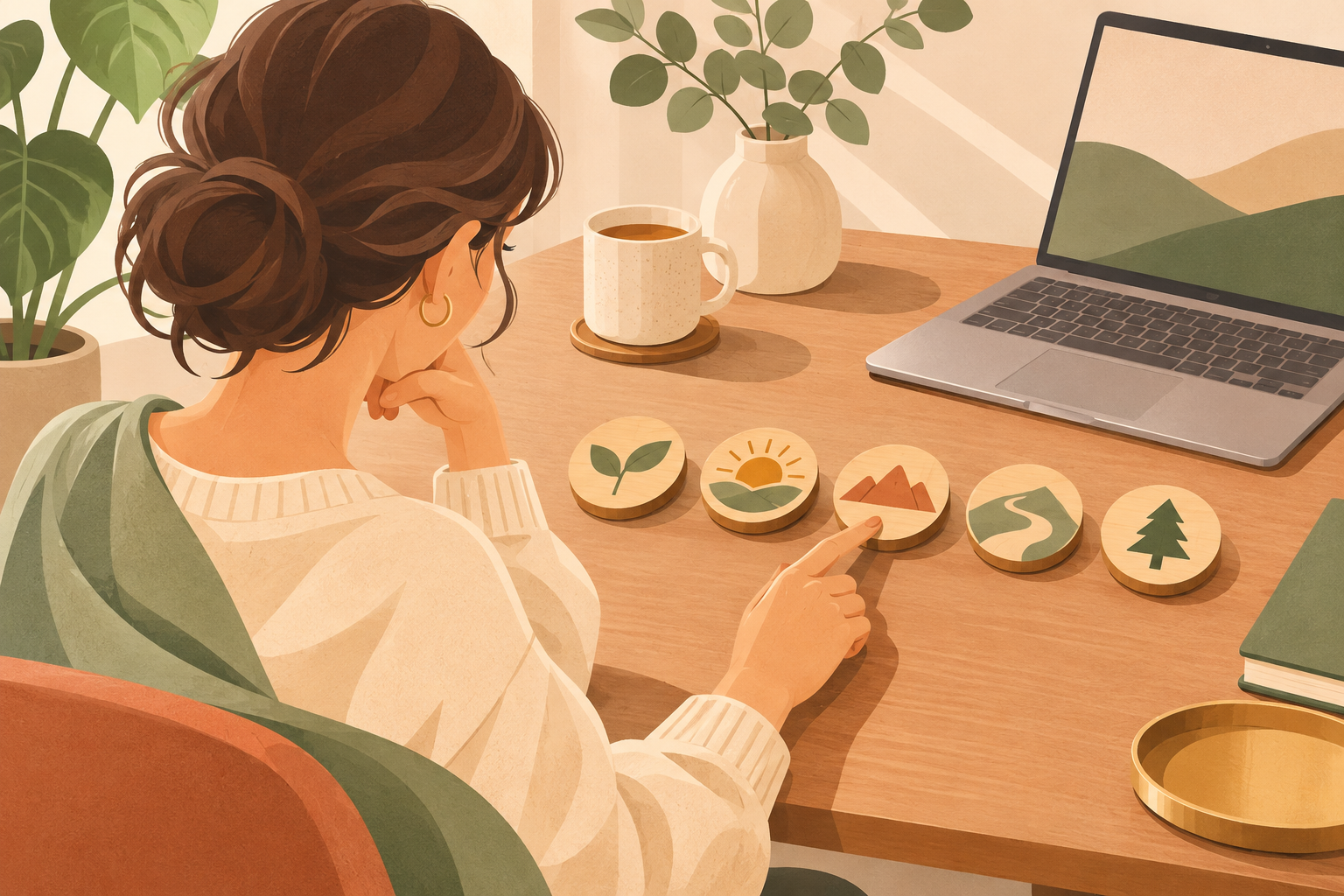
Why is it so hard to keep meditating at home?
Practicing alone and practicing with support differ in two ways: who is holding you up, and how far you step away from daily life.
At home, two minutes after you sit down, the washing machine beeps and your phone lights up. Stopping doesn’t mean your will is weak. You are practicing in a place where it is hard to continue.
Which way of practicing meditation suits which person?
Practicing on your own suits someone who wants to try first. It is free and you can start today, though it is hard to check whether it fits you.
Working with a professional, in a class or one-on-one, suits someone unsure about the method. You can ask questions on the spot, but your fit with the teacher matters.
Joining a place, such as a residential or program-style retreat, suits someone who can’t keep going alone. You get a few days away from daily life, and you need to check cost, dates and your health.
None of these ranks above the others. Choosing the one that fits you now is enough.
What should I check when choosing a meditation class or retreat?
What should I confirm before I sign up for a meditation class or retreat?

There are five safety checks. You can confirm all of them from the website and by asking, before you press the sign-up button.
- Is the organizer’s background clearly stated?
- Can you say “I’ll stop here” partway through?
- Are the fee and cancellation rules clear in advance?
- Is there follow-up after it ends?
- How intense is the breathwork, and will someone be with you?
Even if you feel like signing up on impulse, it is not too late to sleep on it and check the five first.
Is meditation safe for everyone?
Meditation is generally considered low risk. Even so, there are reports of unwelcome experiences, such as anxiety getting stronger.
If you are currently under medical care, talk to your doctor first.
I slip back when I’m alone. Is it okay to go straight to a two-night, three-day retreat?
Can a first-timer join a two-night, three-day meditation retreat?
A first-timer can join a two-night, three-day retreat if the conditions are in place. That means your health can take it without strain, and you have been able to check the five safety points: the organizer’s background, the freedom to stop, fees and cancellation, follow-up, and breathwork intensity and supervision.
It is not a path we would recommend to everyone.
What can I do if I keep slipping back on my own?
If you have tried on your own and keep ending up where you started, a place that takes you out of daily life for a few days is one option.
Just one example. We at nehan run the Soumatou Journey (走馬灯をみる旅), a two-night, three-day residential program in Kobuchizawa. The 14 days after you return home are also part of the program.
You can read more at the Soumatou Journey. Words from people who have taken part are in their stories.
FAQ
Q: How many minutes a day should I meditate? A: There is no fixed right answer. Start with 1 to 3 minutes; being able to continue without strain comes first.
Q: What is the difference between meditation and mindfulness? A: Mindfulness is one form of meditation, in which you place your attention on the present moment. Meditation is the broader word.
Q: What is the difference between meditation and contemplation? A: Contemplation is quietly thinking something through. Meditation is practice in redirecting your attention without following your thoughts.
Q: Can meditation make me feel worse? A: There are reports of anxiety getting stronger, among other things. If it feels hard, stop and rest, and if you are under medical care, talk to your doctor.
Q: How much does the Soumatou Journey cost? A: We share the fee at our assessment sessions.
Tonight, start with just paper, a pen and one minute. If the days when your head won’t rest keep coming anyway, we hope you’ll remember that there are forms of practice with support.
FREE PROGRAM
A doorway to seeing your life anew — through the body
Add us on LINE to receive the free online lessons — the parts we couldn’t fit into this article.
Free to join, unsubscribe anytime. This is not medical treatment; results vary by individual.
Sources/References
- Ministry of Health, Labour and Welfare, eJIM (Information Site for Evidence-based Japanese Integrative Medicine), “Meditation”
- nehan, published program overview (/soumatou/)
This article is general information, not medical advice. Results vary from person to person. If you have concerns about your health, please consult a professional.




