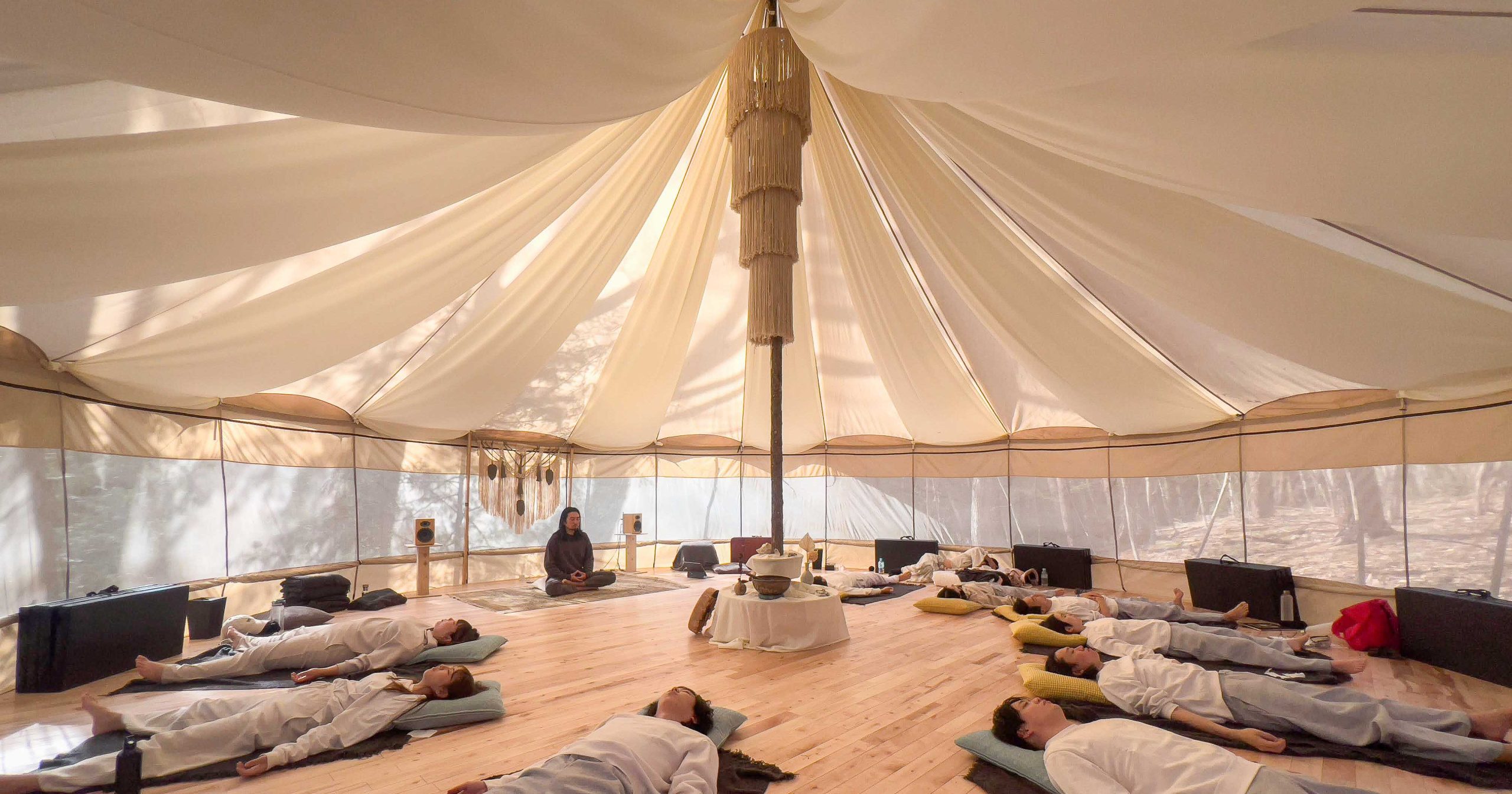


Key takeaways
- Postpartum breathing is a practice of reconnecting the diaphragm and pelvic floor, making abdominal pressure and physical tension easier to work with.
- The starting point is not “take a deep breath.” It is slowing down the exhale and noticing how much your body is bracing right now.
- Breathing does not have to solve every postpartum difficulty. When pain or low mood is intense, getting support alongside a professional is the more realistic path.
Your baby has finally fallen asleep. And somehow, you still cannot sleep.
It is 2:40 a.m. You finish feeding, place your baby in the bed, and their eyes snap open. Your shoulders are still drawn in as you type “postpartum breathing exercises” into your phone, lit by the screen. You are exhausted, but your body is awake as if it is still on shift. A lot of people are probably searching on nights like this.
You are lying down, yet tomorrow’s plans, the laundry, and the message you have not replied to are all lining up in your mind. You probably know this.
“Can breathing really change anything?” you might be thinking. Honestly, that is a fair question. Breathing is often turned into vague self-help talk, and against the reality of postpartum exhaustion—lack of sleep, afterpains, feeding, housework all arriving at once—it can seem like a pretty flimsy answer.
But I do not think postpartum breathing should be dismissed as a mere comfort measure. Breathing practice is not about forcing yourself into a positive mood. It is a way to reconnect the diaphragm, abdomen, and pelvic floor, creating a little room in a body that can easily stay frozen in a state of alert.
The pelvic floor does not move well when all it does is brace

When people talk about the postpartum pelvic floor, it is often framed as: just do more squeezing exercises. I think that advice is only half right. Adding more squeezing strength alone does not create good coordination if you are holding your breath, locking the area beneath your ribs, and pushing abdominal pressure upward. It is like pressing the brake and the accelerator at the same time, then wondering why the car will not move.
Maybe your lower abdomen tightens every time you lift your baby. Maybe you brace in the bathroom, already thinking, “What if I leak again?” Have you noticed this? It is not that your pelvic floor is simply being lazy. Sometimes your whole body has been stuck in a mode that says: do not drop them, hurry up, be ready.
Wei & Guo (2026) reported significant changes in diaphragm function, the regulation of intra-abdominal pressure, pelvic floor health, and core stability in an intervention that combined structured breathing practice with pelvic floor muscle training. The participant group was limited, and there is still room to examine how these effects hold up over longer periods. Still, the interesting point is that breathing connects directly to the pelvic floor. What can look like two separate subjects—breathing and the pelvic floor—may be working as one team inside the body.
The mechanism is fairly physical. As you inhale, the diaphragm descends and pressure inside the abdominal cavity changes. As you exhale, the diaphragm returns, and the pelvic floor can coordinate more easily with that movement. When this up-and-down rhythm is awkward, even small movements—standing up, turning while holding your baby, lifting laundry from a basket—can bring extra tension into the abdomen or buttocks. The body is not a collection of separate parts. It works through coordination. Telling one area to “try harder” does not always help.
Picture 7 a.m.: your baby is balanced on one arm, and with the other hand you switch off the electric kettle. If “do not drop them” makes you hold your breath too, your neck moves forward, your jaw hardens, and your lower abdomen pulls tight. This is not only a pelvic-floor issue. Your whole body is sounding an alarm. You may think you are moving normally, then notice you have been clenching your teeth. Postpartum, this is very common.
POINT
Before cueing the pelvic floor to work harder, start by observing: what tightens when you inhale, and what returns when you exhale? If pain, strong discomfort, or urinary leakage continues, speak with a professional who works with postpartum bodies.
A longer exhale may also change how pain is experienced

After childbirth, it is easy to put your own physical sensations last. Your baby crying, feeding time, an older child saying “Look at this,” the delivery at the door. Discomfort in your lower abdomen goes to the very back of the line. On a Sunday evening, you stand in front of the dishes thinking, “I’ll take care of myself later,” and then later never comes. It may feel something like that.
In a case study, Fitriani & Ningrum (2024) reported a reduction in pain scores after deep-breathing relaxation was used for acute pain following vaginal delivery. Because it was a case study, we cannot assume the same result will happen for everyone. I do not agree with the careless claim that “breathing makes pain disappear.” But the pathway makes sense. Slow breathing may help shift the body toward parasympathetic nervous system activity, making heart rate, blood pressure, and muscle tension more likely to settle. When muscles remain braced, the brain may be more likely to interpret incoming signals from the body as possible danger. When the tension softens, there can be a little more distance from that interpretation.
Pain itself is not the same as the prediction around it: “Here it comes again,” “When will this end?” or “I cannot do this today.” Distress gets much bigger when today’s sensation is layered with past difficulty and worry about what comes next. People say, “Try not to think about it.” But if that were enough to make you stop thinking about it, this would all be easy. So the purpose of breathing is not to deny pain. It is to avoid amplifying the alarm your body is already sending more than necessary.
At 5 p.m., afterpains are bothering you. There are two bottles in the sink and cold miso soup in the pot. Then your abdomen tightens again. When “Here it is again—I cannot do today anymore” piles on top of the pain, your breathing tends to become fast and shallow. Instead of trying to drive the pain away, slow down the exhale just a little. It is one way of telling your body, “Maybe you do not have to keep fighting right this second.”
After seeing many kinds of breathing practices, this is the sequence I want to keep—not a dramatic technique. Trying to breathe perfectly rarely lasts. And postpartum is not the time to give yourself another assignment.
- First, notice whether your exhale is rushing more than your inhale.
- Next, release tension in just one place: your shoulders, jaw, or buttocks.
- Finally, rather than trying to get the next breath right, simply count it.
On some days, three breaths are enough. If your baby cries the next moment, that is the end of it. That is fine. Parents have enough to do without turning breathing practice into a scored event. A day when you could not do it is not a failure. It was simply a day of living with a baby.
Box breathing is less about “getting yourself together” and more about creating a pause before you react
In a quasi-experimental study, Francis et al. (2026) reported significant differences in afterpain scores and postpartum blues scores between the group that practiced box breathing and the control group (p < 0.05). This study, too, has limitations in sample size and long-term outlook. Even so, the fact that differences appeared in both physical discomfort and shifts in mood is worth noticing. It is one reason not to separate postpartum body and mood too completely.
“Is this going to be another empty-your-mind kind of lecture?” Fair enough. But box breathing is less a mysterious technique than a way to make a few seconds of space between a reaction and what you do next. You count the inhale, hold, exhale, and hold for roughly equal lengths of time. As breathing slows, attention can shift from worry replaying in your head to the air moving through your nose or the movement of your ribs.
The brain predicts its next state based partly on the signals coming from the body. If fast, shallow breathing continues, it can reinforce a prediction of danger. If the brain receives a calmer rhythm several times, that prediction may be adjusted a little. Breathing is like a report sent to the brain. It is a very plain format, but there is a difference between sending “Emergency” every minute and sending “Checking the situation for now.” The response that follows may change.
At 10 a.m. on a Monday, your partner texts: “I’ll be home late today.” Your baby woke up after only 30 minutes of morning sleep, and there are three unwashed mugs in the room. It is only a scheduling message, but “I have to do everything myself” suddenly expands. You have seen the message but cannot write back, and you open the same screen again and again. There may be a version of this moment you know.
In those few seconds, inhale for a count of four, hold gently for four if it feels comfortable, and exhale for four. If holding your breath feels difficult, skip the holds. It defeats the point to work so hard at breathing that it becomes uncomfortable.
Writing this, I realized that postpartum breathing may not require emptying your mind. You hear crying and panic. You cannot reply to a message and feel worse about yourself. Your body does not feel like it did before, and you do not know what to make of that. Rather than trying to erase those reactions, create a few seconds of space between them and you. That alone can give you a few more choices: drink some water, text someone “Today is hard,” sit down for a moment. None of this is dramatic. But these small choices can change a day.
Check your current breath
Do not change it. Just notice once: the speed of your inhale and exhale, and whether your shoulders rise.
Lengthen the exhale slightly
Rather than taking a big inhale, find an exhale that is a little slower and longer without strain. Stop if you feel dizzy.
Link it to an existing action
Take a few breaths before a routine moment, such as standing after feeding or taking off the baby carrier.
“I cannot keep it up without a device” is more normal than it sounds
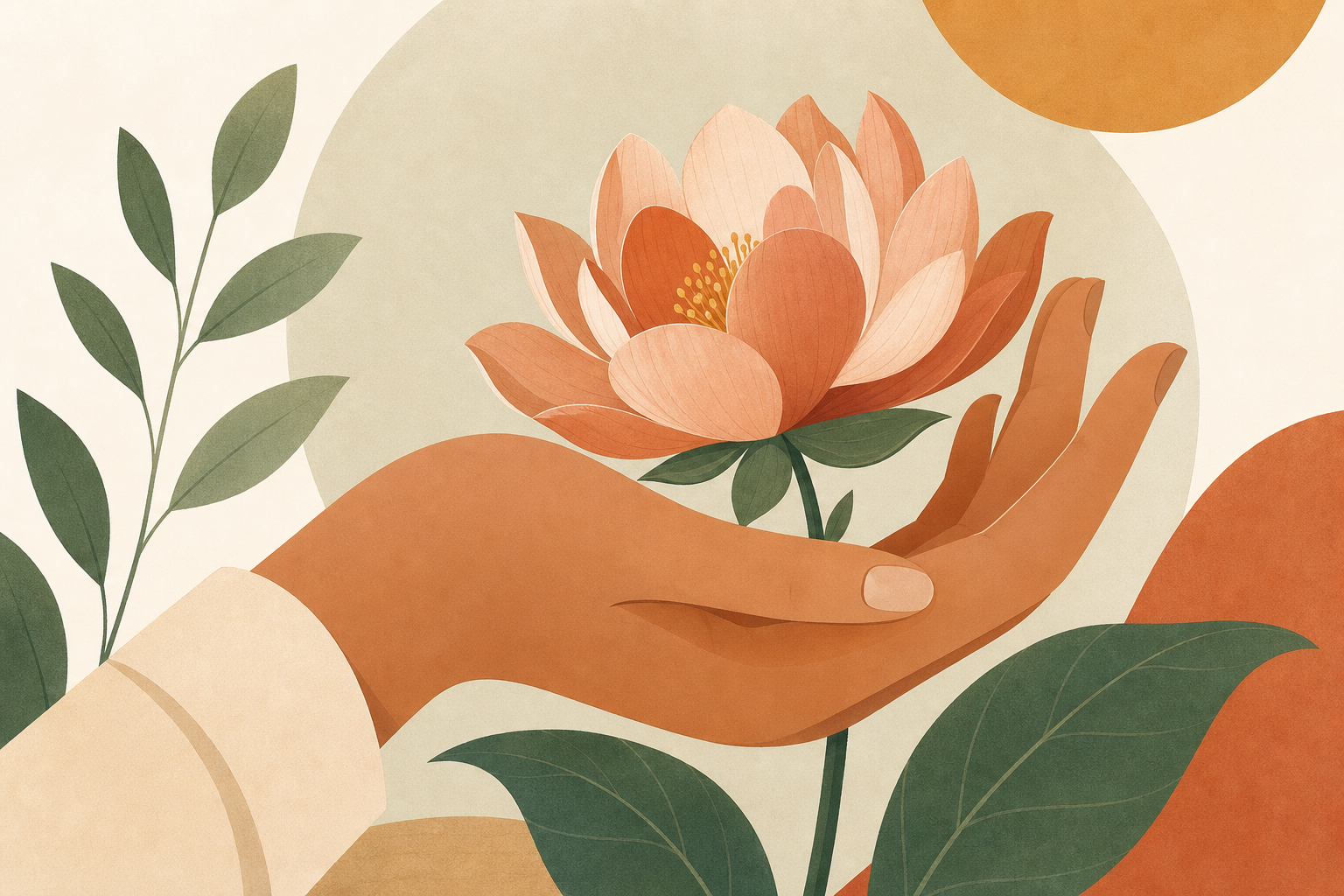
In a pilot study using the handheld mindfulness breathing device “Just Breathe” with postpartum women, Sales et al. (2026) reported user satisfaction and participants’ sense that their stress had eased. However, effect sizes for anxiety and stress on psychological measures—Cohen’s d—were minimal, and there was no control group. It is better not to read more into this than the study supports. There is not yet evidence to say that a device solves anxiety.
Still, there is a counterintuitive point here. Even when physiological changes such as increased heart rate variability (HRV) are not large, a person may still feel “a little better.” When a device sets the pace from outside, an exhausted brain does not have to decide, every time, “What am I supposed to do?” In postpartum life, when cognitive resources are low, that saved effort can matter. It is not about motivation or willpower. It is about reducing the number of decisions you have to make.
At 3 p.m., your baby is asleep, but you are sitting on the sofa still holding your phone, unable to move. Even remembering the steps of a breathing exercise feels like too much. You look only at notifications, cannot reply to anything, and suddenly 15 minutes have passed. In that moment, if a small note on the refrigerator or a phone timer can be your cue, it does not mean you lack discipline. It means you have let your environment carry one decision for you.
Are you blaming yourself for not remembering to breathe?
Postpartum sleep is fragmented. Attention and emotional bandwidth are worn down. When “I’ll do 10 minutes every morning” does not last, it is often not a personality problem. More often, the plan does not fit your life. Your baby does not sleep on schedule every day, so expecting the parent to regulate on schedule every day can be unrealistic. Attach a few breaths to something that already happens: the end of a feed, before using the bathroom, after locking the front door. This is more likely to remain than an impressive goal.
Do not carry everything with breathing alone

Karuniriati et al. (2025) reported that combining perineal massage and deep breathing was associated with fewer perineal injuries during childbirth among first-time mothers. This was research conducted during labor, not something that can be applied in the same form postpartum. Still, its perspective is useful: rather than treating tissue flexibility and relaxation as separate issues, it views them within the overall tension of the body.
The same is true postpartum. Breathing is not a stand-alone magic solution. It is one element alongside rest, nourishment, help from people around you, and professional support when needed. Let me be clear: trying to make breathing handle everything is asking too much of yourself. I do not think the postpartum body is a project for getting back to your old self as quickly as possible. It is a period of building a way of feeling that fits the life you are living now.
Whether your old clothes fit, whether the house is tidy, whether you can reply to work messages right away—people around you can be quick to push the idea of returning. But after caring for a creature that wakes through the night, while your own body has changed profoundly, demanding that you function exactly as you did before is harsh. After getting your baby to sleep, leaving the dishes until tomorrow and sitting down is also a decision that protects your body.
If pain suddenly becomes severe, you have shortness of breath or chest discomfort, or low mood or anxiety makes everyday life hard to manage, do not keep waiting it out with breathing exercises. Contact your maternity care provider or a local support service. This is not weakness. It is sound judgment. Enduring alone and doing your best as a parent do not mean the same thing.
The three minutes while your baby sleeps may not be enough to rebuild your whole life. But some days, you may be able to notice that your shoulders are raised and let one exhale be less rushed. That small signal may be enough to lower the volume of your body’s alarm a little.
FAQ
Q: When can I start postpartum breathing exercises? A: It depends on how your birth went and how your body is doing. Simply observing your breath while seated may be a low-demand place to start. If you have had a cesarean birth, are in significant pain, or notice changes that concern you, such as bleeding, it is safer to check with your maternity care provider first.
Q: How many seconds should I inhale and exhale for? A: Prioritize staying comfortable over a specific number of seconds. You might make your exhale slightly longer, but shorten it again if it feels constricted. If you are holding your baby, you do not need to count at all. Simply noticing that your shoulders lower as you exhale is enough.
Q: Breathing does not make my irritability or anxiety go away. Does that mean it is not for me? A: Not necessarily. Breathing is not a tool for erasing feelings. It can be an entry point for observing the momentum of your reaction a little more easily. On some days, it is more important to put ongoing difficulty into words with family, a midwife, or a local community support service than to carry it alone.
A few postpartum breaths are not another assignment designed to make you work harder. When your mind understands something but your body cannot follow, they can be one way of approaching the reaction from the body’s side.
At nehan, we design retreats that offer a step-by-step way to work with tensions and old response patterns that can be difficult to untangle through everyday thinking alone. We share that approach, and the bigger picture for bringing it back into daily life, in our free online course.
FREE PROGRAM
A doorway to seeing your life anew — through the body
Add us on LINE to receive the free online lessons — the parts we couldn’t fit into this article.
Free to join, unsubscribe anytime. This is not medical treatment; results vary by individual.
Sources / References
- Wei, X. & Guo, Y. (2026). Study on combining breathing exercises and pelvic floor muscle training in postpartum women.
- Fitriani, F. & Ningrum, T. P. (2024). Case study of deep-breathing relaxation for acute pain after vaginal delivery.
- Sales et al. (2026). Pilot study of the handheld mindfulness breathing device “Just Breathe” for postpartum women.
- Francis et al. (2026). Quasi-experimental study on box breathing, postpartum afterpains, and postpartum blues.
- Karuniriati et al. (2025). Experimental study of childbirth care combining perineal massage and deep-breathing techniques.
This article provides general information and is not medical advice. Results vary, and if you have concerns about your health, please consult a qualified professional.