

Key takeaways
- An altered state of consciousness is a broad term for experiences in which your sense of time, body, or self shifts from its usual waking form.
- These experiences are not rare. Population research has reported that around 30% of people have had one.
- More useful than how dramatic an experience was is whether it created even a little distance from your usual patterns of reaction afterward.
It’s 12:17 a.m. You put your phone face down and decide you should sleep, but then there are a few minutes when you can’t quite tell whether you’re asleep or awake. The low hum of the air conditioner keeps going. Suddenly, the edges of your hands and feet feel less distinct. Images of an old classroom appear. A few minutes seem strangely long.
And in that moment, you think: *Is something weird happening to me?*
You’ve probably had something like this, too. Not only before sleep. Maybe your own voice suddenly felt far away while you were working. Maybe you took a long bath, looked at the clock, and realized 40 minutes had passed. Maybe you got so absorbed in something you enjoy that it was suddenly evening. We simply don’t go out of our way to tell people about these small shifts.
An altered state of consciousness is not some inexplicable event reserved for unusual people. It can arise at the edge of dreaming, in deep meditation, through intense absorption, or in environments with reduced sensory stimulation. Put simply, it is a temporary shift in perception, time sense, and the way you experience yourself and your body, away from your ordinary waking mode. I think it is best to leave the definition around there, at least to begin with.
I don’t think we should surround these experiences with dramatic language from the start. The faster we name them, the less clearly we can see what actually happened. A simple question—“What was that?”—quickly turns into grading: “Was this a valid experience?” “Is there something wrong with me?”
“Maybe I’m the only one who’s strange” may be a very quick conclusion

In a population survey, Wright et al. (2024) reported that around 30% of people had experienced altered states of consciousness. Of those people, fewer than 10% went on to seek clinical support. It was self-reported research, so there is still room for fuzzy memory and differences in how people answered the question, “Does this count as an experience?” We do not need to treat the number as absolute. But the point worth noticing is that the experience itself may be more ordinary than it seems.
And yet, people rarely tell anyone.
The reason is fairly simple: they do not want to be seen as strange. On Monday morning, holding a paper cup of coffee in the office kitchenette, it is hard to say, “Last night, before I fell asleep, my body felt far away.” The person beside you will probably say, without meaning any harm, “Maybe you’re sleep-deprived?” and leave it there. You may be able to tell someone that you keep opening an unread chat screen, waiting for a reply. It is much harder to say that your sense of time disappeared. So the experience grows larger than necessary inside your own mind.
I think half of the advice that says, “You should immediately make meaning of a strange experience,” is wrong. You felt scared. It felt good. You did not know what to make of it. Those are the primary facts. But people skip over them and attach labels: “awakening,” “failure,” “a warning sign.” Then the brain begins collecting evidence that fits the label. The human brain takes the words you enter into the search bar seriously and goes looking for them. A bit inconvenient, perhaps, but that is how it works.
This is close to the cognitive biases addressed in cognitive behavioral therapy. When we place a threatening interpretation on an ambiguous sensation, the body becomes more vigilant. We monitor changes in heartbeat or breathing even more closely and conclude, “See? It really is dangerous.” That loop can intensify anxiety.
For example, it is 11 p.m. You are in bed, and your heart gives one heavy thump. If the thought is, “It’s happening again,” your ears begin searching for your heartbeat, your shoulders tense, and the drowsiness disappears. You lay down to sleep, but now you have become a body monitor. If, instead, you can hold it lightly as, “My senses seem sensitive tonight,” you may track the same heartbeat less intensely. How we interpret an experience shapes what happens next, separately from the experience itself.
POINT
Right after an altered-state experience is not the time to reach a conclusion. It is the time to place the facts separately: “What did I see?” “What was happening in my body?” “What changed in my everyday life afterward?” Don’t blend them together. This alone can reduce a great deal of confusion.
You may be thinking, “But I want to know what it means.” Of course you do. If it frightened you, you may want to know even more. But the meaning can wait a little. First, separate what you saw, what happened in your body, and how you were afterward while doing the dishes. That order makes it less likely that the experience will swallow you whole.
The brain is not simply “resting”—it may be reorganizing information

“If you reduce sensory input, the brain will become quiet too.” Many people probably assume that. Close your eyes in a dark room and nothing should happen. You are simply resting. That would be the ordinary expectation. But it may be a little different.
Wackermann et al. (2002) studied the Ganzfeld state—in which external stimulation is made uniform through homogeneous light and sound—and the hypnagogic state around sleep onset. They observed increased alpha-wave activity in the Ganzfeld condition and increased theta-wave activity during sleep onset, and examined their relationship to subjective experience reports. When less information is coming in from outside, the brain does not simply stop. One way to understand it is that memory, imagery, and bodily signals from within may carry more weight.
Think of your morning commute. On the Yamanote Line, there are ads in front of you, train announcements, someone’s music leaking from their earphones, the coldness of the overhead strap. Your brain is busy processing the outside world. Your notifications go off. You are thinking about the transfer. You check whether your wallet is still there. Now compare that with a Saturday afternoon, lying down in a room with blackout curtains closed while the sound of the ventilation fan stays exactly the same. Suddenly, an image of a high-school hallway may appear, or something you never said.
Have you ever thought, *Why that scene, now?* It is a little too rough to dismiss it as, “My brain was bored and started fantasizing.” It may be more natural to say that internal information, usually kept in the background, becomes easier to notice. As outside processing decreases, the volume of memory, bodily sensation, and imagery goes up. Like turning off the television and noticing the refrigerator motor for the first time.
That said, this does not mean that more alpha waves produce one specific emotion, or that theta waves give everyone the same experience. Brainwaves are only one clue to a state. Individual differences, fatigue that day, and how safe you feel in the space all enter the picture. Asking brainwaves to handle all of life’s questions is asking rather a lot of them.
The classification proposed in a review by Fort et al. (2025) also shows this complexity. Altered states of consciousness can be categorized by the felt state itself, by the method used to reach it, or by neurological and physiological indicators. No single yardstick fully captures them.
- State-based: Looking at the person’s experience itself—for example, time feeling slower, changes in self-experience, or more vivid imagery.
- Method-based: Looking at the entry point—for example, the edge of sleep, meditation, deep absorption, or changes in sensory stimulation.
- Neurophysiological-based: Looking at measurable changes, such as brainwaves or bodily responses.
“Was it a dream, an out-of-body experience, or a meditative state?” Sometimes there is no way to narrow the answer down to one thing. Some people may feel unsettled when they cannot make it black and white. But that does not mean ambiguity is a failure. It may simply mean you are looking from different angles. It is like judging a meal by taste, nutrition, or price: the conversation changes depending on what you are measuring. Experiences can be viewed in more than one way, too.
What may be happening when the body’s boundaries and time start to blur

Flotation-REST is a session using buoyant water and an environment with minimal stimulation. Hruby et al. (2024) reported that altered states of consciousness could be induced in this environment, including a sense that bodily boundaries had become less distinct and distortions in subjective time. They recorded subjective reports and physiological measures to examine their relationship.
What is interesting here is that the feeling, “The outline of me is becoming faint,” is not merely a poetic expression. The brain normally keeps updating “this is where my body ends” by bringing together vision, pressure on the skin, muscle tension, gravity, and other signals. In an environment where you float, receive less information about weight, and have little noticeable sound or light, the material available for that update changes. It is reasonable to think that your sense of bodily boundaries and elapsed time may become more variable as a result.
It is a little like soaking up to your shoulders in a bath and eventually no longer being aware of where your feet are. You leave your phone in the changing room, do not check the clock, and then realize 40 minutes have gone by. You get out and think, “Wait, it’s this late already?” That is the smaller version. On a Sunday night, you get out of the bath and suddenly remember that the laundry and dishes are still waiting—that moment when ordinary reality returns. The experiences reported in flotation-REST may be a stronger version of this, occurring in a deliberately designed environment.
A case study by Mizugaki Yoshiyuki (2004) on lucid dreams and out-of-body experiences also focused on changes in clarity of consciousness and self-awareness. Because it is a case study, we cannot apply it to everyone. Still, it leaves room to see that an “out-of-body experience” may involve psychological processes that overlap with lucid dreaming, rather than treating the term only as a paranormal event.
Are you thinking, “Isn’t this just another vague spiritual argument?” That skepticism is sound. I actually think it is careless to explain everything away as mystery. Which is why we do not need to force an experience into a binary of mystical or pathological. We can respect how real it feels subjectively while also looking at it through the lens of brain, body, and environment. We need both.
Have you had a moment recently when time seemed to disappear? Maybe you were deeply absorbed in work you love. Or maybe you were so anxious that you kept checking the clock. Both involve a shift in time sense, but one may feel pleasant and the other exhausting. Once you look at that difference, the experience becomes much more concrete.
When you compete over the intensity of an experience, you move away from daily life

There is a common sticking point for people drawn to altered states of consciousness: they begin chasing intensity. “Deeper.” “More special.” After reading about someone’s powerful experience on social media, your own may start to seem plain. “Nothing happened to me.” But this does not need to become a competition.
The world often acts as if the more intense the experience, the more valuable it is. I do not see it that way. What changes a life is not how spectacular an experience was, but whether it creates a little space around your automatic reactions in everyday life. Being able to say, intellectually, “I understand,” and no longer reflexively doing what you always do are different things.
The following Tuesday, your manager says, “Can you revise this document?” Usually your solar plexus tightens and a debate begins in your head. Does even half a step of space appear before that reaction? At 10 p.m., standing in the kitchen in front of dirty dishes, can you notice the voice saying, “I haven’t accomplished anything,” simply as a voice? When an unread message has you imagining ten worst-case scenarios, can you catch yourself and think, “Ah, my predictions are running away again”? That is what I would look at.
Honestly, the harder you try to explain an experience well, the less language seems enough. “It was amazing” communicates nothing, but too much detail can pull you away from the experience too. So you do not need to turn it into an impressive story. There are nights when you drink miso soup while looking at your phone and cannot remember what you ate. There are mornings when you nod through a meeting while replaying a different worry in your mind. This is where changes—or the absence of change—show up: in these unremarkable places.
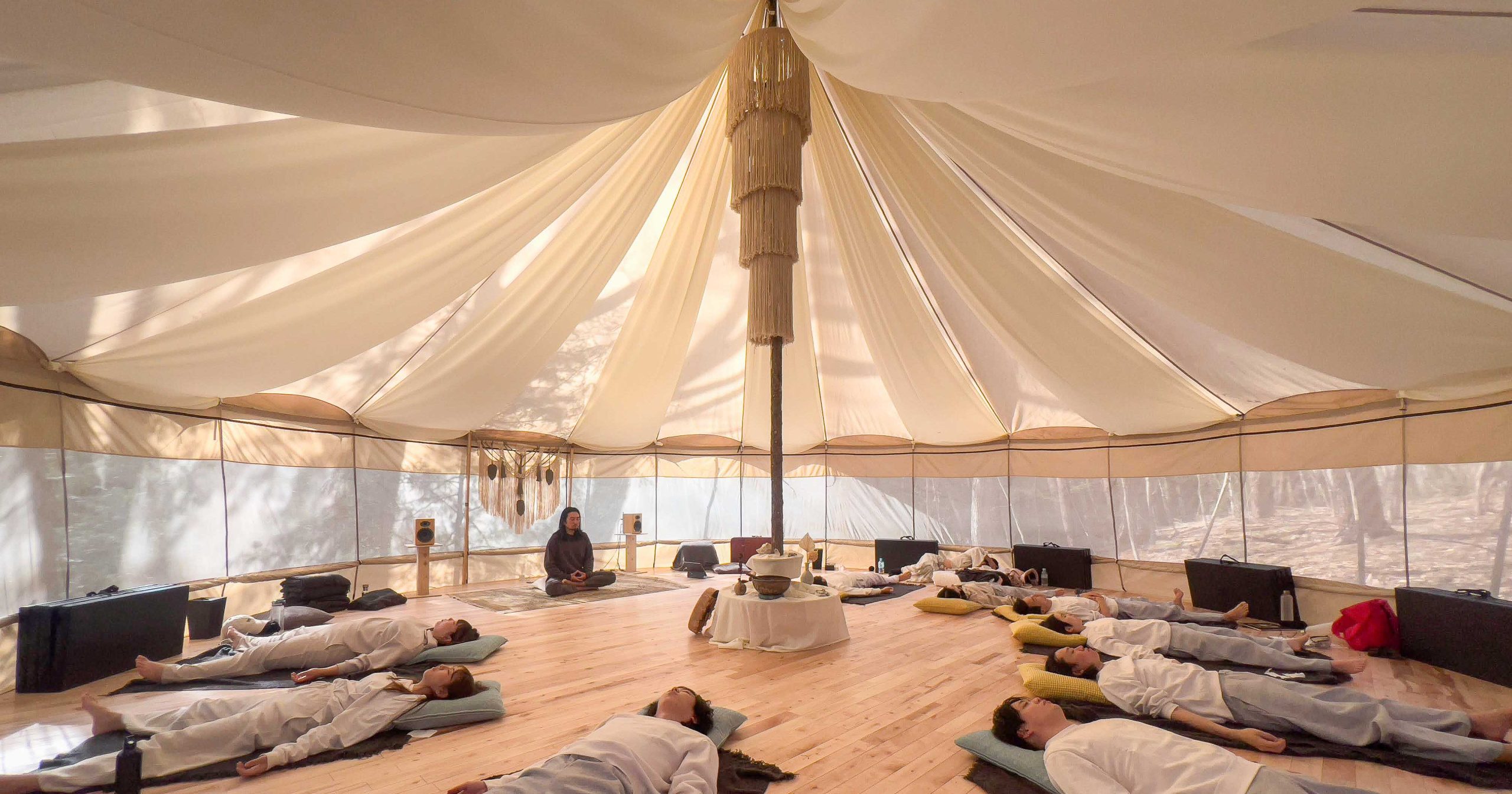
At nehan, we do not see retreat as a vacation for looking away from reality. In our two-night, three-day Journey to See the Life Review in the forests of Yatsugatake, we offer an actively designed process that uses sound resonance, breath-based practices, and bodily awareness to help you meet emotions and old reaction patterns that may be difficult to access while you are in your usual vigilance mode.
The aim is not to come home with a dramatic story. It is to create some distance from reactions you understood in your head but kept repeating, or to recognize through bodily sensation what had been wearing you down. A journey only becomes a journey when it includes how you return to daily life afterward. A retreat is not healing as escape from reality. It is a training ground for updating your relationship with your inner life. That may sound a little firm, but I want to be clear about it.
Soften everyday vigilance mode
Step back from incoming information and social roles, making it easier to return attention to bodily sensation.
Look at deeper reaction patterns
Create a setting in which you can gently approach emotions and memories that words alone may have helped you avoid.
Bring it into everyday choices
Let the experience become more than a story to remember—use it as an opening to revisit how you respond at work and in relationships.
If intense fear continues, sleeplessness overlaps with it, or you feel that daily life is being disrupted, please do not carry it alone. Reach out to a qualified professional. It is safer to distinguish between a space for talking about altered-state experiences and a setting for individualized physical or psychological care. This is not avoidance. It is a sensible decision not to treat your condition carelessly.
You do not need to give an altered-state experience the right answer right away. First, look at what happened. Then look at how your daily life changed afterward. Maybe your hand is a little less rushed when you open notifications in the morning. Maybe you pause once before agreeing to a request you usually could not refuse. Maybe you spend less time monitoring your body before sleep. Changes like these are often harder to fake.

FAQ
Q: How are altered states of consciousness different from dreams? A: There is not always a clear line. Experiences around sleep onset, lucid dreams, and deep absorption can overlap. Wackermann et al. (2002) observed increased theta-wave activity during sleep onset, and Mizugaki (2004) examined the possibility of psychological processes shared by lucid dreams and out-of-body experiences. It can help to record when it happened, what your body felt like, and how clearly aware of yourself you were.
Q: If I have an altered-state experience, will it change my life? A: It is not determined by whether you had an experience, or by how intense it was. The morning after a major experience, the trash still needs taking out and emails still need replies. But if it creates room to notice reflexive anger or self-criticism, it may influence your everyday choices. The key is not to consume the experience as a story, but to observe it in one ordinary moment of your life.
Q: Is it okay to try to enter a deep state on my own? A: It depends on your purpose, physical condition, and environment. Especially when anxiety is strong, we do not recommend forcing yourself toward intense experiences in an isolated place. Being able to talk about your situation with someone you trust or a professional, being able to stop partway through, and giving yourself time to return to ordinary life afterward—build that foundation before pursuing depth.
It would be a waste to view altered consciousness only as a rare phenomenon. But there is no need to rush it into an answer either. Why do we repeat our usual reactions? How might we create new room around those reactions through the body? In our free online course, we talk about these questions in practical terms, as well as what we work with step by step during the retreat.
I hope you can use it as an entry point for not leaving an experience as nothing more than “that strange thing that happened only to me.”
FREE PROGRAM
A doorway to seeing your life anew — through the body
Add us on LINE to receive the free online lessons — the parts we couldn’t fit into this article.
Free to join, unsubscribe anytime. This is not medical treatment; results vary by individual.
Sources / References
- Wright et al. (2024), population survey on the prevalence of altered states of consciousness and clinical support
- Mizugaki Yoshiyuki (2004), case study on psychological processes in lucid dreams and out-of-body experiences
- Fort et al. (2025), review of classification schemes for altered states of consciousness
- Wackermann et al. (2002), experimental study on EEG activity and subjective experience in Ganzfeld and hypnagogic states
- Hruby et al. (2024), experimental study on altered states of consciousness, bodily boundaries, and subjective time during flotation-REST
This article provides general information and is not medical advice. Individual experiences and results vary. If you have concerns about your health or condition, please consult a qualified professional.