


Yes, there are. For a 2-night, 3-day trip from the Kanto area, you can choose a temple-style stay, a nature-style stay, or a third kind: a forest introspection retreat.
One example sits at the foot of the Yatsugatake mountains, in the woods of Kobuchizawa, Hokuto City, Yamanashi, where the nehan retreat center runs a three-day program built around breathwork and silence.
Temple or nature? If you keep going back and forth between those two, it is not because you are indecisive. You simply have not laid the options side by side yet.
What should I use as my criteria when looking for a trip to rethink how I live?
What are the five conditions worth writing down before you search?
You can narrow it to five. The schedule fits in 2 nights and 3 days. The venue is reachable from Kanto. There is time to sit with yourself in silence.
You can join alone. And you can take part without any experience in meditation or similar practices.
That is the whole list. Nothing about scenery, nothing about the food, nothing about whether the photos look good. Those things matter later, if at all.
Why write the conditions down before looking at any retreats?
Because if you start browsing without them, you will end up ranking places by how pretty the pictures are. You probably know this already. Twenty minutes in, you have three tabs open and no idea what you were actually looking for.
So write the five on paper first, then open the search. If you are planning to go alone, I have collected the things to think through in a 2-night, 3-day solo trip to rethink work and life.
Should I choose a temple-style retreat or a nature-style retreat for resetting the body?
What are the three types of retreat, and how do they differ?
The answer is not to make it a choice between two. Add a third type and compare all three.
Temple / shukubo stay
Built on form and discipline. You wake, sit, and eat at fixed times. Entering the structure is what quiets the mind.
Nature / food retreat
Built on physical recovery. At a lodge in the mountains or by the sea, you restore yourself through meals and sleep.
Forest introspection
Built on bodily sensation. In the stillness of the forest, you practice breathwork and sit quietly, and you watch your habitual reactions from inside the body.
How do the three types compare on the five conditions?

These are general tendencies, not rules. Temple stays run from one night to several days, take place at a temple or shukubo, require no experience, and usually welcome solo participants.
Afterwards, continuing is up to you: you keep sitting on your own.
Nature retreats also run one night to several days, at a lodge in the mountains or by the sea, with no experience needed and solo participation common.
What you carry home is the meals and the sleep, and whether they continue depends on your kitchen and your bedtime.
Forest introspection retreats are often structured as 2 nights and 3 days at a facility in the woods. Some require no experience, and solo participants are usually welcome.
The difference shows up afterwards: depending on the place, there may be follow-up once you return.
Which type fits if I want to see my own patterns?
None of the three is better than the others. There is only a fit, or not a fit. Picture this: someone says one offhand thing at lunch, it stings, and by evening you are still carrying it around.
If what you want to look at is that pattern itself, rather than your sleep or your posture, then it is probably the third type.
How to set your own axis for comparison is something I have also written about in how to choose a retreat for reflecting on your life.
If I go for 2 nights and 3 days from Kanto, how do I arrange the leave and the travel?
How much leave do I need, and how long is the journey?
If you book Friday to Sunday or Saturday to Monday, one day of paid leave is enough. For the foot of Yatsugatake, the limited express from Shinjuku takes around two hours, and driving the Chuo Expressway from central Tokyo takes roughly two and a half.
These are general estimates for the area (sources at the end).
For a sense of the region, see retreats in Yatsugatake and Yatsugatake in 2 nights and 3 days from Tokyo.
How should the three days unfold once I am there?

Whatever the venue, the three days tend to go more smoothly when they follow a shape like this. It is a general outline, not a program.
Day 1: Arrive and let the body settle
Loosen the tension of the journey and get used to hours in which nothing pings.
Day 2: Go in deep
The day with the longest stretch of quiet. This is when you touch your own habits.
Day 3: Put it into words and go home
On the train window on the way back, jot down one line about what you noticed.
FREE PROGRAM
A doorway to seeing your life anew — through the body
Add us on LINE to receive the free online lessons — the parts we couldn’t fit into this article.
Free to join, unsubscribe anytime. This is not medical treatment; results vary by individual.
Why do I need to travel so far? Wouldn’t somewhere nearby, or home, work just as well?
How does distance itself become a boundary from everyday life?
Because the two or three hours of travel are what draw the line between the trip and the rest of your life.
- Leave the everyday — The journey itself marks the edge of daily life
- Easier to step away from mental habits — Less likely to be pulled back into dishes or work logistics
- See from the body — Touch your habitual reactions in the quiet
- Return and continue — Because it is close enough to go back, the next time is easier
Too close, and the mind drifts back to the dishes in the sink or the packing you still have to do. Too far, and fatigue and cost make a second trip unlikely.
Two to three hours from Kanto is the distance at which you are cut off, but can still return.
Does going farther mean changing more deeply?
Not necessarily. There is a reasonable view that what decides the depth is not the distance you travel but the days after you get back. The convenience store on the way home from the station is still there, and so is the message you have not answered.
There is research that compares measures such as mood before and after retreats lasting a few days (sources at the end). It suggests change is possible, but it does not say that farther is better.
Is there anything I can try on my own first?

What three things can I try before signing up for anything?
Three. First, take ten minutes and write down on paper whatever is snagging on you right now. Second, leave half a weekend day empty of plans and put your phone in another room.
Third, sit somewhere quiet for five minutes and notice only where your body is tight. Nothing else.
For some people, that is enough. But if you rest for half a day and still land in exactly the same place on Monday morning, it is not necessarily a question of willpower.
Thinking alone, the mind runs along its usual grooves, so it tends to reach its usual conclusions.
What do the different approaches cost, and where does each one stop working?
These are general figures. Thinking it through yourself costs nothing and can happen any time; it suits people who want to try first, and its limit is that you keep arriving at the same conclusion.
Talking with a professional costs a few thousand yen or more per session, usually continued weekly. It suits people who want help putting things into words, and the limit is that you need the stamina to keep going in the middle of ordinary life.
Joining a retreat costs tens of thousands of yen or more and takes 2 nights and 3 days. It suits people who want to step out of daily life and work through the body.
The limits are that it requires leave, money, and a careful check on safety.
If I keep sliding back on my own, what kind of place should I choose?
What yardstick should I use when choosing a retreat?
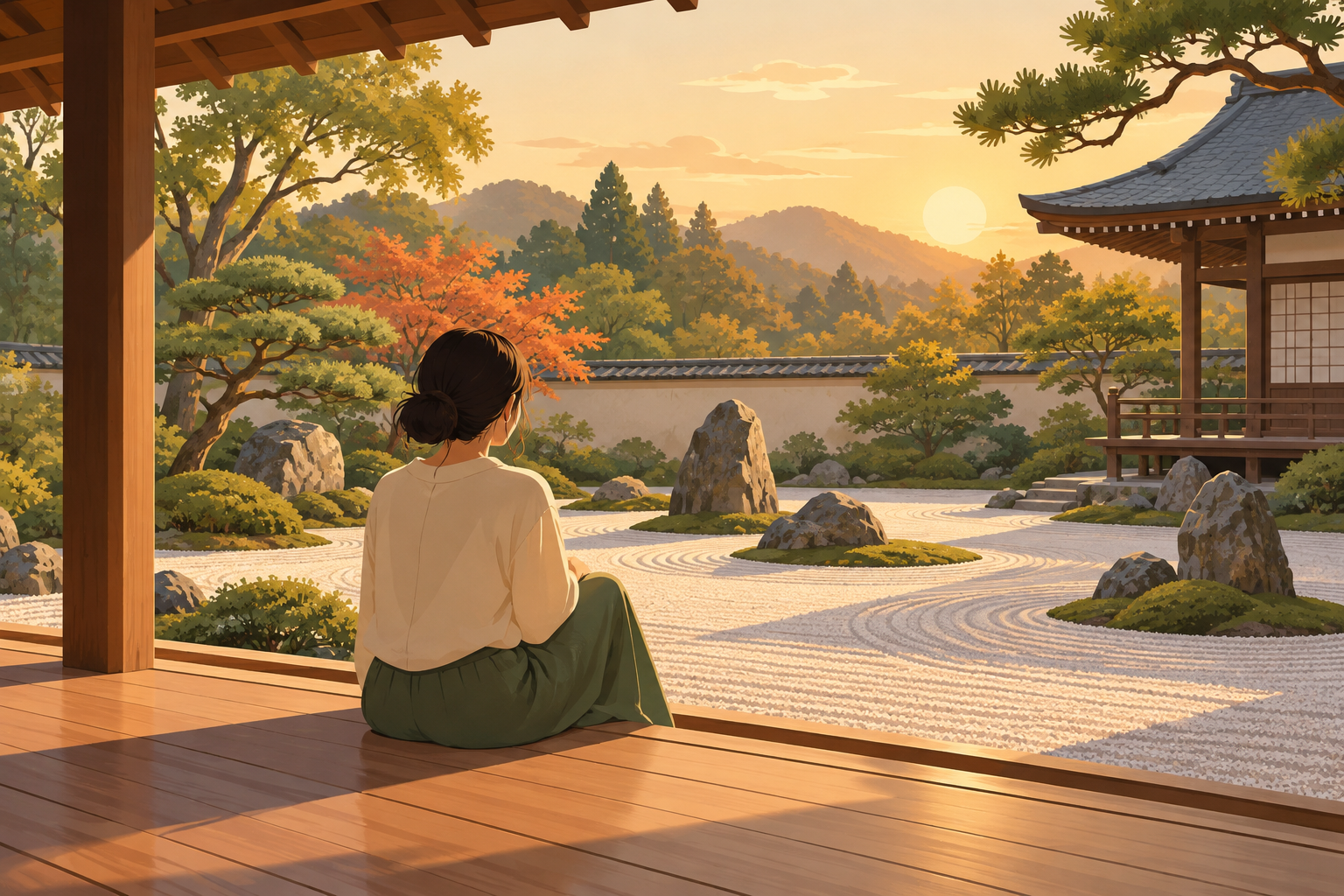
A retreat where you step away for a few days can be one option, if the conditions line up. But the yardstick is not “does it look pleasant.” It is safety.
If even one of these is vague, ask before you apply. Temple or forest, apply the same measure. The questions are laid out in five questions to ask when a retreat feels off.
Is it fine not to choose a retreat at all?
Yes. If all you want is to reset your body, the nature type is enough. If you want to learn a form and a discipline, the temple type is enough. And you are free to choose none of them.
The one case where I would say something stronger is this: if you have tried on your own, more than once, and keep returning to the same spot, then a few days away to face it is one legitimate means. Not the only one. One.
Is it all right to go straight into 2 nights and 3 days of breathwork and silence in the Yatsugatake forest?
Can a complete beginner start with a full three-day retreat?
Two things need to be stated clearly: “no experience required” and “solo participants welcome.” If both are written down, there is a way in, even for a first time.
If either is missing or hazy, that is the question to ask before anything else. It is the same check you would run on a temple stay.
What is nehan’s “Soumatou” journey?
nehan’s “Soumatou wo Miru Tabi” is a 2-night, 3-day retreat held in the forest of Kobuchizawa, Hokuto City, Yamanashi, at the foot of Yatsugatake, at the nehan retreat center.
It combines breathwork sessions with periods of silence. You can take part alone, and without any meditation experience. There is also a defined 14-day period after you return, so the trip has a continuation.
What the retreat involves is in what is the Soumatou journey, and the flow of the stay in facing a turning point in 2 nights and 3 days.
Words from past participants are in stories, and the general guide is at the Soumatou journey guide. Fees are explained at the consultation session.
FAQ
Q: Can I join without any meditation experience? A: Yes. Some retreats are designed for first-timers, and nehan’s retreat is open to people with no experience. If you are unsure, ask the organizer before applying.
Q: Can I take part alone? A: Yes. Many retreats accept solo participants, and nehan’s does too. Check in advance whether you can stop partway through.
Q: Is there any continuation after the 2 nights and 3 days? A: It depends on the type. “Is there follow-up afterwards” is one of the yardsticks for choosing. nehan has a defined 14-day period after you return.
Q: Where are these retreats held? A: Temple-style stays are at temples or shukubo, nature-style at lodges in the mountains or by the sea, and forest introspection retreats at facilities in the woods. nehan’s venue is in the forest of Kobuchizawa, Hokuto City, Yamanashi, at the foot of Yatsugatake.
Check access details with each organizer.
This article is general information, not medical advice. Results vary from person to person. If you have concerns about your health, please consult a professional.
FREE PROGRAM
A doorway to seeing your life anew — through the body
Add us on LINE to receive the free online lessons — the parts we couldn’t fit into this article.
Free to join, unsubscribe anytime. This is not medical treatment; results vary by individual.
Sources / References
- Khoury, B., et al. (2017). Effectiveness of traditional meditation retreats: A systematic review and meta-analysis. Journal of Psychosomatic Research, 92, 16–25.
- Cohen, M. M., et al. (2017). Do Wellness Tourists Get Well? Journal of Alternative and Complementary Medicine, 23(2).
- JR East timetable / NEXCO Central travel-time guide (estimates for Shinjuku–Kobuchizawa and central Tokyo via the Chuo Expressway; referenced as general regional access information)




