

Key takeaways
- Low motivation isn’t weak will. It’s a signal that your body and mind are running low on energy.
- Lasting more than two weeks, not sleeping, no longer enjoying things you used to enjoy: if even one applies, see a doctor first.
- If “I know what to do, but I can’t move” is still there afterward, what you need isn’t a pep talk. It’s time to listen to the body that won’t move.
“Is this laziness, exhaustion, or an illness? I honestly can’t tell, and that scares me.” If that’s where you are right now, start by knowing this: those three are hard to tell apart, from the outside and from the inside.
And when you can’t tell them apart and rule “laziness” anyway, the verdict itself drains you. So let’s start with how to tell them apart.
Is low motivation just laziness?
Why isn’t low motivation a sign of weak will?
It isn’t laziness. Motivation isn’t something you squeeze out with willpower. It rises and falls with how much sleep, rest, and stress you’re carrying.
Japan’s Ministry of Health, Labour and Welfare notes in its sleep guidelines that ongoing sleep shortage tends to lower both drive and mood.
You probably know this already in some form. The nights you slept badly, the week when everything piled up: the “I don’t want to” showed up on schedule. That isn’t a character flaw. It’s a reading on a gauge.
What does low motivation feel like from the inside?
When your phone is at 3%, every app is still installed. You just can’t open any of them. Your “I have to” works the same way. Motivation hasn’t broken. The battery is empty.
But an empty battery can mean tiredness or too little sleep, or it can mean an illness. Which one it is, you can’t easily judge on your own. The next section is about how to make that call.
How do I decide whether to see a doctor or wait it out?
Which signs mean I should see a doctor instead of waiting?

Four signs. It has lasted more than two weeks. You can’t sleep. Your appetite has changed. Things you used to enjoy no longer feel enjoyable. If even one applies, go to a psychosomatic medicine clinic or a general physician.
The Ministry of Health’s mental health portal “Kokoro no Mimi” also uses two weeks of ongoing trouble as the threshold for seeking help. Two weeks is not long.
If you’ve been counting, you probably already know the answer.
Can a physical illness be hiding behind low motivation?
Yes, and this is less known than it should be. Hypothyroidism and anemia both lower drive. Sometimes a single blood test explains everything. That’s why checking for physical causes with a doctor comes before anything else.
“It’s not bad enough for a doctor.” Even if that’s what you think, don’t make the call alone. A mind without motivation has become its own harshest judge, and it rules against you every time.
What should I do if I have thoughts of wanting to die?
Reach out right now, today. In Japan, the Ministry of Health’s unified mental health helpline (0570-064-556) connects you to a counseling service in your area. If you’re outside Japan, contact your local crisis line.
You don’t have to explain yourself well. You don’t have to be sure it “counts.” Picking up the phone is enough.
When I know what to do but can’t move, is there anything I can do today?
What are three small things I can do when I can’t get started?
Just three.
- Write every “I have to” on paper and get it out of your head.
- Don’t try to summon motivation. Sleep first. Just lying down counts.
- Listen to your body. Give one minute of attention to your shoulders, your breath, your belly.
Writing things down matters because unfinished tasks looping in your head are tiring on their own. The unread message, the form you haven’t filled in, the call you keep postponing: on paper they stop circling.
You don’t have to organize them. Just get them out.
How do I actually “listen to my body”?
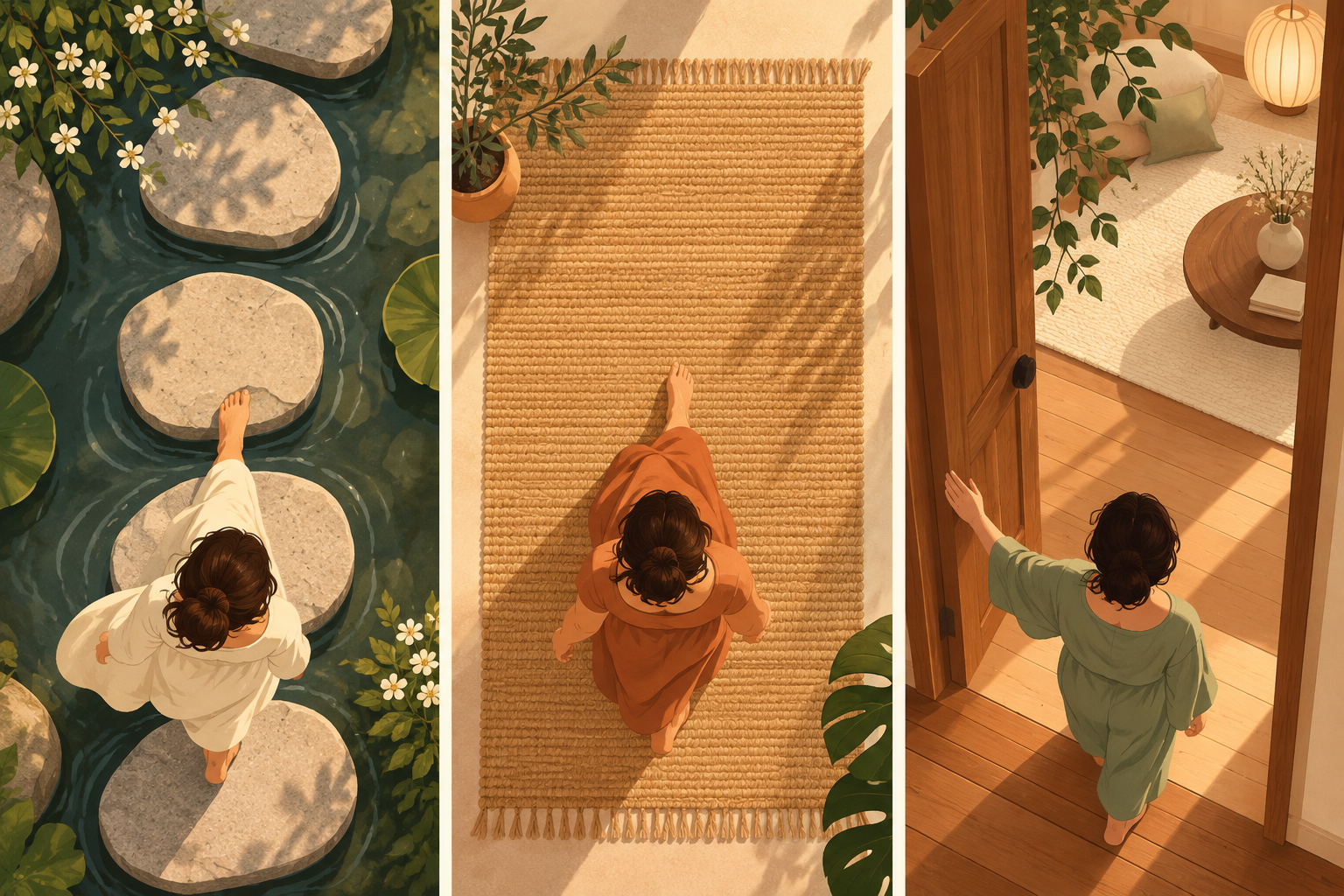
Stay seated. Check whether your shoulders are holding tension. Notice whether your breath is shallow or deep, and count how many seconds the out-breath takes.
Is your belly hard or soft? You don’t have to change any of it. Just confirm: “This is how it is right now.”
Then, sometimes, what looked like “lazy” starts to look like “tired.” Knowing in your head and the body responding are two different things, and when you touch the body’s actual sensation, something can shift a little.
I’ve written more about paying attention to bodily sensation in this article.
FREE PROGRAM
A doorway to seeing your life anew — through the body
Add us on LINE to receive the free online lessons — the parts we couldn’t fit into this article.
Free to join, unsubscribe anytime. This is not medical treatment; results vary by individual.
Doing it alone, seeing a professional, or joining a program: what’s the difference?
What separates self-help, professional care, and residential programs?
The difference is “point or surface,” and how easily you return to daily life. Doing it yourself costs nothing but is hard to keep up; it suits light fatigue that lifts once you rest.
Working with a professional, through medical care or counseling, is safe and comes as a weekly “point”; it suits trouble that has lasted more than two weeks.
Joining a program, residential or structured, means facing yourself over several days in a row: a “surface.” It suits people who have checked for physical causes with a doctor and still can’t move.
How do I choose the right option for where I am now?
None of them ranks above the others. Choose by your current stamina and how easily you can get back to your routine. If your energy is at the bottom, a professional comes first.
If you tried on your own, came back once, and then fell into the same place again, that’s when to consider facing it as a surface. Skipping this order and leaping straight into a program is not something I recommend.
The thinking behind the choice is also laid out in this article.
Why does motivation disappear again even after I start feeling better?

Why do I slide back after a rest?
If you recover alone and then slide back, here is why: every day you return to the same environment and the same way of thinking that drained you in the first place.
The environment stays the same
You recover over the weekend, then Monday returns you to the same workplace, the same notifications, the same conversations.
The thinking stays the same
The habit of judging yourself, “if I can’t do it, I’m no good,” doesn’t change just because you rested.
The insight happens once
A book makes sense in your head, but your body’s reactions don’t change, and in a few days you’re back where you were.
Why doesn’t understanding it in my head change anything?
“Knowing in your head” and “the body moving” are different things. Knowing alone rarely changes how the body reacts. That gap is where “I know, but…” comes from.
Much of the suffering arises when you replay past failures or future worries in your mind, on the train, at the convenience store on the way home. When you can come back to the body’s sensation in this moment, people tend to be fairly quiet inside.
Is a retreat an option, and under what conditions?
With conditions, a self-transformation retreat is one option. After checking for physical causes with a doctor, you step away for a few days and, with a guide, look at yourself again from the side of the body and awareness.
Rest alone doesn’t change what you return to. So some people choose time in a safe setting to touch an inner place that everyday thinking can’t reach. That is a choice, not a prescription.
When choosing a place like that, what should I check?
What five things should I confirm before joining a program?

Carry five measures of safety with you.
- The organizer’s background, and who will be alongside you
- Whether you can decline partway through, or go home
- Fees and cancellation terms
- Whether there is follow-up after it ends
- The intensity of any breathwork, and whether someone stays with you
Ask these directly, before you pay anything. You are allowed to ask them in plain words.
What if the organizer’s answers are vague?
If even one answer is vague, don’t choose that place. The lower your stamina, the less likely a high-intensity setting is right for you; strong stimulation can be the wrong thing for a body that is already depleted.
A sincere organizer won’t mind these questions. If asking them makes someone impatient, that is the answer.
Is it okay to go straight into a three-day, two-night stay?
Is a three-day stay a reasonable first step?
I won’t say “just go.” nehan’s Soumatou journey, the “life-flashing-before-your-eyes” journey, is two nights and three days in Kobuchizawa, Yamanashi, followed by 14 days of integration after you return home.
The three days are the trigger. The real work happens back in daily life, in the same kitchen, at the same desk.
How do you decide whether it’s right for me?
Before participating, there is a consultation session. We listen to your current state and judge together whether this fits you now. If it doesn’t feel right, you don’t have to join.
Keeping the order, doctor first, then the smaller steps, then this, is the greatest safety there is.
POINT
There is nothing this journey can promise a person who has no motivation. What it can do is prepare time to face the self that “knows but can’t move,” from the body’s side, in a safe setting. Beyond that, results vary from person to person.
FAQ
Q: Is low motivation an illness? A: Sometimes it is, and sometimes it’s fatigue or lack of sleep. They’re hard to tell apart on your own, so if it has lasted more than two weeks, you can’t sleep, or you no longer feel enjoyment, have a doctor check.
Q: When I have no motivation, should I rest or push through? A: Rest first. If rest doesn’t bring it back, start with small experiments in paying attention to your body’s sensations.
Q: Will a retreat bring my motivation back? A: I can’t promise that. It’s one way of re-examining your state, and whether it fits you is something we judge together in the consultation session.
You’ve checked for physical causes with a doctor, and “I know what to do, but I can’t move” is still there. For people in that place, a self-transformation retreat is one option. Here is what a self-transformation retreat is, here is the flow of Kobuchizawa, three days, and the 14 days after you return, and here are the records of people who couldn’t move either.
Read them, and then decide for yourself whether it fits.
This article is general information, not medical advice. Results vary from person to person. If you have concerns about your health, please consult a professional.
FREE PROGRAM
A doorway to seeing your life anew — through the body
Add us on LINE to receive the free online lessons — the parts we couldn’t fit into this article.
Free to join, unsubscribe anytime. This is not medical treatment; results vary by individual.
Sources / References
- Ministry of Health, Labour and Welfare (Japan), “Kokoro no Mimi” mental health portal: https://kokoro.mhlw.go.jp/
- Ministry of Health, Labour and Welfare (Japan), Unified Mental Health Helpline (0570-064-556)
- Ministry of Health, Labour and Welfare (Japan), “Sleep Guide for Health Promotion 2023”: the relationship between sleep deprivation, mental health, and motivation
- MSD Manual Consumer Version, “Hypothyroidism” and “Anemia”: symptom overviews including reduced motivation
- nehan official site: Soumatou journey (Kobuchizawa, Yamanashi; two nights and three days; 14 days of integration after return; pre-participation consultation session)