


You’re swept along by the days, and you can’t say what you actually want. So you’re thinking of going somewhere alone. Here is the short answer: stay close to home, leave the schedule blank, walk, write, rest. When you get back, change one thing.
If you’re already worried that you’ll slip back into the old routine the moment you return, the final section answers that head-on.
Does changing your location actually help you look at yourself?
- Staying in the same place — Changing location
- Same notifications, same roles — New scenery, new input
- The same thoughts keep circling — Less repetition, the question starts to move
- The conclusion tends to come out the same — The question itself can change
Why do the same thoughts keep circling when I stay home?
It does help. In the same room, with the same notifications and the same roles, the same thoughts keep going around, and the conclusion you reach comes out the same.
That isn’t weak will. The input hasn’t changed, so the output doesn’t either.
You probably know this already. The plan to “think it through properly this weekend” ends on the sofa with your phone, and by Sunday night you’re back in the same loop.
Is there any evidence that scenery changes how you think?
There is some. One study found that people who walked for 90 minutes in a natural setting reported less of that repetitive, circling thinking than people who walked through a city, and showed lower activity in a brain region linked to it (Bratman et al., 2015). It’s one study, so hold it lightly.
The practical takeaway is simple: before you try to change how you think, change what you see. For a fuller guide to the reflection process itself, see how to look at yourself honestly.
Where should a trip to reconnect with yourself go?
What makes a place right for this kind of trip?
Forget distance and forget fame. Only three conditions matter. You don’t need a schedule to be there. You won’t run into anyone you know. There is nature you can walk in, or a quiet town.
If all three are met, a place 40 minutes away by train works perfectly well. The point isn’t the destination. It’s the gap between you and your usual day.
A day trip nearby
A hillside village or a seaside town in the next prefecture. Walk for half a day, write for 30 minutes in the café by the station, go home.
One night at a hot-spring town
After dinner, a stretch of nothing opens up. You come back to yourself twice: once at night, once in the morning.
A small inn in the mountains or by the sea
Choose somewhere with weak signal. Stay two nights and you start to see what’s on the other side of “bored.”
Is it better to go somewhere far away?

No. Farther is not better. The travel wears you out, sightseeing starts the moment you arrive, and on the train home you’re already opening work email.
That isn’t a break from your daily life. It’s your daily life with a different backdrop. A short trip that leaves room for nothing to happen will give you more than a long one packed with things to see.
What should I do once I’m there? I can’t settle down unless I’m sightseeing
What are the only three things I need to do?
Narrow it to three. Walk with no destination. Write down whatever surfaces in a notebook. Rest without doing anything. That’s the whole itinerary.
The moment you fill the schedule, your head starts working on “where next, and at what time.” Your body is at the destination, but your mind is back at the office.
A trip where you walk along a river for two hours and fall asleep on a bench is better suited to this than one with a full list.
What do I do when I feel restless with nothing to do?
Don’t be afraid of boredom. It’s two in the afternoon, there’s nothing on the list, and you start to fidget. That exact moment is when the question you’ve been putting off comes up on its own.
The restlessness isn’t a sign that the trip is failing. It’s the entrance. Stay with it a little longer than feels comfortable.
What should I pack, and what do I write in the notebook?

What do I actually need to bring?
A paper notebook and a pen, shoes you can walk in, and a phone with notifications turned off. That’s enough.
The more you carry, the more things you have to keep track of, and the less attention is left for yourself. Leave the laptop. Leave the book you’ve been meaning to finish.
What do I write in the notebook?
Before you leave, write three headings and nothing else:
- The thing that’s bothering me most right now
- A moment on this trip when my body loosened
- Something I want to stop doing even after I’m home
A single line like “shoulders feel lighter” is enough. The moment you try to write something tidy, the honest version slips away. If you find yourself wanting to put your values into words, this piece on naming what matters to you will help.
FREE PROGRAM
A doorway to seeing your life anew — through the body
Add us on LINE to receive the free online lessons — the parts we couldn’t fit into this article.
Free to join, unsubscribe anytime. This is not medical treatment; results vary by individual.
Should I do this alone, see a professional, or join a program? How do I choose?
When is a trip not the right first step?
Two things decide it: how heavy the problem is, and whether you can keep going on your own. If you can’t sleep, can’t eat, or can’t get yourself to work, the strain is already showing up in your daily life.
In that case, please talk to a doctor or a counsellor before you plan a trip. If it’s urgent, public helplines such as Inochi no Denwa are there for you.
What are the three options, and who is each one for?

Doing it yourself, through a trip or solo time, suits someone who has room to think but can’t reach an answer. It takes half a day to two nights. Because you’re on your own, it’s also the easiest to slide back from.
Working with a professional, such as a counsellor, suits someone whose strain is affecting daily life. It’s ongoing, typically once a week, and easier to keep up than going it alone.
Joining a program, such as a structured retreat, suits someone who has tried the solo version several times and keeps returning to the old pattern. It takes two to three days plus the period after you get home, and how well it sticks depends on the design.
How do I know which one is mine?
Choose only by where you are right now. Skipping a stage is the quickest way to end up back where you started.
If you have the energy to think but no answer yet, start with a day nearby. If a few solo trips haven’t moved anything, that’s the signal to consider a program.
If you’re not functioning, see a professional first. My thoughts on programs are in this article on retreats for taking stock of your life.
How do I bring what I found back into my everyday life?
What should I decide on the morning I go home?
On the morning you leave, decide on one thing you’ll change at home, and make it small. “I won’t open my phone on the morning train.” That’s the right size.
Not a new career, not a new personality. One thing your body can remember without your head having to manage it.
Why do big resolutions made on a trip fall apart?
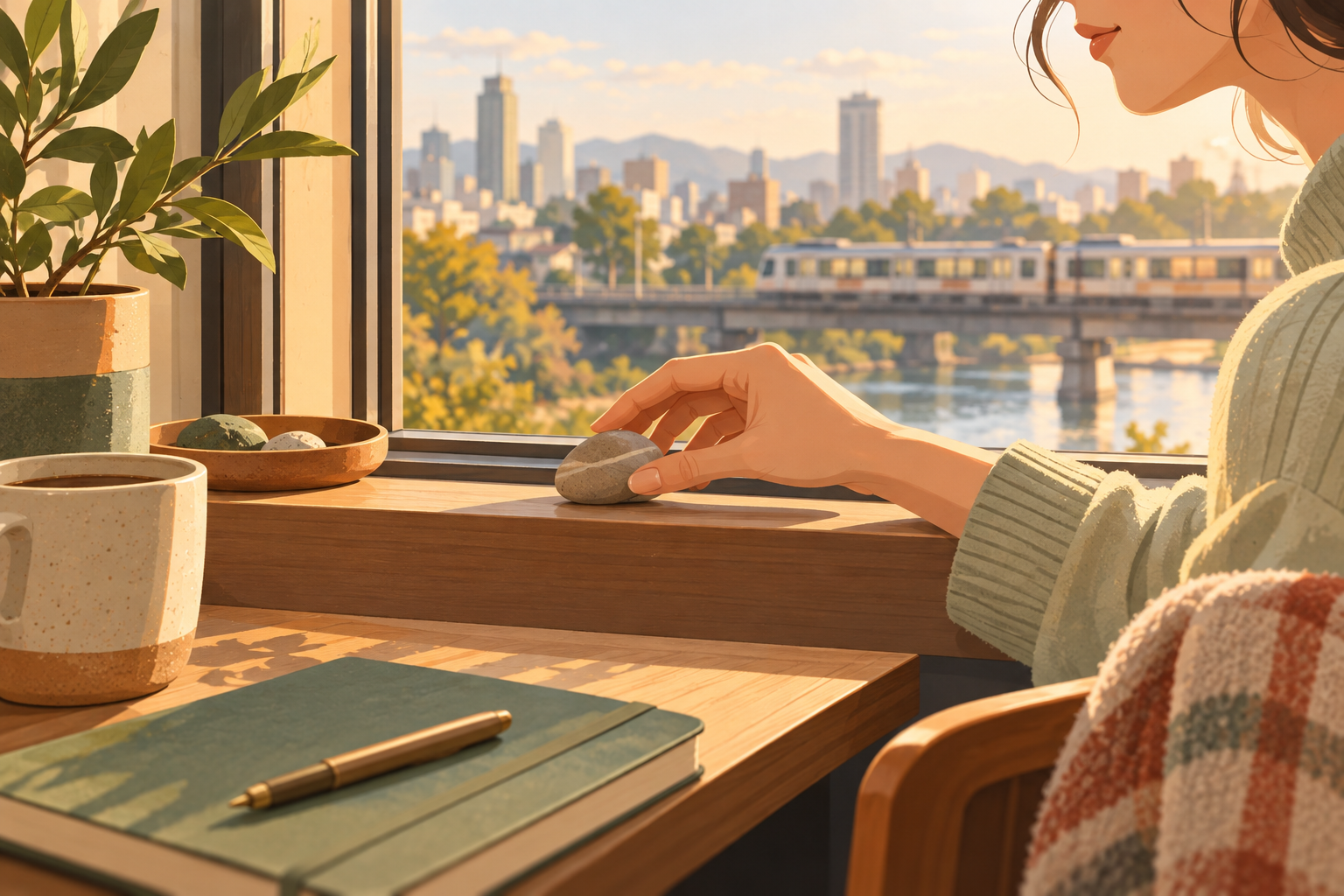
You decide, somewhere by the sea, that you’re going to change your life. A few days later you’re back in the old routine, and the trip feels wasted. It wasn’t.
Understanding something in your head and your life actually changing are two different things.
That’s why the change has to be sized for your body, not your intentions. After you’re home, open the notebook only three times: day 3, day 7, day 14.
Add one line each time: “still going?” How to keep that up is in this practice log on small steps.
I go away alone, and I still end up as my usual self. What then?
Is it my fault that I keep going back?
No. This isn’t a flaw in you. A solo trip strips away stimulation, which is the point, but it also means there’s no one across from you. It’s easy for the trip to end without you ever really facing anything.
If you’ve been through the cycle a few times, a transformative retreat is one option. Not a quiet inn where you rest, but a few days away from daily life, with a guide, working from the state of your body and your awareness rather than from your thoughts.
What’s different about doing this with a guide?
Some people notice that things are hardest when the mind is replaying the past or projecting the future, and that they ease when attention returns to now. That shift is difficult to hold alone.
Borrowing the strength of a place and of other people isn’t weakness. It’s a question of sequence. You try alone first; when that stops working, you add support.
How do I choose a retreat without getting burned?
If you’re unsure about jumping straight into three days and two nights, you don’t have to. Try a nearby solo day first. If you still go back, then consider it.
Use five measures when choosing: the organiser’s background, whether you can opt out partway through, the fee and cancellation terms, the follow-up after it ends, and how intense the breathwork is and who accompanies you.
nehan’s “Soumatou” journey (seeing your life flash before your eyes) runs for three days and two nights in Kobuchizawa, with 14 days of follow-up built in after you return.
The flow is at /soumatou/, participants’ accounts are in the stories, and thoughts on attending alone are in this article.
FAQ
Q: How many days does a trip to reconnect with yourself need? A: A day trip is enough. What matters more than the number of days is whether you get an unbroken stretch away from schedules and notifications.
Q: I can’t write anything in the notebook. Did I fail? A: No. Leave one line about how your body feels. The words often come after you’re home.
Q: Is it okay to go straight into a three-day, two-night retreat? A: Try a nearby solo day first. If you do join one, check five things: the organiser’s background, whether you can opt out partway, the fee and cancellation terms, the follow-up afterwards, and the intensity of the breathwork and who accompanies you.
Fees and details are explained at the consultation session.
Try the solo trip a few times. If you still find yourself back where you started, that’s the moment to remember that a few days facing yourself with a guide exists. Until then, a day nearby, alone, is more than enough.
This article is general information and not medical advice. Results vary from person to person. If you have concerns about your health, please consult a professional.
FREE PROGRAM
A doorway to seeing your life anew — through the body
Add us on LINE to receive the free online lessons — the parts we couldn’t fit into this article.
Free to join, unsubscribe anytime. This is not medical treatment; results vary by individual.
Sources / References
- Bratman, G. N. et al. (2015). Nature experience reduces rumination and subgenual prefrontal cortex activation. *PNAS*.
- nehan official “Soumatou wo Miru Tabi” program overview (Kobuchizawa, Yamanashi · 3 days / 2 nights · 14-day integration period after returning home) /soumatou/




