

Key points
- “Spiritual” originally refers to the workings of the mind and spirit that you can’t see. Fortune-telling and psychic claims are only one narrow use of the word.
- You can tell whether something is shady not by its vocabulary but by its mechanics. Look at three things: money, dependence, and whether you can say no.
- If you’ve been unsure how to live your life and this word caught your attention, that may be a sign you want to know your own inner side. You don’t need to believe in anything, and you can start small.
Did you tense up a little when you read the word “spiritual”? I understand. But when you unpack what it actually means, it turns out to be almost disappointingly ordinary.
And because it’s ordinary, I want to write it down properly.
What does “spiritual” actually mean?
Where does the word “spiritual” come from?
The English word spiritual means “of the mind or spirit,” and it comes from the Latin spiritus — breath, spirit. In Japan, the word is used broadly to mean paying attention to the workings of the mind and consciousness that you can’t see.
That’s it. There’s no claim about ghosts or energy built into the word itself. It points at the part of you that’s doing the thinking and feeling, the part you can’t put on a scale.
Is spirituality the same as fortune-telling, spirits, and crystals?
Fortune-telling, spirits, and healing stones are a very small slice of how the word gets used. Nobody hears the word “music” and pictures only karaoke, right? The entrance just happened to be the flashy one.
The time you spend lying awake at midnight wondering what you’re working for — that, in the broad sense, is also one of the entrances. It just doesn’t come with incense.
How is spirituality different from fortune-telling, religion, and self-help?
Who holds the answer in each one?
The difference is where the answer lives. In fortune-telling, the answer comes from outside you: the reader, the cards. Religion has teachings and a community.
Self-help rewrites the way you think in order to get results.
Spirituality, as I’m using it here, is a posture of turning toward your own inner sensations and awareness. The answer isn’t handed to you; you’re looking at what’s already there.
Why does the word feel different once you’re tired of looking outside?
These four overlap, but they’re not the same thing. You can believe in nothing and still notice that your shoulders are tight.
People who’ve spent years searching for answers out there — in books, in experts, in the next method — and gotten tired of it often find the word lands differently.
It stops sounding like one more thing to buy and starts sounding like permission to stop.
Is spirituality shady? Where does it start to become dangerous?
What are the three warning signs that mean you should walk away?
The word itself isn’t shady. What’s dangerous isn’t the content; it’s the mechanics. If any one of these three is present, leave without second-guessing yourself.
- You’re asked for large sums of money, repeatedly.
- You’re put in a position where you can’t decide things on your own, and leaving is framed as something to be afraid of (dependence).
- You can’t say no partway through.
Keep this ruler nearby while you’re calm. It’s much harder to pick it up once you’re already inside something.
What do “hardcore spiritual” and “spiritual-lite” mean online?
On social media in Japan, people sometimes distinguish between going all-in (“gachi-spi”) and lightly enjoying things like visiting shrines (“light-spi”).
There’s some mockery mixed in, probably because many people have watched a friend get pulled into one of those mechanics.
Still, I think it’s a waste to throw the whole word away because of that. Judge the structure, not the vocabulary.
FREE PROGRAM
A doorway to seeing your life anew — through the body
Add us on LINE to receive the free online lessons — the parts we couldn’t fit into this article.
Free to join, unsubscribe anytime. This is not medical treatment; results vary by individual.
Can I be interested in spirituality without believing in a religion?
Do I need to believe in anything to start?
No. You don’t need to believe in anything. It begins with noticing your body’s sensations and your feelings — that’s all.
If you’ve been unsure about how to live and this word started to catch your eye, that may be a sign you want to know your inner side. Work anxiety, life direction — when people follow those threads, many of them arrive at the same place: “I don’t actually know myself very well yet.”
Is there research linking the spiritual side of health to wellbeing?
Research reviews have reported that spiritual wellbeing is associated with life satisfaction and mental health (Koenig, 2012). That’s a separate matter from whether you believe in anything.
It’s about having a sense of meaning and a connection to yourself.
The World Health Organization’s Executive Board discussed a proposal in 1998 to add a spiritual dimension to its definition of health. The idea isn’t fringe; it’s just quiet.
What can I do on my own to get to know my inner side?

What are three free things I can start with today?
Three things. First, write down how you feel right now, on paper. Second, make ten minutes — just ten — of doing nothing. Third, notice your body: your breath, the weight in your shoulders, the tightness in your chest.
None of these cost money, and none require belief. The real problem is that they’re so unglamorous nobody does them. If the second or third one won’t stick, For people who can’t keep up meditation may help.
What actually happens when I try them?
You try it, and afterward you realize your shoulders had been clenched the whole time. That’s the first shape “noticing” takes. It’s not a revelation. It’s a small, slightly embarrassing fact about your own body.
Most days nothing happens. Even so, some people say that with each time they noticed, the outline of who they are got a little sharper.
Alone, with a professional, or in a group setting — how do I choose?
Which should come first?
Start on your own. If the pain is strong, a professional comes first. Joining a group or program is the option after that.
On your own
Free, and you can start today. The catch is that it may not stick.
With a professional
If the pain is strong, you can’t sleep, or daily life is suffering, a counselor or medical care comes first.
In a group setting
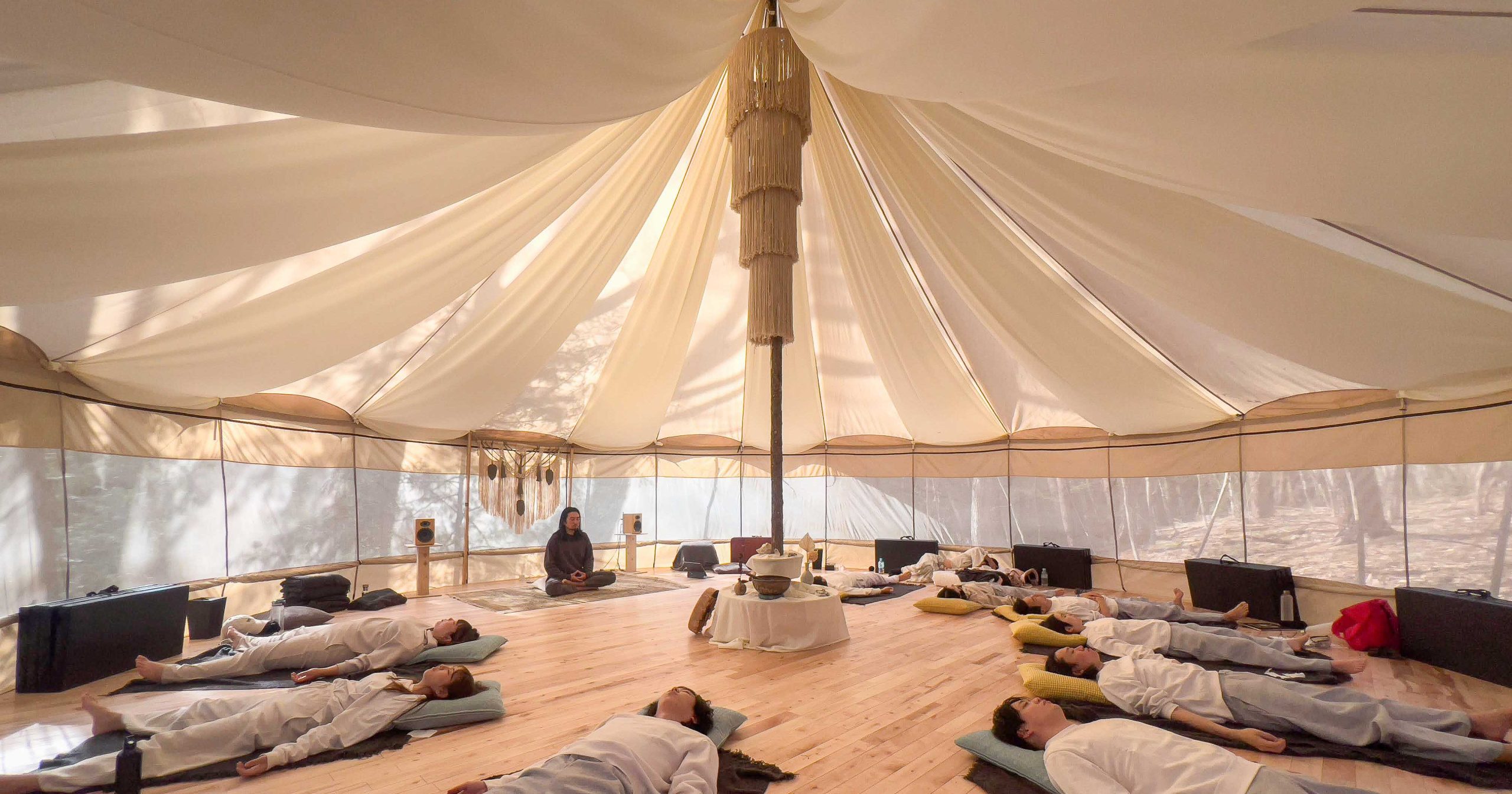
For people who slip back when alone. For example, a structured retreat where you spend a few concentrated days facing yourself.
If the feeling of wanting to disappear persists, please also reach out to a public crisis line in your country (in Japan, Inochi no Denwa or the Yorisoi Hotline).
What five questions keep any program safe?
The safety ruler is the same everywhere. Ask about the organizer’s background, whether you can stop partway, the fee and cancellation terms, what follow-up exists afterward, and how intense any breathing practices are and whether someone stays with you.
If a place gives you only vague answers to these five, I don’t recommend it, however good the atmosphere feels. A warm room is not a safeguard.
What if I keep slipping back to old patterns on my own?
Why do insights fade by the next day?
One option is to use a setting that takes you a few days away from daily life — with conditions. You notice something, and by the next day you’ve forgotten it.
That happens because people naturally return to familiar reactions. It isn’t weakness of will.
Your commute, your inbox, the convenience store on the way home: the whole environment is built to pull you back into the old groove.
What conditions make a retreat a reasonable option?
Three conditions. If your pain is strong, talk to a professional first. Check the place against the five questions above. And make sure it’s a setting that doesn’t ask you to believe in anything. What a self-transformation retreat is, and how it differs from other approaches, is here.
nehan’s “Journey to See Your Life Flash Before You” is built as three days and two nights in Kobuchizawa, plus the fourteen days after you return.
Some participants came “without knowing what I was supposed to believe” (stories). If committing to three days feels like a lot, you can talk at a consultation session first and decide afterward.
If it doesn’t feel right, you don’t have to join.
FAQ
Q: What do “getting spi’d” and “spi activities” mean? A: These are Japanese social-media terms. Lightly enjoying shrine visits or lucky charms is “spi activities” (spi-katsu); starting to go all-in is “getting spi’d” (spitte-kita). Both are sometimes used mockingly.
Q: What is spiritual health? A: A state in which, alongside physical, mental, and social health, you can feel a sense of meaning in life and a connection to yourself.
In 1998 the WHO Executive Board discussed a proposal to add this dimension to its definition of health.
Q: Is it okay to go straight into a three-day retreat? A: You can talk at a consultation session first and decide afterward. If your pain is strong, see a professional first.
If it doesn’t feel right, you don’t have to join.
Start from noticing, not believing. If you still find yourself slipping back when alone, using a setting is one tool among others. You don’t have to choose anything you’re not ready for.
This article is general information, not medical advice. Results vary from person to person. If you have concerns about your health, please consult a professional.
FREE PROGRAM
A doorway to seeing your life anew — through the body
Add us on LINE to receive the free online lessons — the parts we couldn’t fit into this article.
Free to join, unsubscribe anytime. This is not medical treatment; results vary by individual.
Sources / References
- Oxford English Dictionary, “spiritual” (etymology: Latin spiritus)
- WHO Executive Board, 1998, draft resolution EB101.R2 (proposal to add a spiritual dimension to the definition of health)
- Koenig, H.G. (2012). Religion, Spirituality, and Health: The Research and Clinical Implications. ISRN Psychiatry
- nehan official site, “Journey to See Your Life Flash Before You” (/soumatou/)