

Key takeaways
- Before looking for “the best retreat,” ask whether you can write what you want to change in a single line.
- On your own, you can do three things: write it down, rest, and try something small. A safe retreat can be identified with five questions.
- If you are unsure, it is fine to talk it through at a consultation session before deciding.
Does going to a self-transformation retreat change you?
Does going to a retreat change you by itself?
No. Going somewhere does not change you. Before anything else, check whether you can say in one line what you want to change. If you can’t, that is not a problem. Start by writing it out on paper.
This is the one stance this article takes: the place matters less than the pattern. A retreat can give you distance from your daily life, but if you don’t know which reaction you are trying to see, the distance has nothing to work on.
What does “transformation” mean here?
Transformation, as used here, does not mean becoming a different person. It means something smaller and more specific. Your parent’s name shows up on your phone, and you tense up before you even answer.
You find a course you genuinely want to take, and you cannot forgive yourself for spending the money.
Those are automatic reactions. Transformation is a little gap opening between you and them. You still notice the reaction, but it no longer decides everything for you.
What can you do on your own before going to a retreat?
What are the three things to try first?
There are three, and they are enough for some people. First, write down how you feel right now and what is troubling you, on paper. Second, clear one full day and rest without doing anything.
Third, try one small change and watch how your body responds to it.
Some people genuinely change with just these. You do not need to pay for a program to find out whether you are one of them. Try the three steps first, and treat what happens as information.
How do you know if you just need rest?
If you are short on sleep and your morning is nothing but coffee swallowed on the way out, rest first. Exhaustion looks like a lot of things, and it is not worth analyzing a pattern while you are running on empty.
But if you rest, and rest again, and still keep making the same choice, you may be looking at something other than tiredness. Be careful about choosing a place only because it looks soothing.
The calm can thin out the week after you return. It may be that only your surroundings changed.
Why do you keep settling back into your usual self, even when you try?
Why does insight fade by the next morning?
Because it is hard to shift your state from inside daily life. The night you write “Should I really keep working this way?” you feel clear. The next morning you are on the usual train, wearing the usual face, and the clarity is gone.
Research on behavioral extinction suggests that what we learn tends to stay tied to the place and state in which we learned it. In familiar settings, familiar responses are more easily triggered (see Sources).
This is not weak will. The old reaction is simply faster than reconsidering.
Is reacting the same way again a failure?
“I noticed, and I still reacted the same way” is not failure. It is material for observation. Blaming yourself leads nowhere. Finding out which words, which person, and which part of your body the reaction starts in leads to the next step.
You probably know this already from experience. The reaction has a trigger, and the trigger is usually more specific than “stress” or “work.” Write down the moment it happened, not the conclusion you drew from it.
When does leaving daily life for a few days make sense?
Stepping out of your routine for a few days can be one tool, under three conditions. You are not in an emergency right now. The retreat passes the five questions covered later in this article.
And you have support in place for after you return.
If all three are met, read the full picture of what a retreat is in the [pillar article](/self-transformation-retreat/) before going further. If any one is missing, the other two cannot compensate for it.
FREE PROGRAM
A doorway to seeing your life anew — through the body
Add us on LINE to receive the free online lessons — the parts we couldn’t fit into this article.
Free to join, unsubscribe anytime. This is not medical treatment; results vary by individual.
Should you work alone, see a professional, or join a retreat?
How do you decide which approach fits?
Your current state decides. Start on your own. If right now is painful, see a professional. If you have tried on your own and keep making the same choice, consider a retreat. That is the order.
Working alone suits people who can put what they want to change into words. Seeing a professional suits people who cannot sleep, cannot eat, or are otherwise struggling right now.
Joining a retreat suits people who have tested themselves and still land in the same place.
What does each option cost in time and money?
Working on your own takes from ten minutes a day and costs almost nothing, but it depends heavily on willpower. Seeing a professional usually means sessions of around fifty minutes, repeated over time, ranging from insurance-covered care to roughly ten thousand yen per session. It requires keeping up appointments.
A retreat concentrates the work into several days and typically costs tens of thousands to several hundred thousand yen. Whether it holds depends on the support you have afterward.
Note that “joining a retreat” splits in two: a lodging stay where you rest, and a guided program where you look at the root of a repeating reaction with a facilitator. They serve different purposes.
What kinds of retreats exist, and how do you choose?
What are the three types of retreats?
Broadly, there are three: rest, learn, and face. If fatigue has built up, choose a rest-type retreat, built around sleep, food, and nature. If you want to practice where you put your attention, choose a learning-type retreat, such as meditation or yoga.
If you keep repeating the same thing, choose a facing-type retreat, which works with emotion, memory, and the connection back to daily life. Do not mix purposes.
A retreat that promises all three usually delivers the easiest one.
When should you skip retreats and see a doctor first?
If right now is painful, do not choose any of the three types. Consult a medical institution or a psychosomatic clinic first. A retreat is not medical care, and no retreat type is designed to replace it.
Signs that this applies to you include not being able to sleep, not being able to eat, or feeling that you cannot get through ordinary days. Those are reasons to see a professional, not reasons to book a program.
How do you tell a safe retreat from one to avoid?
What five questions should you ask before booking?
Use five questions. If even one goes unanswered, remove the retreat from your list.
- Organizer background: “Who runs this, and with what training or history?”
- Freedom to stop: “If it gets too hard, can I rest? Can I choose not to do something?”
- Fees and cancellation: “Where are the price and cancellation terms written?”
- Follow-up: “Is there contact or support after I go home?”
- Breathwork intensity and supervision: “If strong breathing techniques are used, is there supervision and medical guidance?”
What should you look for beyond the photos?
Read the program design rather than the website photos. A beautiful location says nothing about what happens when someone in the room is overwhelmed.
Ask whether there is care in place for people whose emotions move strongly. Ask whether the atmosphere pressures people to share. A safe retreat makes it easy to say no, and it says so in writing before you arrive.
Is it okay to jump straight into a three-day, two-night retreat?
Is a three-day retreat a reasonable first step?
It depends on your state and your purpose. If right now is painful, go to a medical institution first. If you have tried on your own and still keep making the same choice, a few days away becomes a real option.
The order matters. A retreat works best as the next step after self-work has shown you where the pattern lives, not as the first attempt to find it.
What is nehan’s “Soumatou wo Miru Tabi” program?
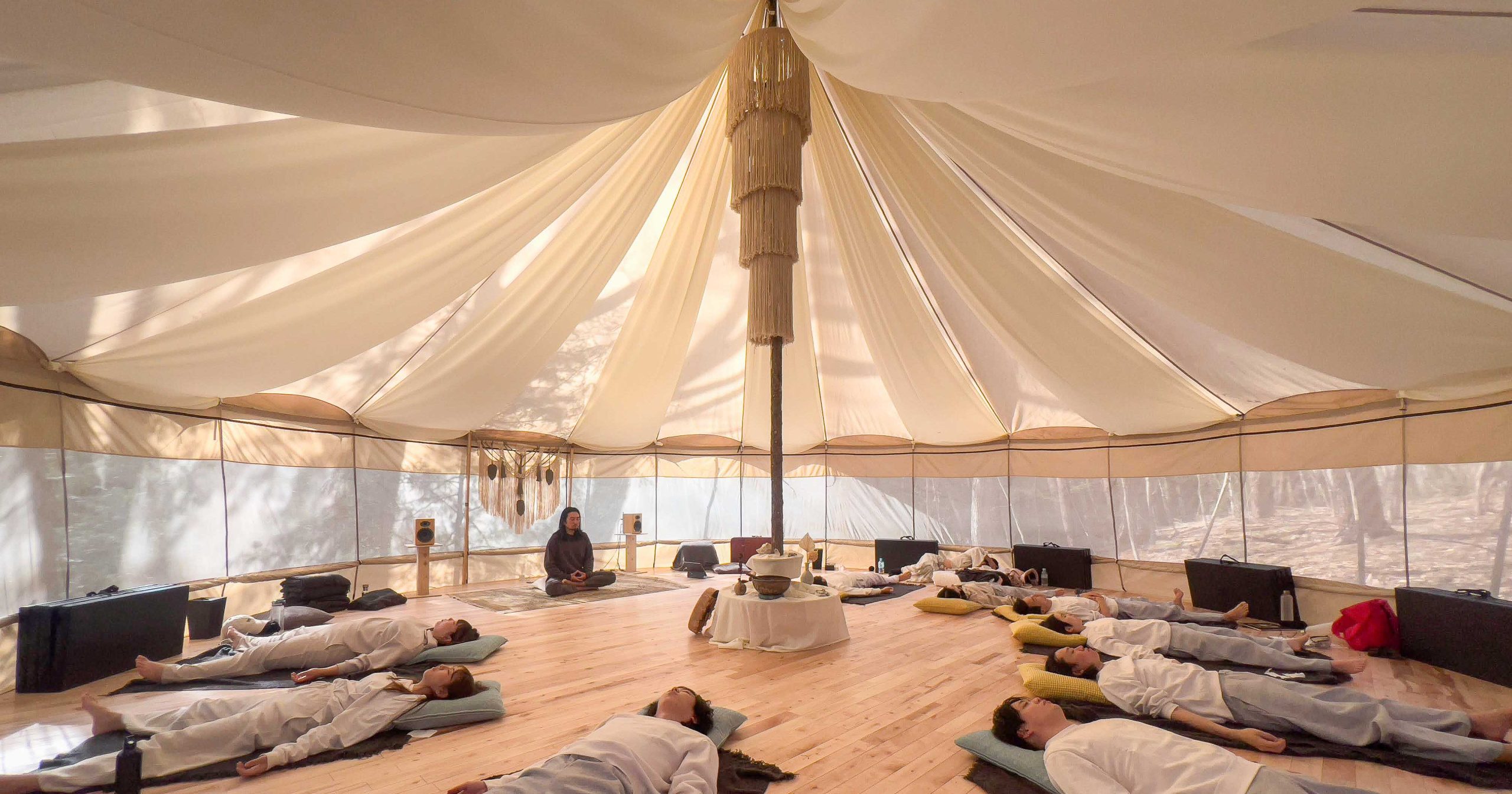
nehan’s “Soumatou wo Miru Tabi” (a journey to see your life flash before your eyes) is a three-day, two-night residential program held in Kobuchizawa, Yamanashi.
It is not a lodging stay for rest. It is a step away from daily life, where you work with a guide on your own patterns through the state of your body and awareness.
A fourteen-day integration period after you return is designed to bring one change back into daily life. Fees are explained at the consultation session.
The full flow is in the [program guide](/soumatou/). If you are unsure, talk it through at a consultation session before deciding. How earlier participants made their choice is in [participant stories](/stories/).
FAQ
Q: Who is a self-transformation retreat for? A: People who have repeated the same struggle for years and, even after trying on their own, settle back into the same choice.
If right now is an emergency, consult a medical institution first.
Q: Can I change without going to a retreat? A: Yes. Some people change with three steps: write it down, rest, and try something small. If the pattern still repeats, borrowing the structure of a retreat is one option.
Q: I’m worried I’ll slip back after I return. A: Slipping back is normal. Choose a retreat that offers follow-up after the program ends.
FREE PROGRAM
A doorway to seeing your life anew — through the body
Add us on LINE to receive the free online lessons — the parts we couldn’t fit into this article.
Free to join, unsubscribe anytime. This is not medical treatment; results vary by individual.
Sources / References
- Bouton, M. E. “Context, ambiguity, and unlearning: Sources of relapse after behavioral extinction.” *Biological Psychiatry* (2002).
- nehan official “Soumatou wo Miru Tabi” https://nehan.life/soumatou/
This article is general information and is not medical advice. How each person experiences these practices varies, and results are not guaranteed.