

You have read the books. You have sat through the seminars. You know exactly what the problem is, and you know — truly — what you are supposed to do.
And yet, nothing changes.
By morning you are back to your old self, reacting the same way in the same moments, carrying the same regret. And so you conclude: “If I have learned this much and still can’t change, my willpower must simply be weak.”
But what if that isn’t it at all?
“Knowing yet not changing” is not a failure of willpower. “Knowing” and “changing” are handled by two different brains. No matter how much understanding you stack up, it does not travel in a straight line to the place where change actually happens.
In this article, we trace why — through the lens of neuroscience — and end with the quiet question of where, then, change can actually begin.
“Knowing” and “Being Able To” Live in Different Brains
When we understand something, the prefrontal cortex — the “thinking brain” — is at work. It reasons in words, builds arguments, weighs gains and losses. The slow, deliberate system. Everything you gathered from books and seminars is filed here.
But your daily behaviour, your split-second reactions, are driven by an entirely different system. Habits are encoded in the basal ganglia (the striatum), the “automatic brain”; emotional reactions live in the amygdala. These are fast, automatic, and run beneath awareness.
So knowledge enters the “thinking brain,” while the reaction you want to change is held by the “automatic brain.” The room where you store it and the room you want to tidy are not the same room. You can pile luggage into one room forever; the other stays untouched.

Take riding a bicycle. Describing how to ride one isn’t hard — pedal, balance, lean. But no matter how perfectly a child memorises the description, they still fall the first time. Scraped knees, half in tears, again and again. Then one day, suddenly, they can. Not by logic — the body “gets it” first. And once you can, you can still ride years later without thinking.
That is the size of the gap between “knowing how to ride” and “being able to ride.” Different brains are in charge. The patterns of the heart work the same way. You already know what to do — and still you can’t, perhaps because you’ve been re-reading the bicycle manual without ever once falling.
“Knowing” Alone Does Not Rewrite the Reaction
Behavioural science calls this the knowing–doing gap.
The neuroscientist Judson Brewer puts it plainly: knowing that “smoking is bad for me” does not, by itself, update the brain’s reward centre (the orbitofrontal cortex). What rewrites the value assigned to a behaviour is not knowledge but direct experience.
Once a habit has been learned through reward, it is encoded in the striatum and replays automatically, below the level of awareness. We then try to override that automatic program with the slow, conscious “thinking brain.” But trying to suppress a fast, automatic system with a slow, deliberate one is a fight that is structurally lopsided.
If willpower fails to break a habit, it isn’t for lack of grit. The tool and the opponent were simply never matched.
“I won’t eat tonight,” you decide. And yet by eleven you are standing in front of the freezer, spoon already in hand, the ice cream half gone before you can recall opening it. You probably know more about nutrition than most. And still — the “you who knows” is right there in that moment, while the hand moves first. Knowledge was never holding the reins.
Old Emotional Memories Have No Sense of Time
There is one more difficulty.
The emotional memories stored in the amygdala (implicit emotional memory) are known to carry no context of situation or time. So when a similar cue appears, a past event can fire a reaction as if it were happening now.
Your manager says, “Have you got a minute?” That alone, and your chest tightens. You haven’t heard a word of the content, yet your mind is already full of “what did I do wrong” — when, usually, it’s just routine admin.
It is likely the tension of being called in by a parent, or made to stand before a teacher long ago, surfacing as something happening today. Emotional memory has no date stamp. To the brain, that afternoon decades ago and this meeting room are continuous. The person startled by a dog as a child still freezes at the sight of one years later — exactly the same mechanism.
And many of these memories were formed in early childhood, before language, without words. Research shows the fast route to the amygdala generalises a situation and fires a threat-tilted appraisal before the cortex’s careful judgement can catch up.
If a pattern was not built out of words, words — understanding — were never going to rewrite it easily. However much you organise it in your head, it rarely reaches the layer of reaction that sits below language.
Exactly When You Need It Most, the Thinking Brain Steps Back
And just as you try to push through by will — that is the moment the second blow lands.
Under stress, the amygdala takes over and the prefrontal cortex’s function drops. The stress hormone cortisol is reported to heighten amygdala reactivity while simultaneously impairing the prefrontal cortex.
So in the very situation that most demands composure, the brain responsible for composure retreats.

The big presentation, and the lines you rehearsed all evening simply vanish. The moment you want to answer back, nothing comes — and then, that night, in the bath or in bed, the perfect reply arrives. With no one left to hear it. That is not a failure of ability. While the “thinking brain” had stepped back, the drawer holding your lines was simply closed. Once it reopens, the answer drifts up on its own.
The Body Decides the Heart, From the Inside
So where does change come in? The clue is the body.
Recent research shows that interoception — the capacity to sense internal signals such as heartbeat and breath — is deeply tied to how we process emotion. People with higher interoceptive awareness showed clearer heart-rate shifts to emotional moments, and remembered them more vividly.
The vagus nerve is forever carrying the body’s inner state up to the brain. We assume the mind moves the body; in truth the reverse is just as strong. The state of the body decides, from the inside, our emotions and our judgements.
You see it everywhere. After a sleepless night, a partner’s offhand remark you would normally let slide somehow stings. Walk into a meeting hungry, and a comment you’d usually ignore snags at you. (English even has a word for it — “hangry.”) Your heart didn’t shrink. The state of the body changed, and so the same world looked different. Which means: tend to the state of the body, and the very same events can be received differently.
Why the Usual Methods Struggle to Reach
Think positive. Push through with grit. Learn more, add more knowledge. All sincere efforts. But as we’ve seen, each is a top-down attempt from the “thinking brain” — once again replaying that lopsided fight, the slow system trying to pin the fast one.
And the harder you press, the stronger it can grow. “Don’t be nervous,” and the hand shakes more; “I must sleep,” and the eyes grow wider; the instant you decide “I won’t think about it,” that is all your mind can hold. Try to wrestle a reaction down by force, and you pour oil on the fire — a feeling most of us know from experience, born of the very same mechanism.
So the problem is not the amount of your effort. It is that the entrance to effort has always been on the side of the head. Change has to begin upstream of the thinking brain — from the state of the body and nervous system (bottom-up).
The few entrances you can touch that state through, without going by way of the will, are breath and bodily sensation. Why breath can genuinely shift brainwaves and the autonomic nervous system is explored in “Sound, Breath, and the True Self”. And deepening that shift in state, safely and in person, is what the nehan retreat is for.
Beyond “Understanding”
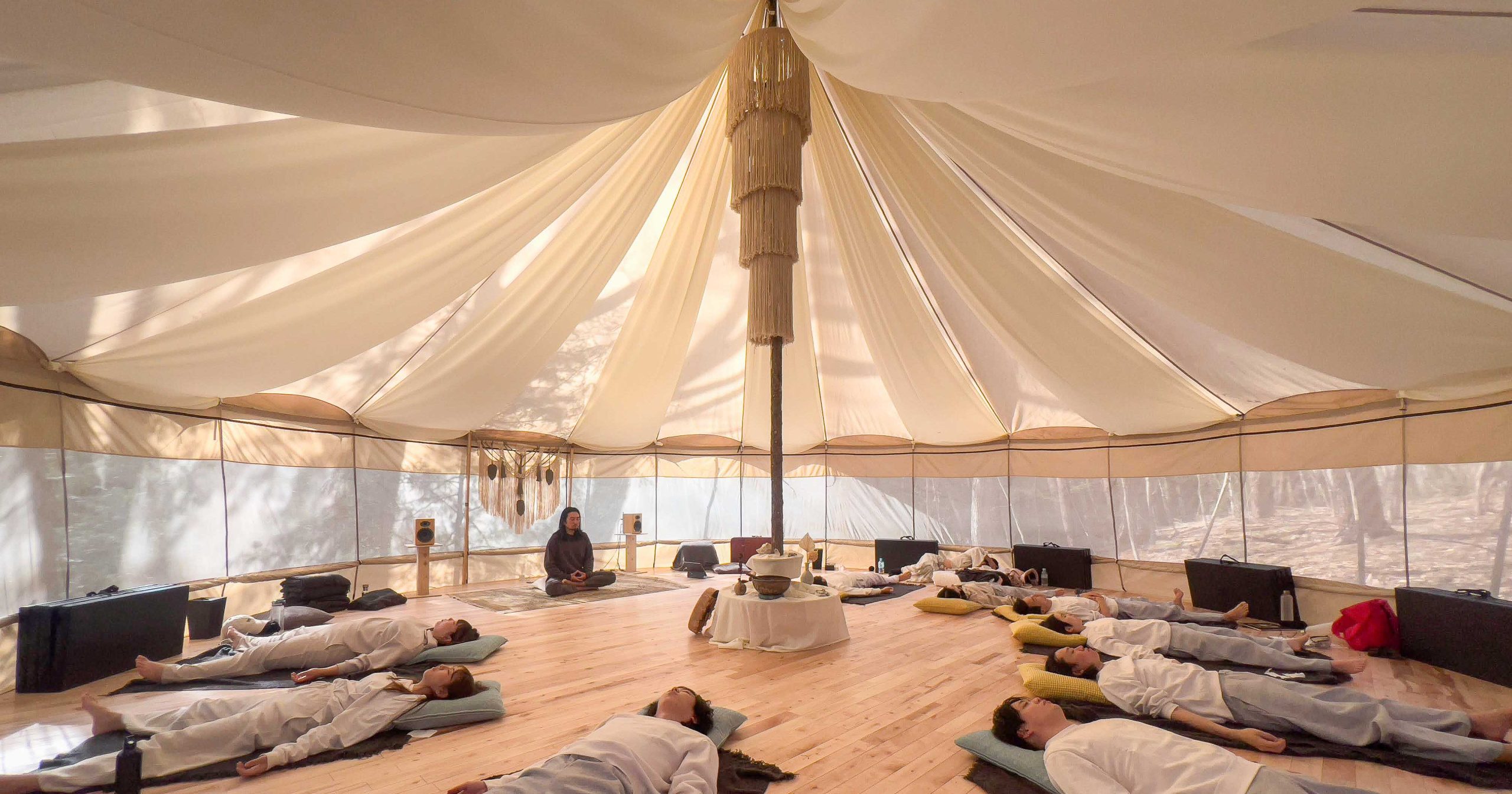
The nehan retreat is built on this very wall — the one where the head cannot reach. Rather than changing your thoughts by will, it works from the side of the body and nervous system, deepening in stages.
There are, within it, several stages. But the specifics — and what actually happens within the experience — lose their power when nibbled at through text alone. They mean something only with the right order, the right place, and a guide. So the rest is something we share inside a free online session.
FREE ONLINE LESSON
The rest, in a free online session
What it means to change from the state of the nervous system, not the head.
We share the heart of the methods in a free session.
※ Registration is free, and you can unsubscribe at any time.
Frequently Asked Questions
So is willpower meaningless?
Not at all. Will and knowledge are useful for setting direction. They are simply the wrong tool for forcing an automated reaction into submission. Shift the entrance to the side of “state,” and willpower works more easily too.
Is there no point in “knowing”?
There is great value in it. Understanding becomes the map for change. But just as looking at a map and actually walking are different, seeing “knowing” and “changing” as separate stages lets you stop blaming yourself.
Is this medical or psychological treatment?
No. The nehan program is not a medical treatment. If you are in a state that needs care, or distressing memories disrupt daily life, please consult a medical professional.
Who is it for?
It tends to resonate most with those who feel: “I’ve done enough learning. But I want to change at a deeper level.”
You Don’t Have to Blame Yourself
That you couldn’t change was never because you were weak. You were only trying to carry “knowing” all the way to “changing” — and the entrance was simply in the wrong place.
The moment you can see that, change from somewhere other than the head can begin. The concrete path is something we share in a free online session.
FREE ONLINE LESSON
An entrance to the nehan retreat
To change from the state of the nervous system, not the head.
We share the three methods in a free session.
※ Registration is free, and you can unsubscribe at any time.
Sources & further reading
· Reward-based learning & the knowing–doing gap: Judson Brewer, “Why Willpower Doesn’t Work”
· Habit & the basal ganglia (striatum): Basal ganglia role in learning rewarded actions (PLOS One)
· Implicit emotional memory in the amygdala: Implicit and explicit emotional memory recall in anxiety and depression (Neurobiology of Learning and Memory, 2021)
· Cortisol, amygdala dominance & prefrontal impairment under stress
· Interoception & emotional memory: Emotional processing and emotional memory are modulated by interoceptive awareness (Cognition & Emotion, 22(2))
※ This article is general information on health and self-understanding, not medical advice. Effects vary by individual, and no specific outcome is guaranteed. If distressing memories or symptoms affect your daily life, please consult a medical professional.