

A self-transformation retreat is not a place to rest and feel better. It is a place to look at your own reaction habits. If a healing retreat’s goal is “feel lighter,” this one’s goal is “go home and change one thing.” For people who have read the books, taken the courses, and still find themselves being the same person, it can be a starting point — with conditions.
What is a self-transformation retreat, and what actually happens there?
What do you do at a self-transformation retreat?
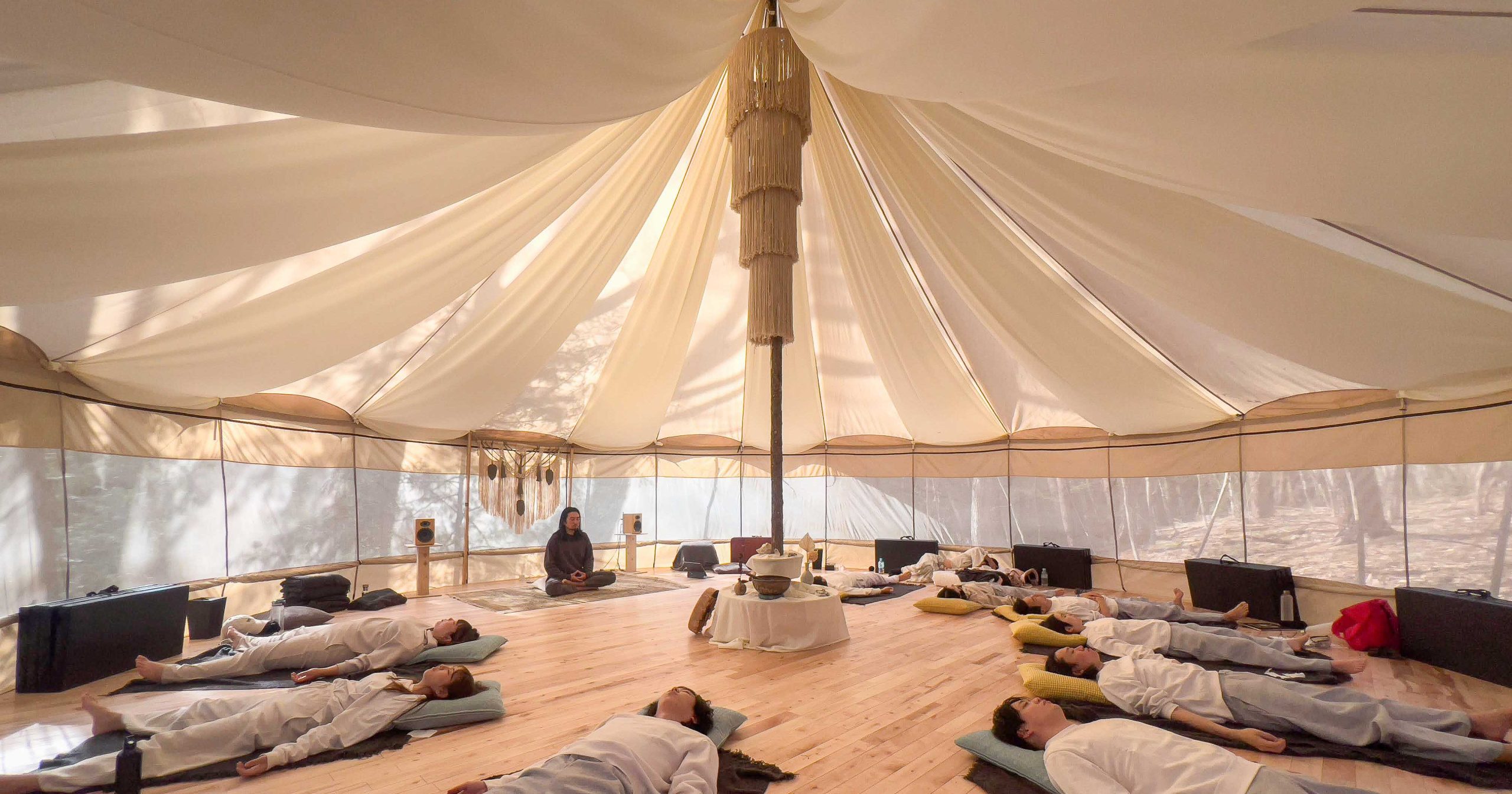
A self-transformation retreat is a residential program where you step out of daily life and, with a guide, look at your reaction habits and the assumptions behind them.
Sleeping at a hot spring is “recovery.” This is closer to an “inspection.” You look at what you react to and where you freeze, starting from the state of your body rather than from your thoughts.
For the full picture, see the overview article on self-transformation retreats.
Why does the body move before the decision does?
You decide, “I’m not going to care what people think of me.” The next morning your manager says, “Got a sec?” and your chest tightens. You decided. The body moved first anyway.
A self-transformation retreat works on exactly that — the body that moves despite the decision. Understanding something in your head and your life actually changing happen on two different circuits.
How is it different from a healing or wellness retreat?
What is the goal of each kind of retreat?
A healing retreat aims at “feeling lighter.” A self-transformation retreat aims at “going home and changing one thing.” The dividing line is rest versus introspection.
Yoga and hot springs loosen the body and mind — that is the former. The latter uses that loosened state as an entrance and goes down to the pattern of your reactions.
Which one should you choose right now?

Neither is better than the other. If you are exhausted right now, a healing retreat is the right fit, and probably the only thing you have capacity for.
The moment for a self-transformation retreat comes later: you rested, you went home, and the same thing happened again. Only then does this kind of place have a job to do.
Why do I keep doing the same thing even though I know better?
Why doesn’t knowing more lead to changing?
Repeating the pattern is not a knowledge problem. Your body and emotions react before your thinking does. The amygdala, which detects danger, is understood to have a pathway that fires faster than the prefrontal cortex, which handles judgment (LeDoux, *The Emotional Brain*).
Before “I’ll be careful this time” has formed, the body has already moved.
Kitchen, late evening. You look at the sink that has been piling up, your partner says “I’ll do it later,” and something snaps. Not one line from the book you read at lunch shows up in that moment.
What does the body need instead of more information?
Most of us have been using “understanding more” as a substitute for “changing.” But if what you are dealing with is a bodily reaction, what’s needed isn’t knowledge. It is contact with the state the reaction arises from.
The times when the body has come back to “now” are often quiet. The question is whether you have a circuit that can reach that quiet at all.
Can I do something myself without going to a retreat?
What are three things you can start today?

Yes. You can start with three things: write down the scenes that repeat, create time when your reactions are duller, and try a small different action.
Write down the scenes that repeat
Where, with whom, and which part of your body tightens first. A pattern starts to show.
Create time when reactions are duller
Short on sleep, the amygdala tends to become more reactive. Rest first. For some people, that alone softens the reaction.
Try a small different action
The message you would normally answer instantly — leave it on read for ten minutes. Watch what your chest or your gut does.
Why do plain methods outlast dramatic ones?
Unglamorous, I know. But dramatic methods tend to be gone by next week, and plain ones tend to stay in the body. Reading about the unanswered message does nothing to your chest.
Leaving it unanswered for ten minutes does something you can actually feel. That is the difference between a method that stays and one that fades.
FREE PROGRAM
A doorway to seeing your life anew — through the body
Add us on LINE to receive the free online lessons — the parts we couldn’t fit into this article.
Free to join, unsubscribe anytime. This is not medical treatment; results vary by individual.
How do I compare doing it myself, working with a professional, and joining a program?
What are the four points to compare?
You can sort the three options by cost, duration, depth, and how easy it is to keep going. Doing it yourself costs almost nothing, can start anytime, reaches shallow to medium depth, and is easily pushed aside by the force of daily life.
Working with a professional costs something each month over several months or more; it reaches medium to deep, and the longer you continue, the more it sets.
A program-style retreat is a single larger cost, a few days plus the time after you get home. It goes deep, and whether it lasts depends on how you design the return.
Isn’t this just a pitch for retreats?

You thought “so this is a retreat pitch after all,” didn’t you? This article is written by people who run a retreat, so suspicion is healthy. But if you can keep going on your own, that is the strongest option of the three.
Before asking “which one is right,” look at “where am I getting stuck.” That order matters more.
On my own I end up back as my usual self. What should I do?
Who is a program-style retreat for, and under what conditions?
For people who tried on their own and couldn’t keep it up, or who don’t have the time to see a professional regularly, a program-style retreat is one option — with a condition.
The condition: you are not currently in a state that needs medical care. If heavy low mood or insomnia has gone on for a while, see a medical professional first. That isn’t a ranking. It is an order.
What are the three walls that stop people from changing?
The daily environment is too strong
Same sink, same notifications, same conversations. The reaction habit gets summoned along with the environment.
You only try thinking-based methods
“Notice it,” “focus” — these use thought. They rarely reach a bodily reaction.
You can’t go deep alone
Looking at the bottom of a reaction, without a safe place and someone beside you, usually means turning back halfway.
Which of the three is yours? Telling someone stopped by environment to “notice more” is useless. Telling someone stopped by depth to “rest first” just goes in circles.
Sort out where you’re caught before choosing a method.
What should I check before choosing a self-transformation retreat?
What are the five things to verify?

Five points make the choice easier: the organizer’s background, whether you can stop partway, fees and cancellation terms, follow-up afterward, and — if strong breathwork is used — supervision and health checks.
- What the organizer studied, and how many years of what kind of work they have done
- Whether you can stop if it gets too hard
- Whether fees and cancellation terms are stated in advance
- Whether there is follow-up after you go home
- If strong breathwork is used, whether someone is with you and your condition is checked
Why does safety come before depth?
The deeper a place goes, the more it needs the safety of “you can turn back at any time” built in first. A retreat that cannot answer the five questions above clearly is not ready to take you deep, however good it sounds.
To compare retreats across Japan side by side, see this comparison article.
What does nehan’s retreat look like? Is three days and two nights too much to start with?
What is the format of nehan’s retreat?
nehan’s retreat takes place in Kobuchizawa, Yamanashi (Yatsugatake), over three days and two nights, followed by fourteen days of integration after you return home.
Because it moves in stages, many people start with this format. With a guide, you work from the state of your body and awareness, with the aim of bringing one change back into daily life.
Some participants say that once one thing changed, the way daily life looked changed too.
Where can I learn more before deciding?
You can read about nehan’s approach, browse stories from participants, and check whether it fits you at an assessment session.
Each page covers one part of the picture; the assessment session is the place to ask directly.
FAQ
Q: Should I choose a self-transformation retreat or a healing retreat? A: If you’re exhausted right now, a healing retreat. If you rest and still repeat the same thing, a self-transformation retreat.
Choosing by your current state is the least error-prone way.
Q: I couldn’t change through books or courses. Will a retreat change me? A: Because it works on bodily reactions, it is a starting point for some people. But how you continue after returning home is what decides it.
Q: Is it okay to go straight into a three-day, two-night retreat? A: It is designed in stages. Confirm that you can stop partway and that someone is with you, and three days and two nights is a fine place to start.
Try on your own, continue with a professional, or join a program. The right order is decided by where you are now. You already have plenty of “understanding.” What may be missing is a look at where, exactly, you are getting stuck.
This article is general information, not medical advice. Results vary from person to person. If you have concerns about your health, consult a qualified professional.
FREE PROGRAM
A doorway to seeing your life anew — through the body
Add us on LINE to receive the free online lessons — the parts we couldn’t fit into this article.
Free to join, unsubscribe anytime. This is not medical treatment; results vary by individual.
Sources / References
- LeDoux, J. *The Emotional Brain* — findings on the amygdala’s fast pathway that bypasses the cortex
- Walker, M. *Why We Sleep* — reports on sleep deprivation and heightened amygdala reactivity
- nehan official site: Soumatou journey (/soumatou/), APPROACH page