


Key takeaways
- It isn’t that a detox is pointless. You go back because the reason you reached for the phone is still there.
- The phone is an exit, not the cause. Before you block it, write down the few seconds just before your hand moved.
- If you keep going back on your own, there are ways to lean on a professional or on a place where notifications can’t reach you.
Why do you go right back after a digital detox?
Was it the detox that failed, or the assumption behind it?
You go back because the reason you reached for the phone never left. I tried three times and went back three times. I kept the phone in a drawer for a week, and the day after I took it out, my thumb was moving on its own.
What failed wasn’t the detox itself. It was the assumption underneath it: put the phone far enough away and the urge to look will fade with it. As long as that assumption stays in place, you can hold out for any number of days and still land in the same spot.
Is it really the phone you’re reaching for?
Most of the time, what you want isn’t what’s inside the feed. You just want to do something with the unnamed restlessness left over at the end of the day.
Boredom, a small worry, the wish to feel connected to someone. The nearest exit that makes it disappear for a moment is the phone by your pillow.
So when you close that exit, the restlessness stays in the room. And what stays goes looking for another way out: the fridge, the TV, whatever is next closest.
Why can’t you settle, even while you’re holding out?
What is your head doing while the phone sits in a drawer?

Because the whole time you’re holding out, your head is still on the phone. The phone is in the drawer, and you glance at the drawer every ten minutes.
The inside of that time is almost identical to the time you spend looking at the screen.
You probably know this already. You haven’t opened anything, and still nothing has gone quiet. Holding out and letting go are not the same thing.
What does habit research say a detox leaves untouched?
A short note on what research has worked out. Habits are described as running in a loop: a cue, a behavior, and a reward, meaning the small satisfaction that follows the behavior (Wood & Neal, 2007; Duhigg, 2012).
It’s also known that rewards you can’t predict, like notifications, make a behavior unusually hard to extinguish (Ferster & Skinner, 1957).
A detox touches only the middle of that loop, the behavior. The cue and the reward are left exactly as they were.
Why is a detox like locking the fridge?
If you want an everyday comparison, it’s like putting a lock on the fridge to lose weight. The lock isn’t wrong. But the version of you who wants to eat something at midnight is still there, and the day the lock comes off, that version comes back to collect everything at once.
A week without the phone works the same way. The thumb that moved on its own wasn’t rebelling. It was finishing a loop nobody had interrupted.
Is there anything you can do on your own?
Yes. Before you move the phone away, look at yourself in the moment just before you head for the exit. These are the three things I kept.
Step 1: What were the few seconds just before you reached?

Right after your hand moves, write one line about what was happening. “After the meeting.” “Still no reply.” “Tight under the ribs.” It can be an event or a sensation in the body; either is fine.
After a few days, the lines pile up and a pattern shows itself. You start to see the cue that sends you toward the exit, before you’ve reached it.
Step 2: Can you rest before you fill the gap?
When the restlessness arrives, lie down for two minutes or look out the window before you fill it with anything. In my case, boredom and loneliness usually changed shape within a few minutes even when I didn’t fill them.
The practice isn’t to make the feeling go away. It’s to wait and let it pass through, without reaching for anything.
Step 3: What happens if you only change one thing?
Instead of a week-long break, try a single rule: the phone doesn’t come into the bedroom. If you slip, don’t scold yourself. Try the same single rule again tomorrow.
For me, this cut the number of times I went back more than setting a period and enduring it ever did. One point, repeated, held better than seven days of willpower.
POINT
The target of a digital detox isn’t the phone. It’s the state you’re in just before your hand moves. Whether you can look at that state is what changes the meaning of the same seven days.
FREE PROGRAM
A doorway to seeing your life anew — through the body
Add us on LINE to receive the free online lessons — the parts we couldn’t fit into this article.
Free to join, unsubscribe anytime. This is not medical treatment; results vary by individual.
Should you do this alone, with a professional, or in a group setting?
The deciding question is whether you can handle the feeling that sits in front of the exit on your own.
Who does well going it alone?

Going it alone suits you if you can keep up the one-line notes and the small single-rule experiments. It doesn’t require discipline so much as curiosity about what the lines say after a few days.
The one thing to watch is how you treat yourself when you go back. Scolding turns a slip into a reason to quit the whole thing. Going back is information, not a verdict.
When should you see a professional first?
If your sleep is being cut short, or your work or relationships are suffering, talk to a medical provider before you think about a detox at all. Check credentials: a medical institution, a licensed clinical psychologist, or the equivalent where you live.
This article covers the ground before that point. It is not a substitute for that conversation.
When does a place away from notifications help?
A group setting suits people who can’t observe their own reactions in the middle of ordinary days, because the days keep moving. Stepping into a place where notifications don’t arrive makes the gaps visible.
The thing to check is the organizer and the safety of the setting. The checklist is under “How do you choose a retreat that’s safe?” below.
If you keep going back on your own: is a retreat for you?
Who is a retreat for, and who should skip it?
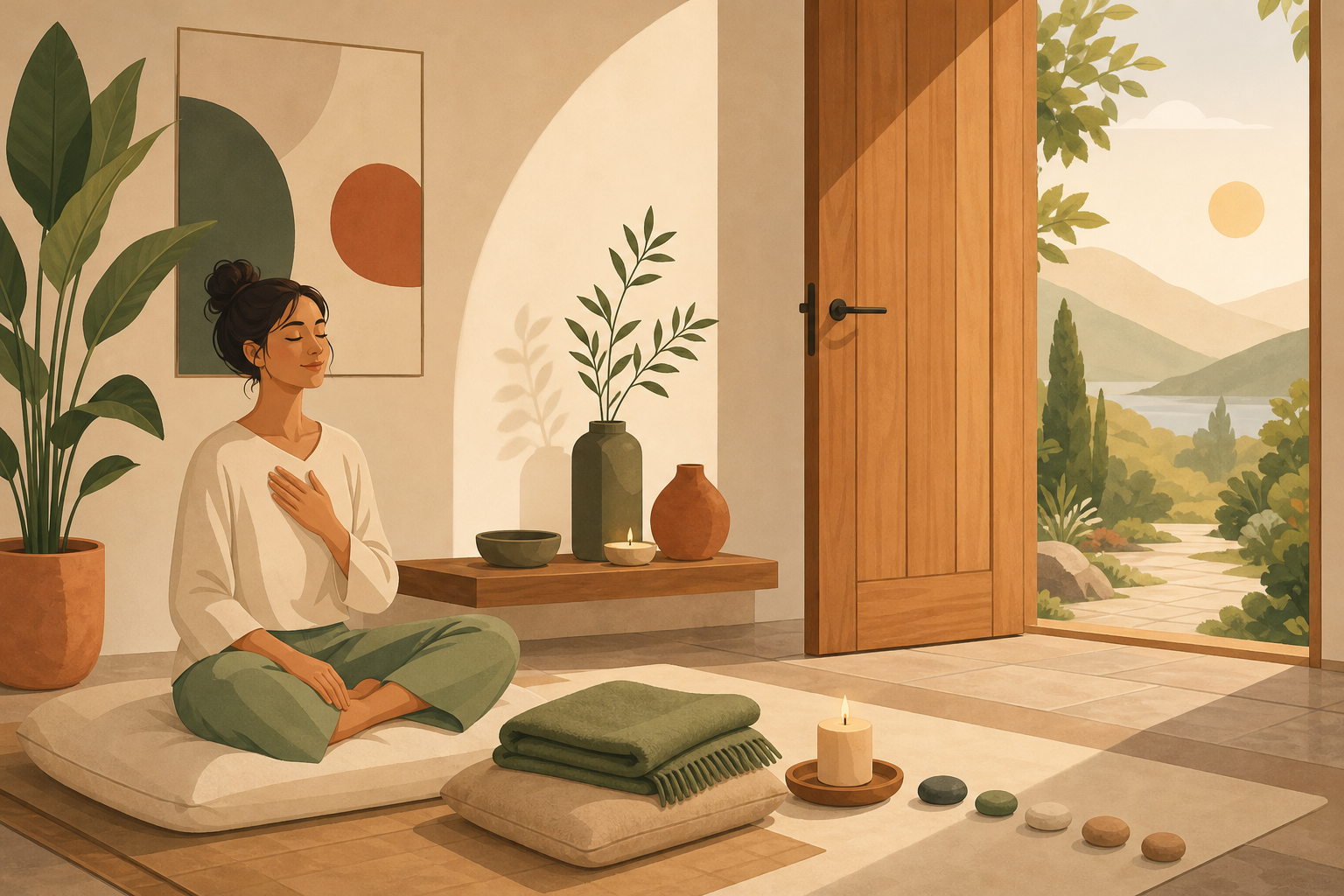
It suits some people and not others. A retreat aimed at self-transformation puts you somewhere notifications can’t reach. You go there to see what surfaces in the gaps you normally fill with the phone.
If you suspect that going somewhere won’t change anything, the pattern I described in [why self-improvement can feel pointless](/blog/jiko-keihatsu-imi-nai), wanting the result before the process, may be part of it.
It suits you if you’ve tried and gone back more than once, and you sense another feeling underneath “I want to look.” It doesn’t suit you if your health or sleep is unraveling right now, or if you’re going in order to come back changed.
How do you choose a retreat that’s safe?
- Is the organizer’s background publicly available?
- Can you stop partway through, and is there a room where you can rest?
- Are the fees and cancellation terms stated in advance?
- Is there any follow-up after it ends?
- If breathwork is involved, is the intensity explained, and is someone with you?
Is three days and two nights too much to start with?
What order does nehan recommend?
Not straight in. The order is an online consultation, then the three-day, two-night stay, then fourteen days after you get home. nehan’s “Life Review Journey” (Sōmatō o Miru Tabi) is three days and two nights in the forest at Kobuchizawa, at the foot of the Yatsugatake mountains.
Sound and breath are the handholds for noticing your own reactions.
The fourteen days afterward are about how you carry it into ordinary days, and you work through that together. It isn’t medical care, and it doesn’t promise results.
What happens at the online consultation?
What you probably want to know first is whether this place fits you. At the [online consultation](/shindankai), we listen to where you are now and sort out together whether continuing on your own makes more sense, or whether a place like this would.
It isn’t where you decide to join. It’s where you find out if the question is even the right one for you.
FAQ
Q: Should I stop doing digital detoxes? A: Time at a distance from the phone is useful. But writing down the restlessness that shows up after you put it away is what makes you less likely to go back.
Q: Does checking my phone a lot mean I’m addicted? A: Frequency alone can’t tell you. If your sleep or daily life is suffering, talk to a medical provider.
Q: Will three days and two nights change anything? A: Change is different for each person. The design includes the fourteen days after you return, so that what shifts is seen in ordinary life rather than only on site.
This article is general information, not medical advice. Results vary from person to person. If you have concerns about your health, please consult a professional.
FREE PROGRAM
A doorway to seeing your life anew — through the body
Add us on LINE to receive the free online lessons — the parts we couldn’t fit into this article.
Free to join, unsubscribe anytime. This is not medical treatment; results vary by individual.
Sources / References
- Wood, W., & Neal, D. T. (2007). A new look at habits and the habit–goal interface. *Psychological Review*, 114(4), 843–863. (Habit as the link between cue and behavior)
- Duhigg, C. (2012). *The Power of Habit*. Random House. (The habit loop)
- Ferster, C. B., & Skinner, B. F. (1957). *Schedules of Reinforcement*. Appleton-Century-Crofts. (Variable rewards and the persistence of behavior)
- Elhai, J. D., et al. (2018). Proneness to boredom mediates relationships between problematic smartphone use with depression and anxiety severity. *Social Science Computer Review*. (Boredom avoidance and smartphone use)