

Key points
- Meditation feels tiring when you strain to erase your thoughts. The fatigue comes from how you’re trying, not from meditation itself.
- Sitting while grading your own performance is the same as continuing to work with your eyes closed. That is usually why your shoulders are stiff afterward.
- Meditation that doesn’t exhaust you starts when you stop trying to do it well and settle for simply noticing.
Meditation tires you out because you’re working hard to get rid of distracting thoughts. Every time one surfaces and you tense up with “no, come back,” your body isn’t resting.
It’s repeating a small contraction, over and over. If your shoulders are locked solid after ten minutes, that isn’t a sign you need more practice. It’s a sign you’re trying too hard.
For my first few years, I finished every session with a heavy body, more drained than I was after work. That wasn’t meditation. It was cramming for a meditation exam.
From here, I’ll answer the questions people actually bring me.
Why does meditation make me tired?
Because your body isn’t resting. Your eyes may be closed, but if your mind keeps working at “doing this right,” your muscles never let go.
Is it a failure if my thoughts won’t stop during meditation?
No. Thoughts surfacing is the brain doing its ordinary job. What wears you out isn’t the thought itself. It’s the effort you spend trying to push it away every time one appears.
Press your hand on the surface of water to make it flat, and all you get is more ripples.
You probably know this feeling: the harder you try to be calm, the less calm you are. That isn’t a personal weakness. It’s how the mechanism works.
Why do my shoulders get stiff when my eyes are closed?

Usually because you’re sitting there asking, “Am I doing this well right now?” and scoring the answer. Your eyes are closed, but your mind is doing the same work it does in a meeting.
Research suggests that fatigue and unpleasant experiences during meditation are not rare (Lindahl 2017; Britton 2021). Those studies describe them as a recognized part of practice, not as a flaw in the person.
If your body feels heavy afterward, you’re in well-documented company.
Why do unpleasant thoughts surface the moment I go quiet, and when should I stop?
Because whatever you pushed down during the day comes up as soon as things get still. The message that still hasn’t been read. Your manager’s “got a minute?” The bill due next month.
If you sit down carrying worries about relationships, work, or money, the tiredness of meditation is partly the weight of those worries. Having them surface is hard.
But noticing them is not, in itself, a bad thing.
One clear line, though. If you experience intense anxiety, a racing heart, or flashbacks, stop and talk to a doctor or qualified professional. That is not a sign you’re “going deep.” It’s a sign to stop.
FREE PROGRAM
A doorway to seeing your life anew — through the body
Add us on LINE to receive the free online lessons — the parts we couldn’t fit into this article.
Free to join, unsubscribe anytime. This is not medical treatment; results vary by individual.
How do I switch to meditation that doesn’t require effort?

Change the method first, not the amount.
Will it get easier if I just do 20 minutes every day?
Not if you keep the same exhausting pattern and simply stretch the time. More minutes only set the habit harder.
Making sessions longer
Twenty minutes of the same tiring approach just means more tiring.
Hunting for the “correct” technique
Change the method all you like; if the self doing the scoring stays the same, so does the result.
Aiming for zero thoughts
Thinking is a natural function. Setting zero as the goal tends to make things harder, not easier.
What can I do on my own to stop straining?
The whole instruction is: when you notice a thought, leave it alone. That’s it. The moment you think “oh, I was thinking,” you’re already back.
- Start small (a three-minute body meditation): follow only the feeling of your seat touching the chair. Ending while you still feel “that wasn’t enough” is what keeps you coming back.
- Write things down first: before you sit, put whatever is on your mind on paper in three lines. Left in your head, it will keep resurfacing.
- Rest on tired days, or skip entirely: don’t sit that day. That counts as practice too.
Should I meditate alone, with a professional, or join a guided setting?

The right form depends on how you get tired.
- On your own: the three-minute body meditation. It costs nothing, you can try it tonight, and you can stop immediately if it doesn’t suit you.
- With a professional: if your fatigue comes with strong anxiety or insomnia, see a doctor or counselor. Meditation is not a substitute for care.
- In a guided setting: for people who keep slipping back into the same reaction no matter how often they try alone. You change the whole environment.
The overall approach is in [How to live with meditation](/blog/meditation-guide). Working with distracting thoughts and self-scoring is covered separately in [When meditation doesn’t seem to work](/blog/meditation-no-effect).
For people who keep slipping back when they practice alone
It’s usually not weak willpower. It’s that your everyday environment doesn’t allow you to return to the present.
Why do I fall back into scoring mode even when I know better?

Because understanding it in your head is different from your body knowing the state. The dishes in the sink catch your eye, your phone buzzes, your mind jumps to tomorrow.
If that’s your pattern, one option is to change the environment itself rather than fight it in place.
That doesn’t mean something is wrong with you. It means the room you sit in has more pull than the instruction you’re holding onto. Some people only find the non-effort state once there is nothing around them asking for effort.
What should I check before choosing a retreat or guided program?
Five measures of safety.
- The host’s background: what training stands behind the guidance.
- Whether you can opt out partway: is there a way to step out if it isn’t right for you.
- Fees and cancellation: are extra costs and refund conditions clearly written.
- Follow-up afterward: is there a contact and a period of support once you’re home.
- Intensity of breathwork and supervision: if strong breathing techniques are used, is there someone attending and a check on existing conditions.
The detailed criteria are in [How to choose a retreat](/blog/retreat-guide).
Is it okay to go straight into a three-day, two-night retreat?
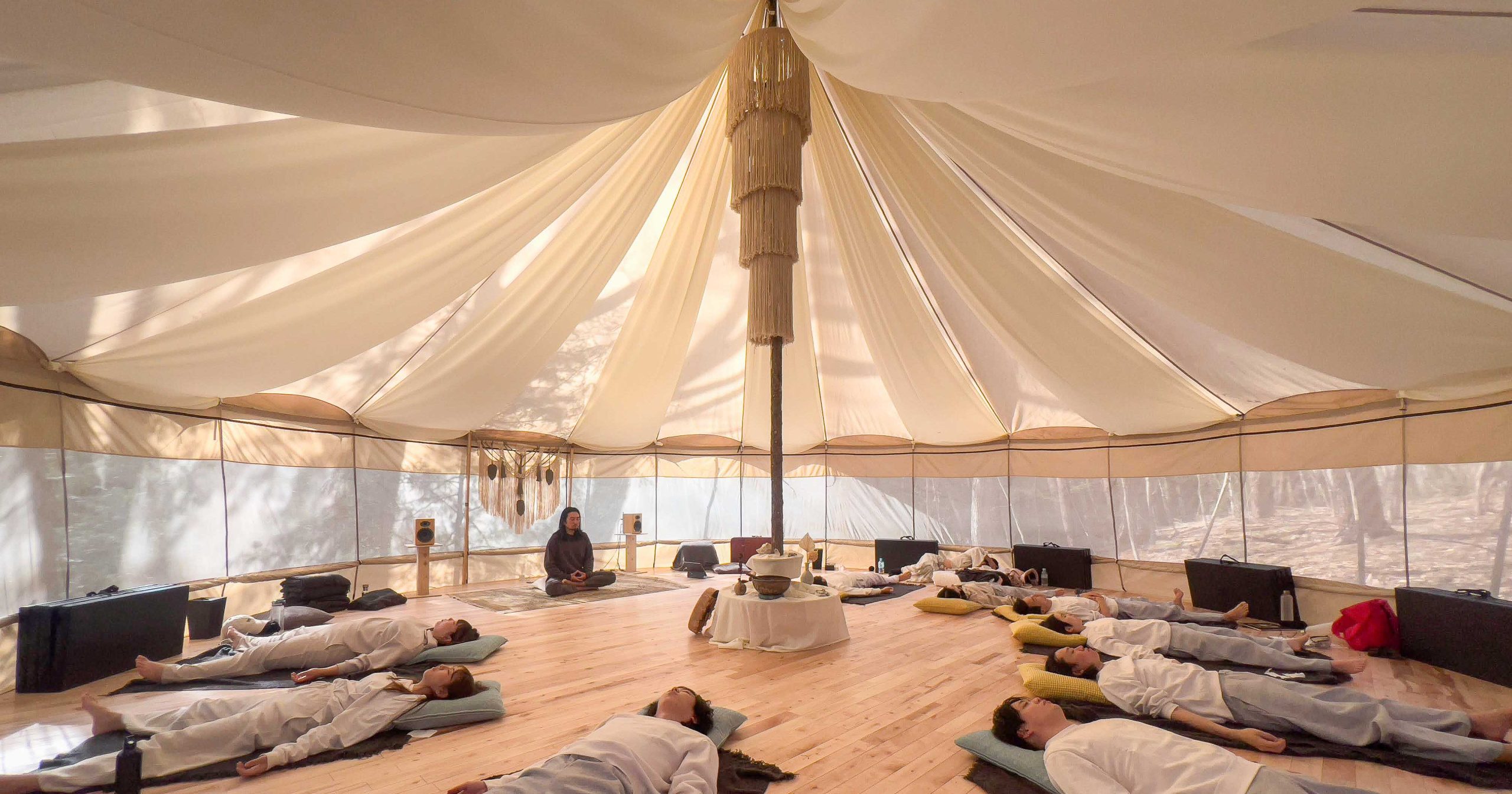
If you’re unsure, you can talk it through at a consultation session first and decide afterward. If it doesn’t feel right, you don’t have to join. nehan’s “Journey to See Your Life Flash Before You” is two nights and three days in the forests of Kobuchizawa, Yatsugatake.
The fourteen days after you return are part of it, a period for bringing what you noticed back into daily life. The flow is built for people who return to the same reaction every time they try alone.
Release the tension
Step away from the “scoring mind” first.
Go deeper
Enter in stages, with a guide alongside you.
Bring it home
Over the fourteen days after, let it take root in everyday life.
FAQ
Q: If meditation tires me out, does that mean I’m not suited to it? A: It’s more often a question of method than of suitability. When people shift from a trying mode to a noticing mode, the experience can change.
Q: I keep slipping back when I meditate alone. Who is a guided setting for? A: People who return to the same reaction no matter how many times they try alone, and people who can’t go deep in their everyday environment.
Q: What if breathwork scares me? A: Choose a setting where you can opt out partway. If you have a health condition or anxiety, tell them beforehand.
Q: Is falling asleep a failure? A: No. Your body may simply be asking for rest.
Understanding “don’t try so hard” in your head is one thing. The body takes time to learn it. You don’t have to carry that on your own. Would you like to look together at which kind of tiredness is yours, at a consultation session?
This article provides general information and is not medical advice. Results vary from person to person. If you have concerns about your health, please consult a professional.
FREE PROGRAM
A doorway to seeing your life anew — through the body
Add us on LINE to receive the free online lessons — the parts we couldn’t fit into this article.
Free to join, unsubscribe anytime. This is not medical treatment; results vary by individual.
Sources / References
- Britton WB et al. (2021). Defining and measuring meditation-related adverse effects in mindfulness-based programs. Clinical Psychological Science.
- Lindahl JR et al. (2017). The varieties of contemplative experience: a mixed-methods study of meditation-related challenges. PLOS ONE.
- Brewer JA et al. (2011). Meditation experience is associated with differences in default mode network activity and connectivity. PNAS.
- Kabat-Zinn J. Writings on Mindfulness-Based Stress Reduction (MBSR).