


Key points in this article
- If a destination is about two hours each way from Tokyo, one day of paid leave plus a weekend is enough for a 2-night, 3-day retreat.
- Yatsugatake (Kobuchizawa) is roughly two hours from Shinjuku by limited express (anywhere from the 1h50 range to a little over two hours, depending on the train). It’s a destination that doesn’t leave much travel fatigue behind.
- If all you’re short on is rest, a hot-spring inn is enough. If you rest and still slide back within days, you need a place where you face yourself. That’s the rule of thumb for choosing.
From Tokyo, a destination about two hours each way is realistic. nehan’s 2-night, 3-day self-transformation retreat is held in Yatsugatake (Kobuchizawa, Yamanashi), about two hours from Shinjuku by limited express.
You can take Friday off or Monday off and it still fits. But “an inn where you rest” and “a place where you face yourself” are chosen by different standards.
This article lays out the travel logistics, and that difference.
How far from Tokyo is realistic for a 2-night, 3-day retreat?
What’s the practical travel limit from Tokyo for a three-day retreat?
The rule of thumb is about two hours each way, with at most one transfer. Hakone, Yugawara, and Yatsugatake all fall inside that range.
Go much further and the first day disappears into the trip, and the third day disappears into the trip back. You arrive tired, you leave tired, and the middle day gets squeezed.
Two hours is roughly the distance where you can still feel like a person when you step off the train.
How long does it take to get from Shinjuku to Kobuchizawa in Yatsugatake?
From Shinjuku Station, the JR Chuo Line limited express reaches Kobuchizawa Station in roughly two hours. Depending on the train, it ranges from the 1h50 mark to a little over two hours, and the number of departures changes by time of day (JR East official timetable, as of October 15, 2026).
Before you leave, double-check the departure time and duration of the train you’ll actually take.
By car, it’s the Chuo Expressway. Traffic can change the drive time considerably, so treat any estimate as a rough guide only.
Does distance matter more than your arrival and departure times?
What matters most is this: arrive early afternoon on the first day, and leave before evening on the last day. The distance itself is less important than “what time you arrive and what time you leave.” That’s what you’ll feel in your body the next day.
You probably know this from ordinary trips. A late arrival means you spend the first night just catching up to where you are. A late departure means you walk in the door at 9 p.m. with a bag still packed and work in the morning.
What does the three-day flow look like, including the round trip?
What’s a typical day-by-day shape for a 2-night, 3-day retreat?

A common way to structure it is in three stages. Please read this as one example, not as nehan’s actual schedule.
Day 1
Leave Tokyo in the morning, arrive early afternoon. By evening, you’re drifting out of your everyday pace.
Day 2
Morning to night, the main part of the program. The day that uses the most energy and focus.
Day 3
Reflection in the morning, departure around midday. Home by evening.
The first day is for slowing down, the second is the heart of it, and the third is for gathering up what happened. Keeping that shape is what makes two nights feel like enough.
Should you take Friday or Monday off?
Take Friday off and it’s Friday–Saturday–Sunday. Take Monday off and it’s Saturday–Sunday–Monday. Either works.
What I’d recommend is leaving yourself one free evening after you get home. Some people find that if they go straight back to work the next morning, whatever they brought back tends to fade.
One quiet night at home, before the unread messages, makes a difference. What a 2-night, 3-day length actually means is written up in A 2-night, 3-day retreat at a turning point in life.
What can you do on your own before you go?
What are three simple things to do before a retreat?
Just three.
- Write down the single heaviest thing on your mind, in one line, on paper.
- The night before you leave, put your phone down early and rest.
- Check with your own hands where your body is tired.
None of these take more than a few minutes. They’re not preparation for the program so much as a way of noticing where you actually are before you go.
What if nothing comes out when you try to write your worry down?
If the one line comes out easily, you’re ready to face something. If nothing comes out, resting might need to come first. Neither is better than the other.
But here’s the honest part: if you try to face yourself in an exhausted body, you’ll just get sleepy halfway through. I’ve seen it, and I’ve done it. The body decides before the mind does.
How should you compare a hot-spring inn with a program-based retreat?
Why does rest at a hot-spring inn wear off after a few days?

Compare by purpose. If you need to rest, choose an inn. If you rest and still go back to how you were, choose a place with a program.
- Rest at a hot spring — You feel lighter
- Return to the same daily life — The same office, the same kitchen, the same cues
- Your habitual reactions resurface — Back to the same pace as before
- Tired again — "I need a break" comes around again
Have you ever come back from a hot-spring weekend feeling genuinely renewed, then stopped at the convenience store on the way home from work on Wednesday and realised you were already back to exactly where you started? That loop is what the diagram shows.
What are the differences between resting alone, consulting a professional, and joining a program?
Lining up the three options makes the difference clear.
Resting on your own at a hot-spring inn is for recovery and rest. It’s physically easy, simple to do alone, and the cost is just the room.
Working with a professional in one-on-one consultation is for sorting out a specific problem. It’s also physically easy and easy to do alone, and it’s priced by the hour.
Joining a program-based retreat is for noticing your own patterns of reaction. The second day takes real stamina. Whether it’s easy to attend alone depends on the venue, so check in advance.
Costs include the stay, and vary by organiser.
Is a hot-spring stay enough for some people?
Yes. For some people, a hot spring is genuinely enough, and that’s not a lesser choice.
But if you decide purely on how easy the trip is, you’re more likely to drift back to your old rhythm once you’re home. Resting lightens your mood, but your habitual reactions stay put.
Psychological research points out that habits are easily reactivated by environmental cues, such as the same places and the same scenery (Wood & Neal, 2007).
The office chair and the kitchen sink are cues. That’s why a place where you rest and a place where you face yourself need to be judged separately.
FREE PROGRAM
A doorway to seeing your life anew — through the body
Add us on LINE to receive the free online lessons — the parts we couldn’t fit into this article.
Free to join, unsubscribe anytime. This is not medical treatment; results vary by individual.
What do solo participants worry about when packing and preparing?
What are the four things to figure out before going alone?
The four sticking points are: clothing, ease of movement, the cold that comes with altitude, and how to tell people you’ll be out of contact.
None of these are complicated. But they’re the things that nag at you the night before, when you’re standing in front of the closet wondering whether you can do this in jeans.
Settle them a few days early and the night before gets quieter.
How cold does Yatsugatake get compared to Tokyo?
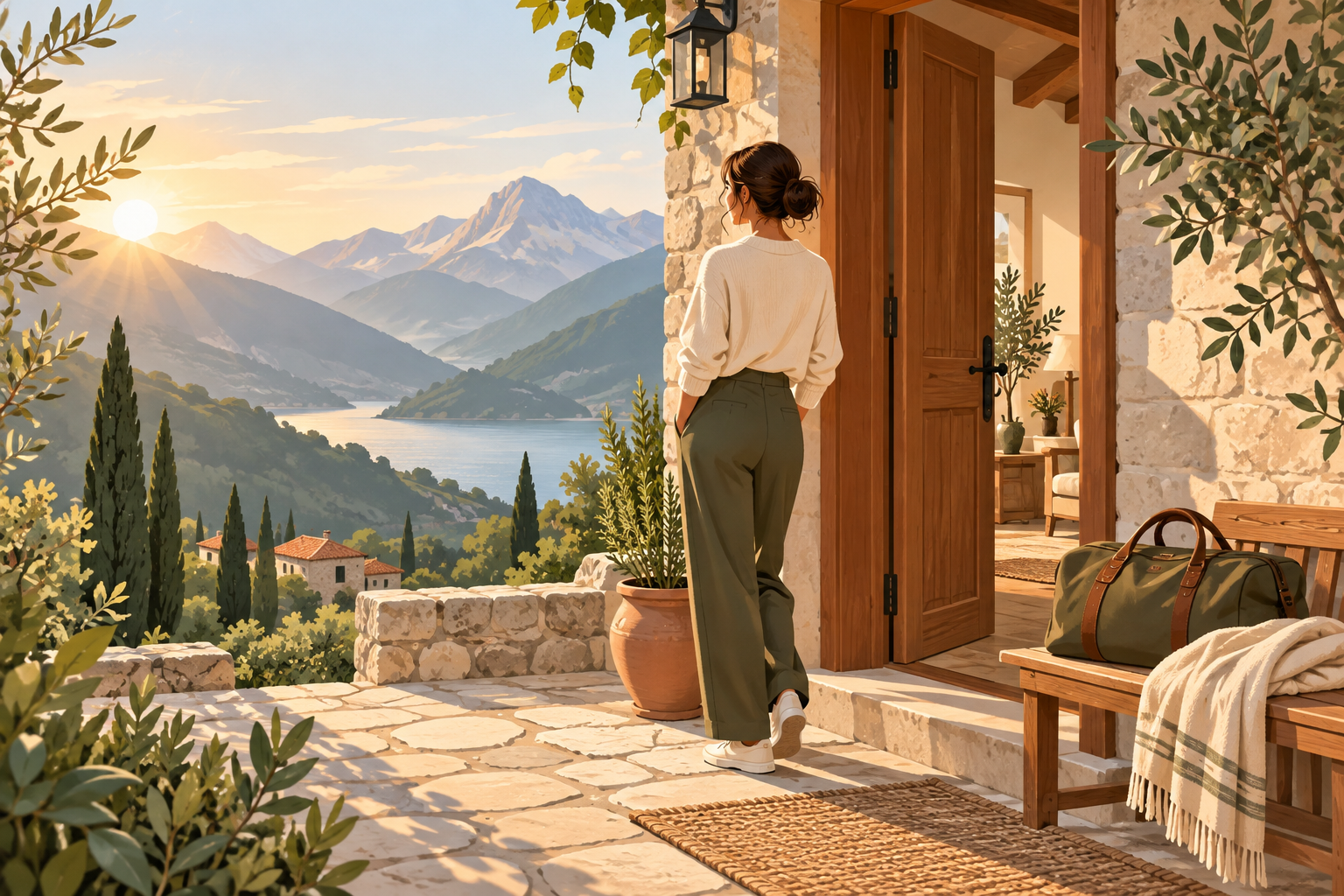
The southern foot of Yatsugatake sits at a high elevation, and on the same day it’s often colder than Tokyo. Mornings and evenings in particular can get chilly, so bring one extra layer.
If you’re in doubt, the Japan Meteorological Agency’s historical weather data lets you compare monthly average temperatures around Hokuto City in Yamanashi with Tokyo.
One jacket you didn’t need is better than a cold morning you didn’t expect.
How do you tell work and family you’ll be out of reach?
Tell your workplace and family in advance: “I’m going somewhere with weak signal.” Taking one worry off the table is, honestly, the most important preparation of all.
The retreat isn’t ruined by a phone. It’s eroded by the half-attention of wondering whether someone’s trying to reach you. Say it ahead of time, and that half-attention has nowhere to go.
If the hesitation is about going alone at all, that’s written up in When a man in his 40s goes to a retreat alone.
Who is this for, who isn’t, and what if you keep sliding back on your own?
Who is a 2-night, 3-day retreat suited to, and who should skip it?
It suits people who already know, “I rest, and within a few days I’m back where I was.” It doesn’t suit people whose health is unstable, or people for whom rest itself is what’s needed right now.
That second group isn’t a failure state. Sometimes the correct answer really is to sleep, eat properly, and not try to work on anything. Facing yourself can wait until the body can carry it.
What are the conditions for choosing a self-transformation retreat with a guide?
For people who go in circles thinking alone, a self-transformation retreat, a few days away, facing yourself with a guide, is one option, with conditions.
There are two. Your health must be stable. And it must be a place where you can stop partway through.
“Designed for you to come back” means two things: you can stop midway, and the period after you return home has been thought through. Not just the three days, but the weeks after.
How do you avoid a questionable retreat?
What five things should you check before booking a retreat?

Look at five things. Is the organiser’s background published? Can you stop partway through? Are fees and cancellation terms stated clearly? Is there follow-up afterward?
And how intense are the breathing techniques, and what support is on hand during them?
These are plain questions, and a trustworthy organiser will answer them plainly. If any of them gets an evasive reply, that’s the information you were looking for.
Does being close to Tokyo make a retreat safer?
No. Being close doesn’t make a place safe. Two hours from Shinjuku tells you nothing about who’s running it or what happens if you want to leave on the second morning.
More detail is in If a retreat feels suspicious and How to choose a retreat at a turning point.
Is it okay to go straight into 2 nights and 3 days? What about nehan’s retreat in Yatsugatake?
Is it safe to start with a 2-night, 3-day retreat?
Whether it’s okay depends on one thing: is the schedule built so you can rest partway through? nehan’s “Soumatou wo Miru Tabi” (A Journey to See Your Life Flash Before Your Eyes) is a 2-night, 3-day retreat held in Kobuchizawa, Yamanashi, followed by a 14-day integration period for letting the experience settle into daily life after you return.
For questions about how rest works on the day, or anything related to your physical condition, please check at the pre-retreat consultation session.
Why separate understanding in your head from change in your life?
Some people feel that “understanding” something in your head and your life actually “changing” are two different things. The time spent in contact with the body and with emotion is there for that reason.
That’s why I’d ask you to think of this separately from an inn where you rest. The two aren’t competing. They’re just for different things, and confusing them is how people end up disappointed by both.
Where can you read more about nehan’s program before deciding?
What the program contains is in What is Soumatou wo Miru Tabi, participants’ voices are in Stories, and a comparison with other venues in the area is in Retreats in Yatsugatake.
Travel ease is only one condition. For people who rest and then slide back, there’s also the option of a 2-night, 3-day stay facing yourself with a guide, including the 14 days after you return.
First look up how to get there, then check whether it fits, then ask at the consultation session. There’s no need to rush. If you’re considering joining, go to the application page.
FAQ
Q: From Tokyo to Yatsugatake, is train or car easier? A: If you’re going alone, the train is easier: you can sit the whole way on the limited express from Shinjuku.
Take the car if you have a lot of luggage or want to stop somewhere on the way back. By train, expect anywhere from the 1h50 range to a little over two hours, depending on the service.
Q: Does a 2-night, 3-day retreat really fit with just one day of leave? A: If the destination is about two hours each way, yes. Take Friday off for Friday–Saturday–Sunday, or Monday off for Saturday–Sunday–Monday.
I’d recommend a plan that leaves you one free evening at home afterward.
Q: Isn’t just relaxing at a hot-spring inn enough? A: For someone who needs rest itself, it is. For someone who feels “I rest, and within days I’m back where I was,” a place that includes time to face yourself tends to be a better fit.
FREE PROGRAM
A doorway to seeing your life anew — through the body
Add us on LINE to receive the free online lessons — the parts we couldn’t fit into this article.
Free to join, unsubscribe anytime. This is not medical treatment; results vary by individual.
Sources / References
- JR East official timetable (Shinjuku–Kobuchizawa limited express travel time; from the 1h50 range to a little over two hours depending on the train. As of October 15, 2026; re-check before publication)
- NEXCO Central Japan, Chuo Expressway route information (travel times vary with traffic)
- Japan Meteorological Agency, “Historical Weather Data Search” (monthly average temperatures at observation stations around Hokuto City, Yamanashi, and in Tokyo)
- Wood, W. & Neal, D. T. (2007). A new look at habits and the habit-goal interface. Psychological Review, 114(4), 843–863. (Habits are easily reactivated by environmental cues)
- nehan official website (Soumatou wo Miru Tabi; the 14 days after returning home)
This article is general information and not medical advice. Results vary from person to person. If you have concerns about your health, please consult a qualified professional.




