


Key points
- A sōmatō (走馬灯) is a revolving lantern: a paper lantern with shadow pictures that turn round and round.
- From that image, the word came to describe a life’s memories coming back one after another.
- People have reported looking back over their lives near death, but how it happens is not yet settled.
At night, once you are in bed, old memories keep coming up. Did you wonder, “Is this a sign of something?” and feel a little scared?
Sōmatō originally means a revolving lantern. There are reports of people reviewing their lives close to death, but the mechanism is not yet settled.
Remembering the past is, in most cases, a natural thing for the mind to do. But if you can’t sleep, or the distress goes on, please talk to a doctor or another professional.
What did sōmatō originally mean?
What is a sōmatō?
A sōmatō is a revolving lantern, called mawari-dōrō in Japanese. It is the light you see turning under the eaves on a summer festival night.
The name is written with the characters for “running horse” and “lamp.” It is said to come from the shadow pictures of galloping horses that the lantern shows.
How does a revolving lantern turn?
- Heat is madeThe candle flame warms the air inside
- Air risesThe warm air becomes an updraft
- The cylinder turnsThe inner cylinder of pictures catches the draft and spins
- Shadows appearShadow pictures flow one after another across the outer paper
A revolving lantern turns on nothing but candle heat. The air warmed by the flame rises and spins the inner cylinder of pictures. On the outer paper, the shadows pass by one after another.
When did people in Japan use the sōmatō?
In the Edo period, the sōmatō was a familiar part of summer evenings, when people sat outside to cool off. In haiku, it is a season word for summer.
What do “like a sōmatō” and “I saw the sōmatō” mean, and when do you use them?
What does “like a sōmatō” mean?
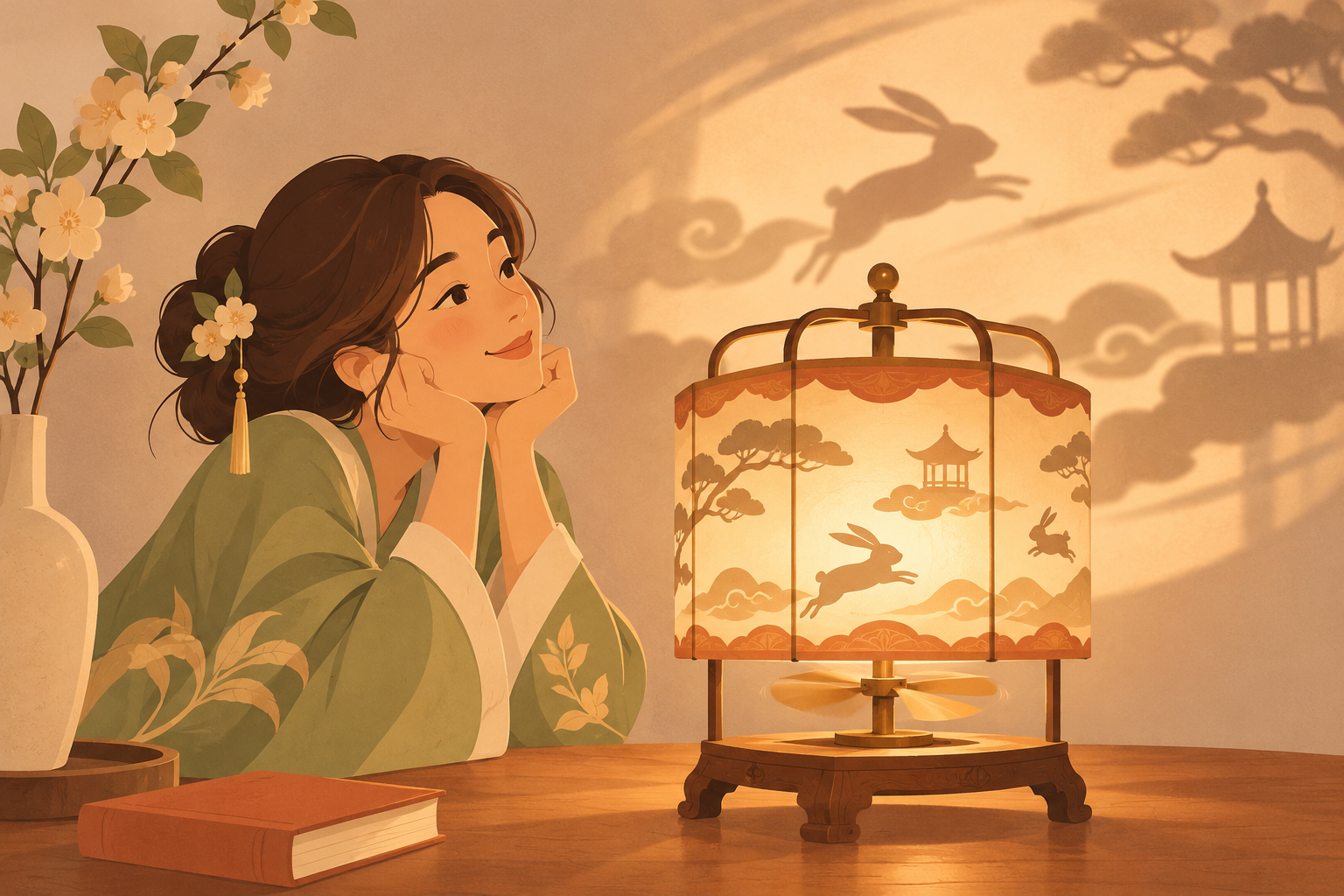
“Like a sōmatō” (sōmatō no yō ni) describes memories that come up and vanish quickly, one after another. It is not only for stories about dying. You can use it for a graduation, a retirement, or a place you used to know.
Take a last day at work. “I looked at my emptied desk, and twenty years came back like a sōmatō.” That is how it is used.
How is “I saw the sōmatō” different?
“I saw the sōmatō” (sōmatō ga mieta) is a heavier phrase. It means that in a moment when you felt your life was in danger, your memories came up all at once.
If you only felt a little nostalgic, “like a sōmatō” is the natural choice.
What are other ways to say sōmatō?
Plainer ways to say “like a sōmatō” include “the memories came one after another” (tsugitsugi to omoidasu), “I could see it before my eyes” (me ni ukabu), and “it raced through my head” (atama o kakemeguru).
In formal writing, Japanese also has mune ni kyorai suru, roughly “it came and went in my chest.”
Do people really relive their lives just before death?
Do people report a life review near death?
Yes, there are reports, but the mechanism is still unknown.
Researchers have interviewed people about near-death experiences, meaning what people describe after coming close to dying. In those studies, some people report looking back over their lives.
Has science proven that life flashes before your eyes?
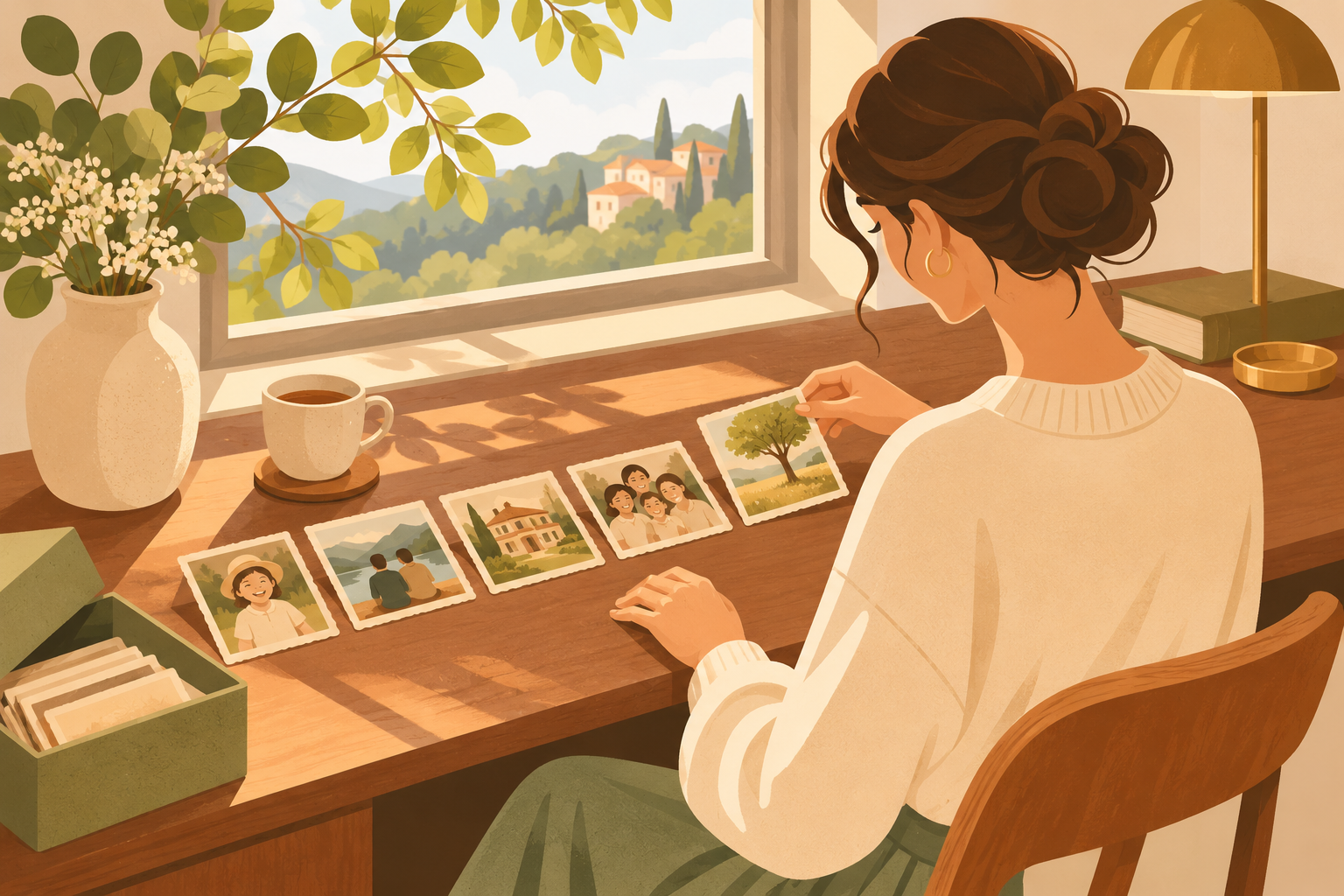
No. There is a recording of brain waves from around the time of a death, but it is a single case. It does not prove the sōmatō.
So when an article says flatly that it is “proven by science,” you can doubt it a little. If you want the reasons, see why the sōmatō experience happens and how to take it.
FREE PROGRAM
A doorway to seeing your life anew — through the body
Add us on LINE to receive the free online lessons — the parts we couldn’t fit into this article.
Free to join, unsubscribe anytime. This is not medical treatment; results vary by individual.
Is there a point in looking back on your life while you are still alive, not just before you die?
Why look back on your life before the end?
There is a point. When you look back, it gets easier to see what you have treated as important. Then your choices from here on tend to get clearer too.
What is a “life review”?
“Life review” is the name the psychiatrist Robert Butler gave in 1963 to the way people in old age naturally look back over their lives.
Why do I keep making the same choices?
People repeat the same choice in similar situations. In a meeting, you swallow what you wanted to say, again. Someone asks you for something, and again you can’t say no.
You don’t notice habits like these until you lay them side by side.
Where do I start if I want to look back on my life on my own?

What can I do today to start a life review?
There are three things you can do starting today.
Write it out by decade
Divide your life into your teens, your twenties and so on, and write three events you remember from each in a notebook.
Rest with nothing scheduled
Thirty minutes on a Sunday afternoon is enough. Leave your phone in another room.
Notice what your body does
When a memory comes up, see what happens in your shoulders and your stomach.
Which step is easiest to miss?
The one people tend to miss is the third: noticing the body. Your head says “I’m over that,” and yet there is a memory that makes only your shoulders go stiff. That may be the place for you to look again.
What if a painful memory comes up?
If a painful memory comes up strongly, you can stop. You don’t have to push on.
If you are unsure how to write, how to practice self-reflection and how to look back at your sōmatō may help.
On my own, with a professional, or in a group setting: which suits me?
How do the three ways of looking back differ?
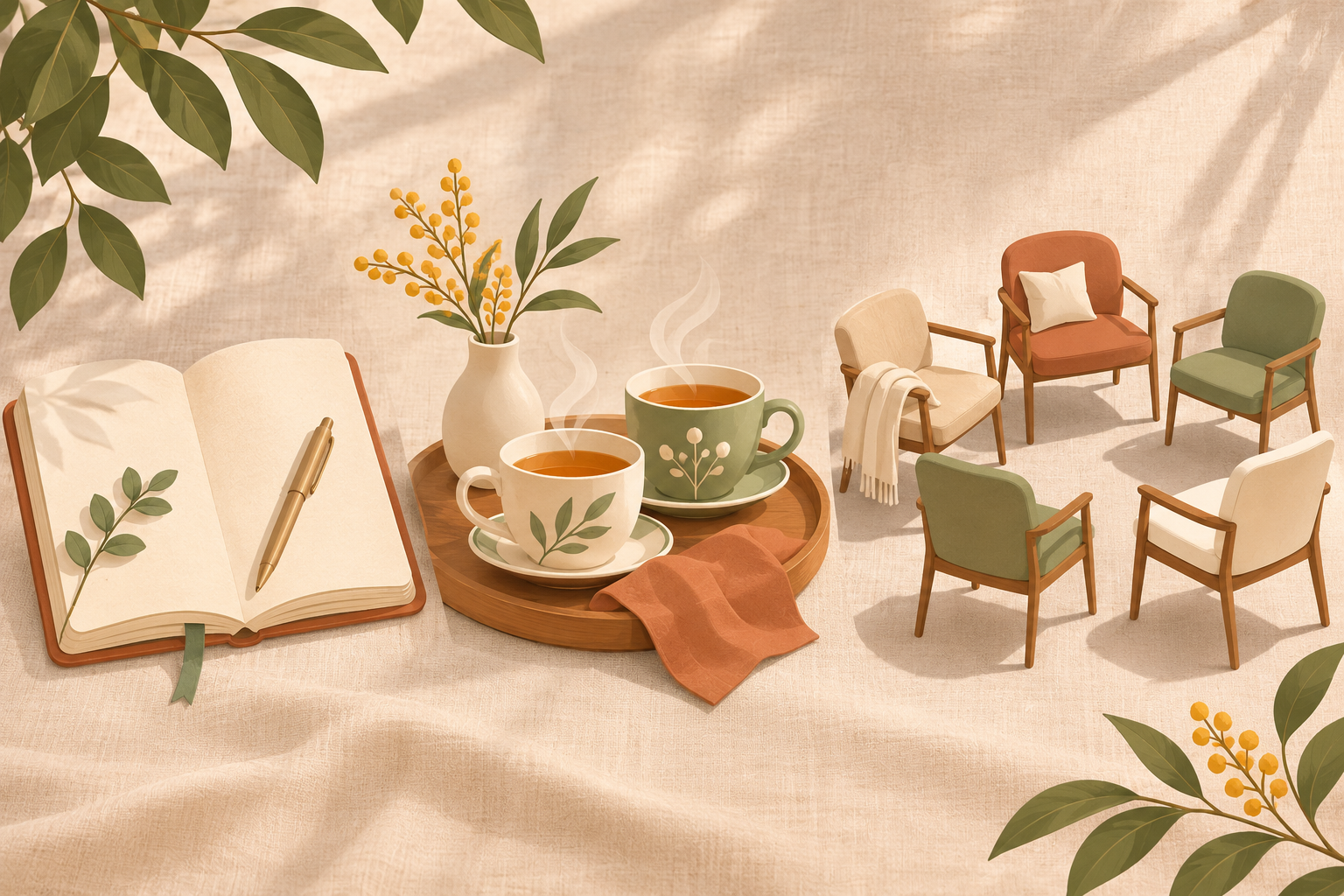
The shortcut is to choose by where you get stuck.
Doing it on your own suits people who can sort things out by writing. It takes a short time every day, and it tends to stop when you get busy.
Working with a professional suits people who think by talking. It takes a handful of sessions, one at a time. Check in the first session whether the two of you are a good fit.
Joining a group setting suits people who can’t keep it up once daily life resumes. It takes a few days. Check the safety side first.
What if I write it all out and forget it by morning?
You write, you feel clearer, and by the next morning it is gone. If that is you, the problem is your environment, not your method. It does not mean your will is weak.
If your mind or body is in a bad way, see a doctor first.
If you keep slipping back on your own: can a few days away be an option? Is going straight to three days and two nights all right?
Is a retreat of a few days a realistic option?
If the conditions fit, it is one option. Of course you feel uneasy hearing “three days and two nights” straight away. You can ask questions and check first. If you listen and think “this isn’t it,” you can walk away.
Your usual surroundings are full of cues that call up your usual way of thinking. A few days away puts some distance between you and those cues for a while.
How do I judge whether a retreat is safe?
There are five things to measure a retreat by.
- Is the organizer’s background clear?
- Can you say “I want to stop” partway through?
- What are the fee and the cancellation rules?
- Is there follow-up after it ends?
- How intense are the breathing exercises and similar practices, and will someone be with you?
What is one example of this kind of retreat?
One example is nehan’s self-transformation retreat, “A Journey to See Your Sōmatō” (走馬灯をみる旅). It is held in Kobuchizawa, Japan, over three days and two nights. After that come 14 days back at home.
How it feels differs from person to person. You can read what participants have said in their stories.
FAQ
Q: How do you read 走馬灯? A: It is read “sōmatō.” It is another name for the revolving lantern.
Q: Can “sōmatō” be used for happy occasions? A: Yes. It also fits turning points like a graduation or a retirement, when memories come flooding in.
Q: Are there other ways to say “sōmatō”? A: “The memories came one after another” and “it raced through my head” are close.
Q: What does “I saw the sōmatō” mean? A: It means that in a moment when you felt your life was in danger, the past came up all at once.
Q: Do you only see the sōmatō when you die? A: As a word, it is not limited to the moment before death. Why it happens as an experience is covered in why the sōmatō experience happens and how to take it.
Q: How much does “A Journey to See Your Sōmatō” cost? A: The price is not given in this article. We explain it at the diagnostic session.
If you want to know more about what it involves, see what “A Journey to See Your Sōmatō” is. If you want to check things before applying, see the dates and how it runs.
This article is general information, not medical advice. If you are worried about your health, please consult a professional.
FREE PROGRAM
A doorway to seeing your life anew — through the body
Add us on LINE to receive the free online lessons — the parts we couldn’t fit into this article.
Free to join, unsubscribe anytime. This is not medical treatment; results vary by individual.
Sources/References
- Entries for “sōmatō (revolving lantern)” in Japanese dictionaries, encyclopedias, and saijiki (haiku season-word almanacs), for the word’s origin and its use as a season word
- Butler, R. N. (1963). The life review. Psychiatry. (For the sentence on naming the “life review”)
- Greyson, B. (1983). The Near-Death Experience Scale. Journal of Nervous and Mental Disease. (For the sentence that some people report looking back over their lives)
- Vicente, R. et al. (2022). Frontiers in Aging Neuroscience. (For the sentence that the brain-wave recording around death is a single case)




