

You searched for a “Yatsugatake retreat” and landed here. My guess is you’re not only looking for a place to stay. On the surface, work and life are running fine. And yet, every so often, a quiet voice asks: *is this really how I want to keep living?*
You’ve tried to change before. You read the books, set the alarm earlier, wrote the goals down. But a few days later you’re standing at the freezer at eleven at night, spoon already in hand. Sound familiar? Before listing places to stay, let me share something more useful: why we don’t change even when we mean to — and why changing your surroundings is the key.
Why three days of resolve fades
You may have blamed weak willpower. But research paints a different picture. Self-control behaves like a muscle: it depletes the more you use it. The sharp judgment you had at dawn is gone by night, and on stressful days, restraint is the first thing to break. That late-night spoon isn’t a character flaw — it’s almost the predictable ending.
There’s more, and it runs deeper. Most of our behavior runs not on willpower but on environmental cues. Sit in the same chair and you reach for the same phone; take the same route home and you stop at the same store. Behavioral science keeps showing that habits resist information and stay tied to context. As long as the scenery and schedule around you stay the same, an old gravity keeps pulling you back.
POINT
You don’t fail to change because you’re weak. Willpower depletes, and habits are anchored to your environment. Try to override them with sheer effort and the gravity of your surroundings usually wins.
It’s the same reason diets fail. Rather than vowing “I won’t eat it” with ice cream in the freezer, simply not buying it works far better. We don’t lack the right knowledge — there’s just a deep valley between what we know and what we do. And that valley is crossed by design, not willpower. The single biggest lever in that design turns out to be the environment itself.
It’s clearer when you look at the brain. In familiar surroundings, the brain saves energy by predicting “the usual” and running it on autopilot — your body moves before you think, because that’s easier for the brain. Place yourself somewhere unfamiliar, though, and that autopilot switches off. Facing a new landscape, the brain starts consciously asking, for the first time in a while, “what shall I do now?” Real change usually begins in exactly that small gap — the moment the autopilot cuts out.
The key is changing your environment, not your willpower
Here’s the hopeful part. When the context of life shifts sharply — a move, a new job — the strength of old habits temporarily loosens. The cues disappear, and a window opens in which you can choose your behavior again. That sense of “I could change here” you feel when traveling isn’t your imagination; the environment is switching the cues.
This is the real essence of a retreat. Placing yourself somewhere unfamiliar isn’t just a reward trip — it cuts every habitual cue at once. No usual chair, no notifications, no roles. Only then can you quietly see how you actually feel.
What a Yatsugatake forest does to your nervous system

So what happens when that “somewhere” is a forest? This is measured territory, not wishful thinking. In a study across 24 forests in Japan with about 280 people, compared with being in the city, those who spent time in the forest showed lower cortisol (a stress hormone), higher parasympathetic activity, and lower sympathetic activity. Heart rate and blood pressure settle. A body braced for fight-or-flight shifts toward calm — and to think deeply, the body needs to be in that state first.
A Stanford study found that people who walked 90 minutes in nature — unlike those who walked in the city — showed less rumination (those looping negative thoughts) and reduced activity in the brain region tied to it. And research by immunologist Qing Li found that after a two-night forest stay, natural killer cell activity (immune cells that protect you) rose by roughly 50% and stayed elevated for about 30 days. The point isn’t the numbers but the fact that a few days of changed environment can stay in the body for a month.
But just “going to nature” wears off once you return
Let me be honest: going to a forest doesn’t automatically change your life. The window that opens will, left alone, close again. Being soothed by scenery and heading home is a wonderful holiday — but Monday morning, the old cues are usually waiting.
| What to look at | Rest-focused retreat | Self-transformation retreat |
|---|---|---|
| Main purpose | Recover, refresh | Notice your reactions, choose anew |
| How you spend time | Free time and activities | Stillness, reflection, a guide alongside |
| After you return | Refreshed, but back to normal in days | Small daily reactions begin to shift |
What matters is what you see — and what you let go of — while the window is open. Whether there is an order to it, and someone walking beside you, is what makes you different a month later.
Why you shouldn’t carry it alone
Changing yourself is, by nature, a lonely task. Your own heart should be the closest thing to you, yet it’s so close that you can’t quite see it. The honest feelings you’ve muffled for years tend, when you face them alone, to get sealed away with a quick “well, never mind.” It’s hard to reach toward the place that hurts on your own.
That’s why a quiet setting and someone watching over you from the right distance matter. This isn’t about being taught. Rather than receiving answers from outside, the awareness already within you finally finds words in a safe place. Counseling and reflection research shows the same thing: it’s within relationships that feel safe that people lower their guard and approach the feelings they’d usually rather not admit. Not scolded, not rushed — simply received. When that feeling is there, we no longer need to lie to ourselves. What we hold dear in Yatsugatake is exactly this: time where you feel safe enough to be honest.
Change has an order
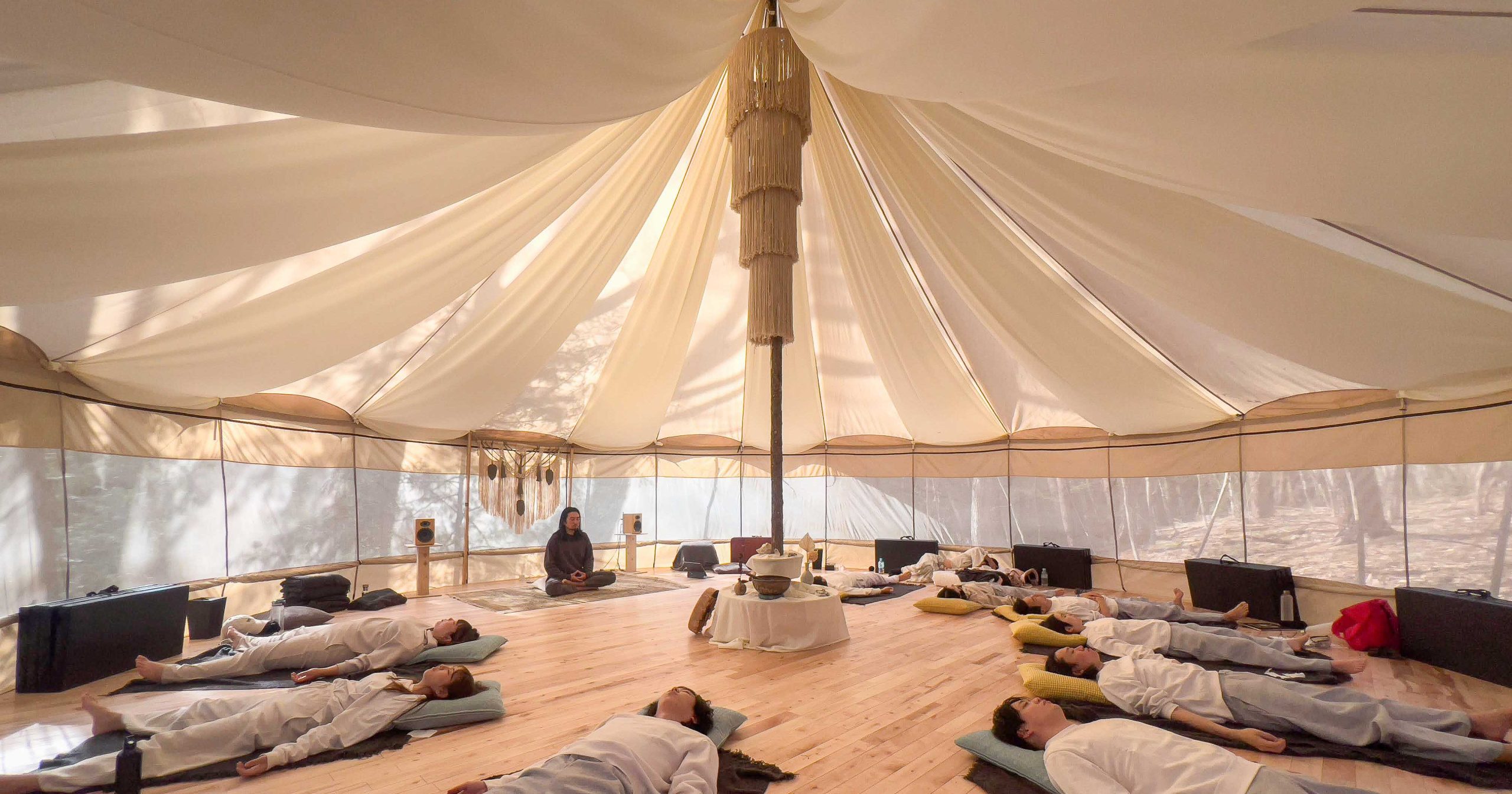
Our nehan retreat *Soumatou wo Miru Tabi* (“A Journey to See Your Life Flash By”), held in Yatsugatake, is designed around exactly this — how to use the open window. We let the forest’s stillness loosen the body and settle the nervous system first, then move, little by little, toward the reactions you usually look away from.
I won’t spell out the how here, because change has an order, and that order matters most. Do the same things in the wrong sequence and they don’t work — like sowing seeds before tilling the soil. That’s why we use a staged, original approach, and we share the specific steps gently in a free online lesson. What most participants mention afterward isn’t a “big answer,” but that their everyday reactions began to change.
Who this is for
- You’ve tried to change many times, only to slide back within days
- On the outside things are fine, but something inside keeps asking “is this it?”
- You have enough information; what’s missing is the actual *order* of change
- You want to face yourself deeply, in a small group, surrounded by quiet nature
FAQ
Q: When choosing a retreat in Yatsugatake, what should I look at first? A: Decide your purpose before the venue. Do you simply want rest, or to rethink how you live? Different purposes suit different places. If you seek transformation, look for quiet, small groups, and the presence of a guide.
Q: Will anyone change just by going into nature? A: A change of environment is a powerful trigger, but on its own it’s temporary. What makes the difference after you return is whether there is design and guidance for what you see, and in what order you release it, while the window is open.
FREE PROGRAM
A doorway to seeing your life anew — through the body
Add us on LINE to receive the free online lessons — the parts we couldn’t fit into this article.
Free to join, unsubscribe anytime. This is not medical treatment; results vary by individual.
References
- Park BJ, Tsunetsugu Y, Kasetani T, Kagawa T, Miyazaki Y. The physiological effects of Shinrin-yoku (forest bathing): field experiments in 24 forests across Japan. Environ Health Prev Med. 2010.
- Bratman GN, Hamilton JP, Hahn KS, Daily GC, Gross JJ. Nature experience reduces rumination and subgenual prefrontal cortex activation. PNAS. 2015;112(28):8567-8572.
- Li Q, et al. Effect of forest bathing trips on human immune function; phytoncides and natural killer cell activity. 2008-2010.
- Verplanken B, Wood W. Habit discontinuity hypothesis.
- This article is not medical advice; individual results vary.